Shopify does more for AI search out of the box than most founders realise, and less than most agencies admit. The default robots.txt allows every major AI crawler. Shopify Catalog pushes eligible products into ChatGPT, Copilot, Gemini and Google AI Mode by default (Shopify Help Center, 2026).
The rest is on you. Product pages are the least machine-readable pages in retail, scoring 66 out of 100 for AI visibility (Adobe Analytics, April 2026). The crawlers behind ChatGPT, Claude and Perplexity do not run JavaScript, so app-injected content is invisible to them (Vercel, 2024). And if your store ships only within Australia, the ChatGPT product feed does not include you. That channel requires selling to US customers (Shopify Help Center, 2026). You get found by crawling or not at all.
This guide publishes the full 12-point audit we run on every Shopify store: the test, the fix and the code for each check. It is also our honest answer to a fair question. Our AI search programme is newer than our email and website work and has no published multi-year case study yet. What we have is the method, and we run it on elinix.ai first.
Key facts
- AI-referred traffic to US retail sites grew 138% year on year in May 2026 and 1,324% since October 2024 (Adobe Analytics, June 2026)
- AI-referred visitors converted 42% better than non-AI traffic in March 2026, up from 38% worse a year earlier (Adobe Analytics, April 2026)
- AI-driven traffic and orders to Shopify stores each tripled year on year in Q2 2026, and new-buyer orders from AI channels arrive at nearly twice the rate of other channels (Shopify Q2 2026 earnings, via TechCrunch and Retail TouchPoints)
- Retail product pages score 66 out of 100 for machine readability, the lowest of any page type (Adobe Analytics, April 2026)
- None of the major AI crawlers execute JavaScript (Vercel, December 2024)
What changed for Shopify stores in 2026
Shopify now syndicates eligible products into AI assistants through Shopify Catalog, active by default. Products need a title, an image, a price above zero and a public URL (Shopify Help Center, 2026). For Australian brands there is a catch. The ChatGPT channel requires that your store sells to United States customers. An AU-only store is left to crawling, which makes every check below matter more.
AI-driven traffic and orders to Shopify stores each tripled year on year in Q2 2026. Traditional search still holds about a third of sessions, so AI is arriving on top of Google, not replacing it. And 75% of AI-attributed purchases came from outside Shopify's top 100 categories (Shopify Q2 2026 earnings, via Retail TouchPoints). Specific, long-tail products are winning, which favours small Australian brands over marketplaces.
These figures are measured on US stores. Treat them as direction, not a forecast. Our AI search statistics for Australian ecommerce separates the two markets.
Want the audit run on your store? We run all 12 checks live on a free call and walk through the findings together. No obligation. Book your free AI visibility audit.
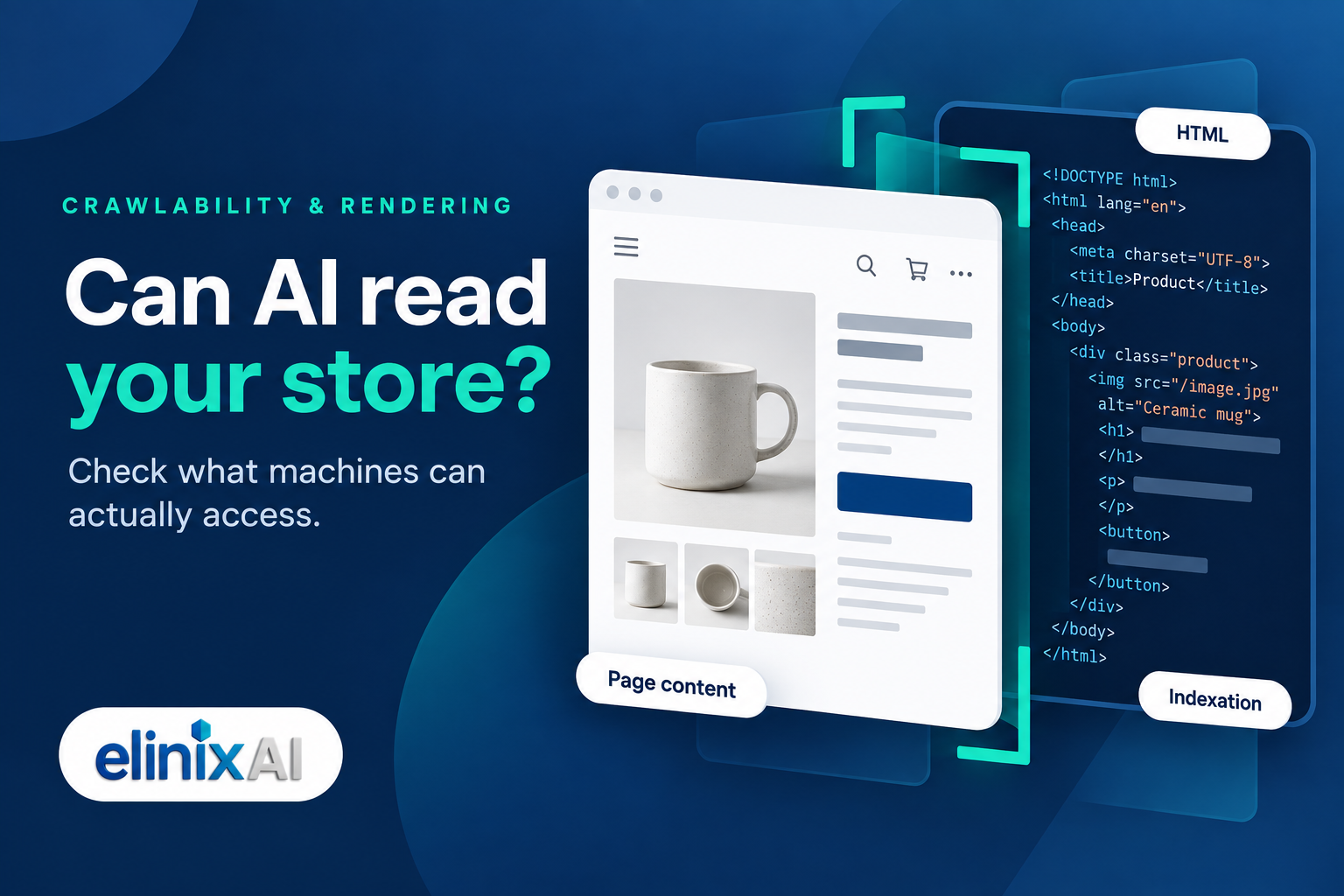
Check 1: Live AI visibility test
We ask ChatGPT, Perplexity, Claude and Gemini the exact questions your buyers ask and record whether your store is named, cited or ignored. This is the baseline every other check is measured against. Most founders have never run it. It takes ten minutes and usually changes what they do next.
Write down 10 buyer questions in plain language. "Best natural deodorant for sensitive skin Australia." "Is [your brand] worth it." Run each in all four engines, logged out. Score each answer 0 (absent), 1 (mentioned), 2 (recommended) or 3 (cited with a link).
Then read the sources column. Which pages did the engine cite? That column shows what an engine considers citable in your category. The full prompt set and scoring sheet is in our 5-minute ChatGPT brand test.
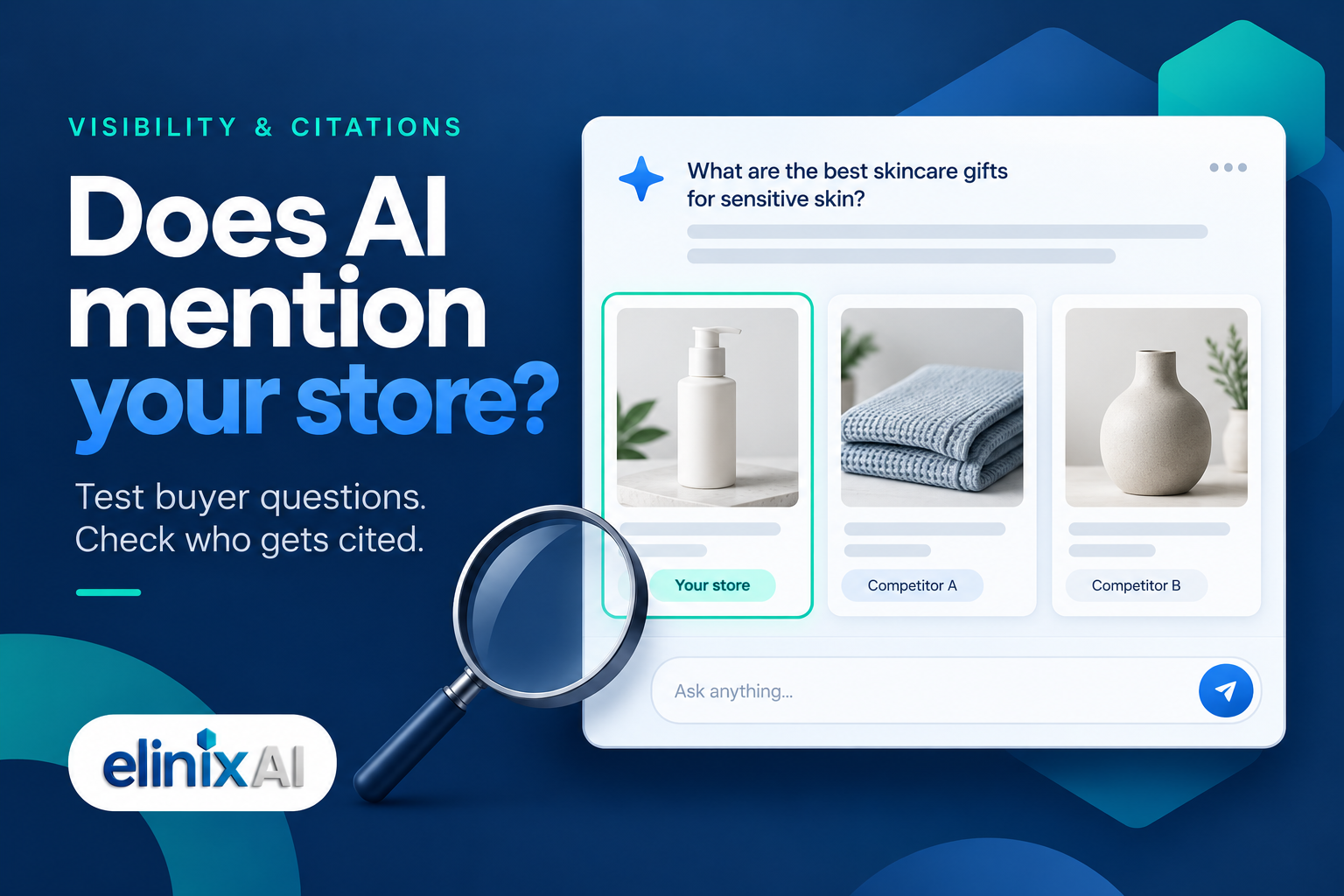
Check 2: Competitor citation share
Competitor citation share is the number of times each rival is named across your 10 test questions, divided by total mentions. It tells you who owns the answer today and what their cited pages do that yours do not. A store with 0% share in its own category has a content problem before it has a technical one.
Build a table: question, engine, brands named, page cited. After 40 answers a pattern shows. In our tests the cited pages share three traits: a direct answer in the first 100 words, specific numbers, a named source. The Princeton GEO study found the same. Citations lifted AI visibility by around 40% and statistics by around 35% (Aggarwal et al., KDD 2024).
Do not chase the marketplace. If Amazon owns 60% of citations for a head term, you will not displace it in six months. Target the long-tail questions where the engine still cites a blog or a forum thread.
Check 3: Crawlability and indexation
If an AI crawler cannot fetch a page, nothing else on this list counts. Shopify's default robots.txt allows product, collection, blog and page URLs to every crawler. It blocks cart, checkout, account and search results (Shopify Help Center, 2026). The most common failure we find is not Shopify. It is a Cloudflare rule or a bot-blocking app switched on months ago and forgotten.
Open yourstore.com/robots.txt and look for any Disallow line under OAI-SearchBot, ClaudeBot, Claude-SearchBot, PerplexityBot or Google-Extended. Then fetch a product page as one of those agents:
curl -A "OAI-SearchBot/1.0" -o /dev/null -s -w "%{http_code}\n" https://yourstore.com/products/your-product
Anything other than 200 means that engine cannot read your product. A 403 usually points at Cloudflare or a firewall app. Shopify lets you add rules through a robots.txt.liquid template while keeping its defaults (Shopify Help Center, 2026):
{% for group in robots.default_groups %}
{{- group.user_agent }}
{%- for rule in group.rules %}
{{ rule }}
{%- endfor %}
{%- if group.sitemap != blank %}
{{ group.sitemap }}
{%- endif %}
{% endfor %}
User-agent: OAI-SearchBot
Allow: /products/
Allow: /collections/
Allow: /blogs/
Allow: /pages/
Disallow: /cart
Disallow: /checkout
Disallow: /account
Repeat the block for PerplexityBot and Claude-SearchBot. Blocking a training bot such as GPTBot is a values call. Blocking the search bots removes you from the answer.
Check 4: Rendering and machine readability
AI crawlers read the raw HTML your server returns and nothing more. Vercel's analysis of more than 500 million GPTBot fetches found zero JavaScript execution. ClaudeBot and PerplexityBot behaved the same (Vercel, December 2024). Gemini is the exception because it uses Googlebot's rendering. Everything else sees your page before any app runs.
On Shopify this bites in three places. Review widgets that load ratings by script. FAQ accordions from page-builder apps. Descriptions swapped in by personalisation tools. Google may index that content. ChatGPT, Claude and Perplexity never see it.
Open a product page, press Ctrl+U and search the source for a sentence from your description, then a review, then an FAQ answer. If the text is not there, it does not exist for three of the five engines. This is why product pages average 66% machine readability against 82% for returns pages, which are plain text (Adobe Analytics, April 2026).
The fix is to move content into Liquid. Descriptions belong in the description field or a metafield the theme renders. Review summaries can be written into the template from the review app's metafields. FAQs go in as real HTML, which is Check 5.
Check 5: Answer-first content structure
An answer-first page puts a complete, standalone answer to the buyer's question in the first 40 to 80 words, before the story and the lifestyle imagery. AI engines extract that block. A product page that opens with "Meet your new favourite" gives them nothing to lift. One that opens with what the product is, who it is for and what it costs gives them the answer.
For a Shopify product page the pattern is two or three sentences directly under the title. Product type, the problem it solves, the key spec, the price framing. Then a short FAQ of the three questions your inbox gets most.
We render FAQ answers in the page HTML, not hidden behind JavaScript. On Shopify that means a product metafield rendered in main-product.liquid:
{% if product.metafields.custom.faq_1_q != blank %}
<section class="product-faq">
<h2>Questions about {{ product.title }}</h2>
<h3>{{ product.metafields.custom.faq_1_q }}</h3>
<p>{{ product.metafields.custom.faq_1_a }}</p>
</section>
{% endif %}
Question-form queries trigger a Google AI Overview 64.7% of the time against 9.5% for non-question queries (arXiv measurement study, 55,393 queries, April 2026). Structure pages around the question and you meet the engine where it works.
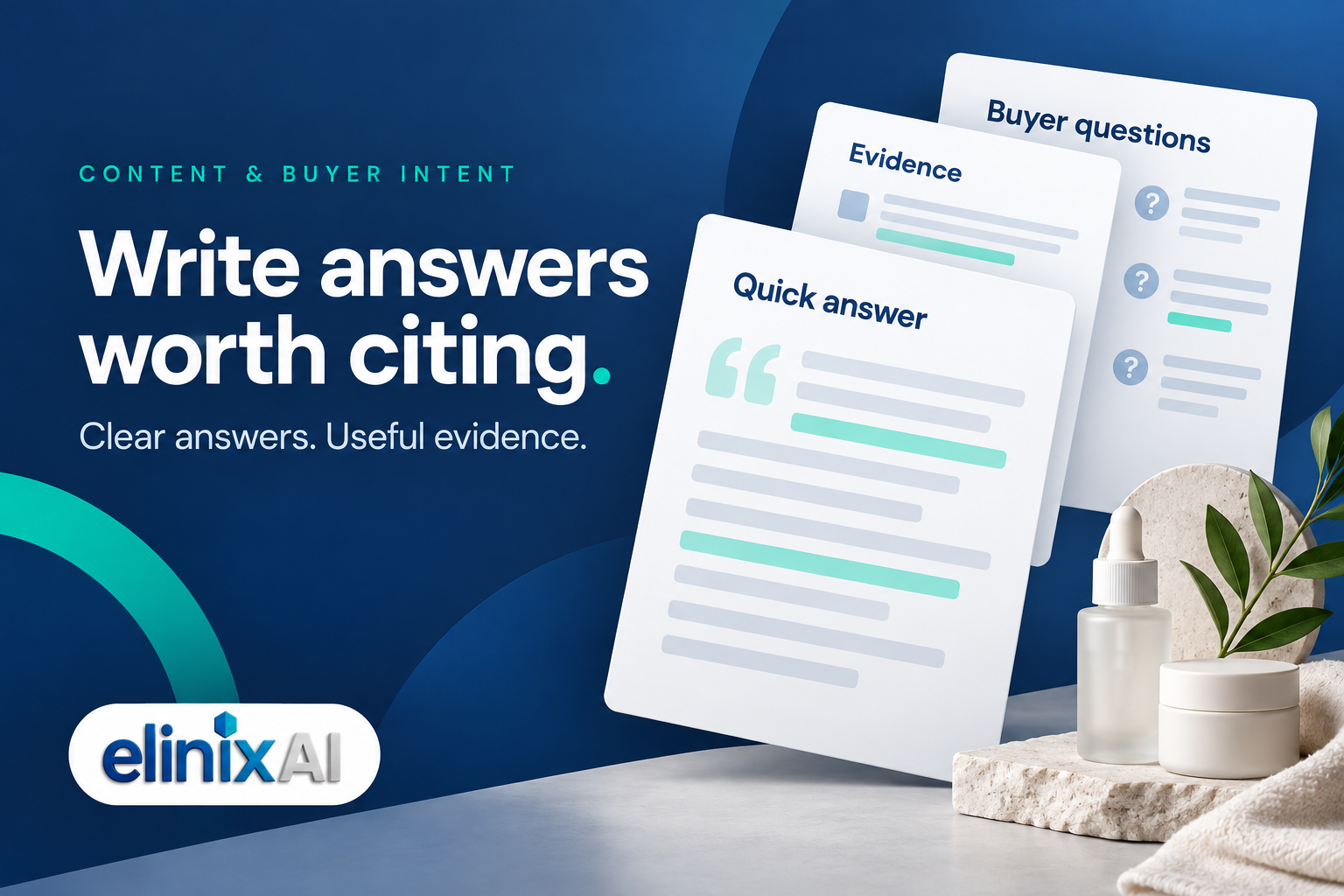
Check 6: Citation-worthiness
A page is citation-worthy when it contains a specific, verifiable fact an engine can quote with attribution. "Premium quality" is not a fact. "100% GOTS-certified organic cotton, 400 thread count, tested to 200 washes" is three. We score each commercial page on whether it carries at least one number a sceptical buyer could check.
Rewrite the top of every description as facts: materials, dimensions, certifications, country of manufacture, delivery times to Australian capitals, warranty length.
Two Australian rules apply. Every claim must hold up under Australian Consumer Law, which treats a misleading statement as misleading regardless of intent. And Shopify advises that legal disclosures sit within the first 6,000 characters of the description, because that is what the ChatGPT channel reads (Shopify Help Center, 2026). Put the facts up top for the engine and the lawyer both.
Reviews count as facts when they are real, dated and counted. "4.7 stars from 312 verified reviews" is citable. Ten anonymous quotes are not.
Not sure which of your pages an engine would quote? On the free audit call we show you the sentence a competitor is being cited for instead. Book the free AI visibility audit.
Check 7: Structured data coverage
Structured data (JSON-LD, the hidden code that tells engines what a page is) is the fastest technical win on Shopify, because the platform already ships some. Dawn and most Online Store 2.0 themes output a basic Product block with name, description, image and price. They leave out what engines want most: aggregate rating, brand as an entity, currency, availability as a schema URL, and FAQ.
View Page Source on a product page and search for application/ld+json. If there is no aggregateRating, your review app is either not writing structured data or writing it by JavaScript, which loops back to Check 4.
This is the Product block we add to main-product.liquid, pulling ratings from the standard reviews metafields most review apps populate:
<script type="application/ld+json">
{
"@context": "https://schema.org",
"@type": "Product",
"name": {{ product.title | json }},
"description": {{ product.description | strip_html | truncate: 500 | json }},
"image": {{ product.featured_image | image_url: width: 1200 | prepend: "https:" | json }},
"sku": {{ product.selected_or_first_available_variant.sku | json }},
"brand": { "@type": "Brand", "name": {{ product.vendor | json }} },
"offers": {
"@type": "Offer",
"url": {{ shop.url | append: product.url | json }},
"priceCurrency": {{ cart.currency.iso_code | json }},
"price": {{ product.selected_or_first_available_variant.price | money_without_currency | remove: "," | json }},
"availability": "{% if product.available %}https://schema.org/InStock{% else %}https://schema.org/OutOfStock{% endif %}"
}
{%- if product.metafields.reviews.rating_count and product.metafields.reviews.rating_count.value > 0 -%},
"aggregateRating": {
"@type": "AggregateRating",
"ratingValue": {{ product.metafields.reviews.rating.value.rating | json }},
"reviewCount": {{ product.metafields.reviews.rating_count.value | json }}
}
{%- endif -%}
}
</script>
Then add FAQPage where a Check 5 FAQ block exists, Organization on every page (Check 8), and Article on blog posts. Validate in Google's Rich Results Test before shipping. One malformed block silences the whole page.
Check 8: Entity consistency
Entity consistency means your brand name, founder, address, phone and product names match exactly across your site, Google Business Profile, social profiles, marketplaces and directories. Engines build a picture of who you are by cross-referencing. Three spellings of your brand is a blurry picture. Blurry brands do not get recommended.
Audit it in a spreadsheet, one row per profile. Any cell that differs from the site is a fix. Australian stores often trip on this because the ABN entity differs from the trading name. State both and let the Organization schema link them.
The sameAs array tells engines the profiles are all you. This goes in theme.liquid:
<script type="application/ld+json">
{
"@context": "https://schema.org",
"@type": "Organization",
"name": "Your Brand",
"legalName": "Your Brand Pty Ltd",
"url": "https://yourstore.com.au",
"logo": "https://yourstore.com.au/cdn/shop/files/logo.png",
"founder": { "@type": "Person", "name": "Founder Name" },
"address": { "@type": "PostalAddress", "addressLocality": "Melbourne", "addressRegion": "VIC", "addressCountry": "AU" },
"sameAs": [
"https://www.instagram.com/yourbrand",
"https://www.facebook.com/yourbrand",
"https://www.linkedin.com/company/yourbrand",
"https://g.page/yourbrand"
]
}
</script>
Stores in Shopify Catalog get help here. Shopify structures the data itself and reports that Catalog-powered AI searches convert at twice the rate of searches built on scraped data (Shopify, June 2026). AU-only stores get no such help.
Check 9: Buyer-intent keyword coverage
Buyer-intent coverage measures which commercial questions you have a page for and which you do not. Not search volume. Questions. "Best [category] for [use case] Australia." "[Product] vs [product]." Each one an engine gets asked and cannot answer from your site is a citation you handed to someone else.
Start with the 10 questions from Check 1 and expand to 40, using your customer service inbox, Google's People Also Ask, and Shopify's search intelligence panel if you are eligible. Map each to a URL. Blanks are the content plan.
Prioritise questions where the current cited source is weak: a forum thread, an old blog, a thin retailer page. Those are winnable in months. Our complete ecommerce SEO, AEO and GEO guide covers how to size this for a 40-product catalogue versus a 900-product one.
Check 10: Product and collection page optimisation
Product and collection pages carry the revenue, and they are where AI shoppers arrive ready to buy. Shopify says new-buyer orders from AI channels come in at nearly twice the rate of other channels (Shopify Q2 2026 earnings, via Retail TouchPoints). A blog post can earn a citation. A product page earns the order.
On product pages we check five things. The title includes product type and main spec, not just the brand. The first 80 words answer what, who for, and why. Specifications sit in a real HTML table, not an image. Reviews render in the source with a count and a rating. Delivery to Australian capitals is a stated timeframe. A date is a delivery promise. "Fast shipping" is not.
Collection pages get the same treatment plus an opening paragraph. "Summer Sale" with no text tells an engine nothing. "Linen Sheet Sets for Hot Sleepers" with 120 words on who they suit gives it a category answer to cite. Move the description above the grid.
Check 11: Internal linking and topical clustering
Internal linking tells engines which of your pages belong together and which one is the authority. A store with 300 products, 12 collections and 40 blog posts that never link to each other reads as 352 unrelated documents. The same store with every guide linking to its collection, and every collection linking to its best guides, reads as a brand that knows its category.
The audit is a crawl. We export every internal link and look for three things. Product pages with fewer than three inbound links from outside their collection. Blog posts with no link to a commercial page. Orphan pages the sitemap lists but nothing links to.
The fix is structural. One pillar page per category question. Cluster pages (comparisons, use-case guides, ingredient explainers) that link up to the pillar and across to each other. Product pages that link to the guide a buyer needs right before adding to cart. Descriptive anchor text every time.
Check 12: Technical health and Core Web Vitals
Technical health is the floor. Slow, unstable pages get crawled less, cited less and abandoned more. Shopify handles hosting, CDN and image delivery, so most speed problems are self-inflicted. Too many apps, uncompressed hero video, third-party scripts that block rendering.
This matters more in Australia than most markets. 77% of Australian ecommerce visits happen on a smartphone (Australia Post eCommerce Report, 2026). A page that passes Core Web Vitals on a MacBook and fails on a mid-range Android is failing for three in four of your visitors.
We test with PageSpeed Insights on a product page, a collection page and the homepage, mobile first. Largest Contentful Paint under 2.5 seconds is the target. Then we count installed apps and check which inject scripts on every page. Uninstalling an app does not always remove its code from theme.liquid.
What Shopify handles for you, and what you have to do yourself
| Area | Shopify does by default | You must do |
|---|---|---|
| Crawler access | robots.txt allows AI search bots; blocks cart, checkout, account | Check for Cloudflare or app blocks; add rules via robots.txt.liquid |
| AI product feeds | Catalog syndicates eligible products to ChatGPT, Copilot, Gemini, AI Mode | Meet eligibility; AU-only stores are outside the ChatGPT channel |
| Rendering | Liquid renders server-side into HTML | Move app-injected reviews, FAQs and descriptions into Liquid or metafields |
| Product schema | Basic Product JSON-LD in Dawn and most OS 2.0 themes | Add aggregateRating, brand, currency, availability, FAQPage, Organization |
| Speed | Global CDN, image optimisation, hosting | App audit, script cleanup, video compression |
| Answer-first content | Nothing | Rewrite product and collection openers; add HTML FAQs |
| Citation-worthy facts | Nothing | Specs, certifications, delivery windows, sourced claims |
| Entity consistency | Structures data if you are in Catalog | Match name, address, founder, ABN across profiles; add sameAs |
| Buyer-intent coverage | Search intelligence panel for eligible stores | Map 40 buyer questions to URLs; write the missing pages |
| Internal linking | Collections link to products | Pillar and cluster structure; descriptive anchors |
How long before any of this shows up?
Meaningful movement usually takes 3 to 6 months, and competitive categories take longer. The technical checks (3, 4, 7, 8, 12) change what an engine sees within days of a recrawl. Being named in an answer depends on content, authority and third-party mentions, and those compound over quarters. Anyone promising AI citations in 30 days is either lucky or lying.
The order matters. Month 1 is technical: crawl access, rendering, schema, entity consistency, speed. There is no point publishing citable content into a store engines cannot read. Months 2 and 3 restructure the commercial pages and publish the first buyer-question content. Month 3 onward is compounding.
Re-run Check 1 every month on the same 10 questions. The number that matters is whether your citation share moves month on month. Google AI Overviews now appear on roughly one in four queries (Conductor, 2026 AEO/GEO Benchmarks), so the surface you are competing for is still growing.
Who should fix conversion before doing any of this?
Sending more traffic to a leaky store makes the leak bigger. If your product pages convert below 1% or your checkout abandons above the 70% Baymard Institute average, every AI visitor you earn will leave the way the Google visitors do. Fix the store first. The AI search work will still be there in three months.
Three types of brand should not buy this yet. Brands that need revenue this month, because it compounds over quarters. Brands whose store converts poorly. Brands unwilling to publish content, because citability requires something worth citing. We say this on the call rather than take the budget.
If that is you, start with the conversion rate optimisation checklist and come back once the store holds the traffic it already has.
Frequently asked questions
Does Shopify block AI crawlers by default?
No. Shopify's default robots.txt allows the major AI crawlers on product, collection, blog and page URLs. Blocks usually come from Cloudflare rules or bot-protection apps, not Shopify (Shopify Help Center, 2026).
Do I need an app to optimise a Shopify store for AI search?
No. Every check in this guide can be done with theme code (Liquid), metafields and a spreadsheet. Apps that inject content by JavaScript can make visibility worse, because AI crawlers do not run scripts.
Are Australian Shopify stores included in ChatGPT shopping?
Only if the store sells to US customers. Shopify's ChatGPT channel requires US sales and Catalog eligibility. An Australia-only store is discovered by crawling, so the technical and content checks matter more (Shopify Help Center, 2026).
What is Shopify Catalog?
A structured dataset of eligible Shopify products that Shopify syndicates to ChatGPT, Copilot, Gemini and Google AI Mode. Products qualify with a title, an image, a price above zero and a public URL (Shopify Help Center, 2026).
Which AI crawlers render JavaScript?
None of the major ones. Vercel found zero JavaScript execution across more than 500 million GPTBot fetches, and ClaudeBot and PerplexityBot behaved the same. Gemini can render because it uses Googlebot's infrastructure (Vercel, December 2024).
How do I check if my product page is readable by AI?
Open the page, press Ctrl+U to view the source, and search for a sentence from the description, a review and an FAQ answer. If the text is not in the source, ChatGPT, Claude and Perplexity cannot read it.
Should I block GPTBot to stop AI training on my content?
That is a values decision, separate from search. GPTBot is OpenAI's training crawler. OAI-SearchBot and ChatGPT-User power search and citations. Block the first and allow the other two if you wish.
Is AI search traffic worth it for a small Australian brand?
AI-referred traffic is still a small share of visits but it converted 42% better than non-AI traffic in March 2026, on US retail data (Adobe Analytics). Shopify says 75% of AI-attributed purchases come from outside its top 100 categories, which favours specific, long-tail products.
Can I opt out of AI channels in Shopify?
Yes. Go to Sales channels, then Agentic, in your Shopify admin and switch off Shopify Catalog access per channel. Shopify says it can take up to 7 days for product data to stop being shared, and engines may still find pages by crawling (Shopify Help Center, 2026).
How much does Shopify AI search optimisation cost?
Elinix AI programmes usually start from A$1,500 for a foundation and technical fix month, then from A$950 per month. Scope depends on catalogue size and how many buyer queries you compete for, so we quote after the free audit.
Does AI search replace Google SEO for Shopify?
No. Traditional search still holds about a third of Shopify storefront sessions and grew 1.3 times over two years while AI traffic tripled (Shopify Q2 2026, via TechCrunch). The same foundation serves both.
Run the 12 checks, then decide
You now have the full method: the 12 checks, the test for each, and the code we use. Run them this week and you will know where your store stands with AI engines. If you would rather we run them with you, the audit is free and we walk through every finding on the call. Book your free AI visibility audit and find out what AI says about your brand today.
**