For most Australian stores comparing Shopify vs WooCommerce, Shopify converts better out of the box, because hosting, checkout and Shop Pay come built in. WooCommerce can match it, but only when the checkout and hosting are built and maintained well. Card fees are almost the same: 1.7% + 30c on Shopify Basic against 1.75% + 30c on WooPayments for domestic cards (Shopify Australia pricing, 2026; WooPayments fees, 2026).
The real choice is a trade. Shopify gives you hosting, checkout, Shop Pay and a direct Australia Post integration in one monthly bill. WooCommerce gives you full control, but you own the hosting, the plugins and the security updates.
The platform is also rarely the reason a store converts badly. Across ecommerce, 70.22% of carts are abandoned (Baymard Institute, 2025), and the top reasons are extra costs, trust and a long checkout. Both platforms can fix those. Both platforms can also ship them broken.
We build and revamp stores on both, for Australian brands. This guide compares the real costs in AUD, the checkout, AI search, catalogue size and migration, so you can pick on facts.
Key facts
- Shopify Basic costs A$42 a month billed yearly, or A$56 billed monthly (Shopify Australia pricing, 2026)
- Shopify adds a 2% fee on the Basic plan if you use a payment provider other than Shopify Payments (Shopify, 2026)
- WooPayments charges 1.75% + 30c on Australian cards, plus 1.5% more on cards from overseas (WooCommerce, 2026)
- 70.22% of online carts are abandoned on average, across 50 studies (Baymard Institute, 2025)
- 91% of the 11,334 new WordPress vulnerabilities found in 2025 were in plugins (Patchstack, 2026)
- Australians spent $82.6 billion online in 2025, up 14% on 2024 (Australia Post eCommerce Report 2026)
What does each platform cost an Australian store per year?
For a store doing A$20,000 a month, Shopify Basic costs about A$5,304 a year in plan and card fees. WooCommerce with WooPayments costs about A$4,920 in card fees, plus hosting and any paid extensions. The card fees are close. The real difference is what you pay for hosting, apps and upkeep.
Here are the published prices, checked on 18 September 2026. All Shopify figures are in AUD and exclude GST.
| Cost | Shopify | WooCommerce |
|---|---|---|
| Platform | Basic A$42 a month (yearly) or A$56 (monthly). Grow A$114 or A$149 | Free plugin |
| Domestic card fee | 1.7% + 30c on Basic, 1.55% + 30c on Grow | 1.75% + 30c on WooPayments |
| Overseas card fee | 3.5% + 30c on Basic | 1.75% + 30c, plus 1.5% |
| Hosting | Included | You pay a host. WordPress.com Commerce is US$70 a month, billed yearly |
| Paid features | Apps, usually monthly | Extensions, usually yearly. WooCommerce Subscriptions is A$395 a year |
Now the worked example. Take a store selling A$20,000 a month from 200 orders of A$100, all on Australian cards, with plans billed yearly.
| Setup | Platform per year | Card fees per year | Total before hosting and apps |
|---|---|---|---|
| Shopify Basic | A$504 | A$4,800 | A$5,304 |
| Shopify Grow | A$1,368 | A$4,440 | A$5,808 |
| WooCommerce + WooPayments | A$0 | A$4,920 | A$4,920, plus hosting |
The card fee gap between Shopify Basic and WooPayments is 0.05%. On A$20,000 a month, that is A$10.
Grow costs A$72 a month more than Basic, but its domestic card rate is 0.15% lower. That pays for itself once your domestic card sales pass about A$48,000 a month.
If you sell overseas, the maths flips
Overseas cards cost more on Shopify Basic. Shopify Basic charges 3.5% + 30c on international cards and 2.9% + 30c on Amex (Shopify, 2026). WooPayments charges 1.75% + 30c plus 1.5% for a card from outside Australia, so 3.25% + 30c (WooCommerce, 2026). WooPayments adds another 2% when the shopper pays in a currency that does not match your payout account.
So if a large share of your orders come from New Zealand, the US or the UK, run the numbers on your own order mix. A 0.25% gap on overseas cards adds up faster than the 0.05% gap on Australian ones.
The fee most comparisons skip
Shopify charges an extra fee when you take payments through a provider other than Shopify Payments. It is 2% on Basic, 1% on Grow and 0.6% on Advanced (Shopify, 2026). On A$20,000 a month, 2% is A$400 a month, on top of that provider's own fee.
WooCommerce has no platform fee on payments. On WooCommerce, the running cost moves to hosting, extensions and the time someone spends keeping plugins updated.
GST sits on top of both. Shopify charges 10% GST on its subscription unless you add a GST-registered ABN to your account (Shopify Help Center, 2026). WooPayments also adds 10% GST to its fees, with an exemption for registered merchants.
Which converts better out of the box?
Shopify usually converts better out of the box, because its checkout, Shop Pay and hosting come built, tested and maintained. WooCommerce can match it, but only when someone builds and maintains the checkout well. No independent study compares the two head to head. The only published numbers come from Shopify itself.
Here is what Shopify claims. Shopify says its checkout converts an average of 15% better than competitors, and up to 36% better (Shopify, 2026). Shopify also says Shop Pay converts as much as 50% better than guest checkout (Shopify, 2026). Both figures come from a study Shopify ran with a large consulting firm in April 2023. Treat them as a vendor's numbers.
What is independent is the reason carts die. Baymard Institute found these reasons among US shoppers who abandoned a checkout (Baymard Institute, 2025):
| Reason shoppers abandon | Share | What to check on either platform |
|---|---|---|
| Extra costs too high (shipping, fees) | 40% | Show shipping cost on the product or cart page |
| Didn't trust the site with card details | 19% | Payment logos and reviews near the pay button |
| Forced to create an account | 18% | Guest checkout switched on |
| Checkout too long or complicated | 17% | Only the fields you need, plus an express option like Shop Pay |
Baymard also found the average checkout has 23.48 form fields, when 12 to 14 is enough. That is a build problem. Any platform can fix it.
What the platform cannot fix
Conversion rate mostly comes from the store. One of our clients, an Australian beauty brand on Shopify, was already on the "better converting" platform. After a conversion-first revamp, its conversion rate rose to 2.7% (up 78%) and sales rose 104%, on 20% more sessions. Nothing about the platform changed. The store did.
A platform switch is a hypothesis. A revamp of the pages people actually land on is usually the faster test.
Free audit: not sure if your platform or your store is the leak? Book a free 15-minute website audit and we will show you where visitors drop off.

Which is easier for AI search?
Shopify is easier for AI search by default. Shopify's agentic storefronts put your products into AI channels such as ChatGPT and Microsoft Copilot, and are on by default for eligible stores. WooCommerce has built the pieces too, but most of them need extensions and setup. Neither platform makes you cited on its own.
Here is what each platform gives you without extra work, checked on 18 September 2026.
| AI search item | Shopify | WooCommerce |
|---|---|---|
| Product feed to AI channels | Agentic storefronts, on by default for eligible stores | Via the Stripe for WooCommerce extension, with more protocols coming |
| AI access to store data | Built into the agentic storefronts channels | Model Context Protocol and 9 built-in abilities in WooCommerce 10.3 |
| robots.txt | Default file that Shopify says "works for most stores" | Depends on your SEO plugin and host |
| Hosting and speed | Included, managed by Shopify | Depends on the host you choose |
Two cautions. First, Shopify's help centre says some AI channels only serve US buyers. Microsoft Copilot's direct checkout, for example, shows only to customers in the United States (Shopify Help Center, 2026). So check which channels your store is eligible for before you count on them.
Second, a product feed is not the same as being named in an answer. AI engines still decide who to cite from your pages, reviews and third-party mentions. We cover the full list in the 12 AI search checks we run on every Shopify store.
Which suits a 40-SKU store vs a 900-SKU store?
A 40-SKU store usually suits Shopify, because the monthly fee buys hosting, checkout and security you would otherwise manage yourself. A 900-SKU store can suit either. The deciding factors are how complex your products are, how many options each one has, and whether you have someone to maintain WordPress.
Use this table as a starting point.
| Your store | Usually suits | Why |
|---|---|---|
| Under 50 products, founder runs everything | Shopify | No hosting or plugin upkeep, fast to launch |
| Hundreds of simple products | Either | Both handle it. Choose on team skills and apps you need |
| Products with more than 3 options each | WooCommerce, or Shopify with an app | Shopify allows 3 product options per product |
| Content-heavy site with a shop attached | WooCommerce | WordPress is built for content first |
| No developer on call | Shopify | WordPress plugins need regular security updates |
That last row matters more than most founders expect. Patchstack found 11,334 new vulnerabilities in the WordPress ecosystem in 2025, up 42% (Patchstack, 2026). 91% were in plugins, and the most targeted ones were exploited within a median of 5 hours of disclosure. A WooCommerce store is only as safe as its update routine.
WooCommerce is still the more common platform. W3Techs data shows WooCommerce runs on 8.0% of all websites and Shopify on 5.4% (W3Techs, September 2026). Popular does not mean right for you. It means more plugins, more developers and more targets.
What changes for Australian stores
Shipping is where Australian stores feel the difference. Australia Post's MyPost Business connects to Shopify directly, inside Shopify's shipping settings (Australia Post, 2026). WooCommerce has no direct MyPost Business integration. It connects through a shipping platform such as Starshipit, ShipStation or Sellerdash (Australia Post, 2026).
Delivery choice also affects conversion. 69% of Australian shoppers want a wide range of delivery options at checkout (Australia Post, 2026). Whichever platform you pick, make sure the checkout shows those options and the full cost before payment.
When should you migrate, and what does redirect mapping protect?
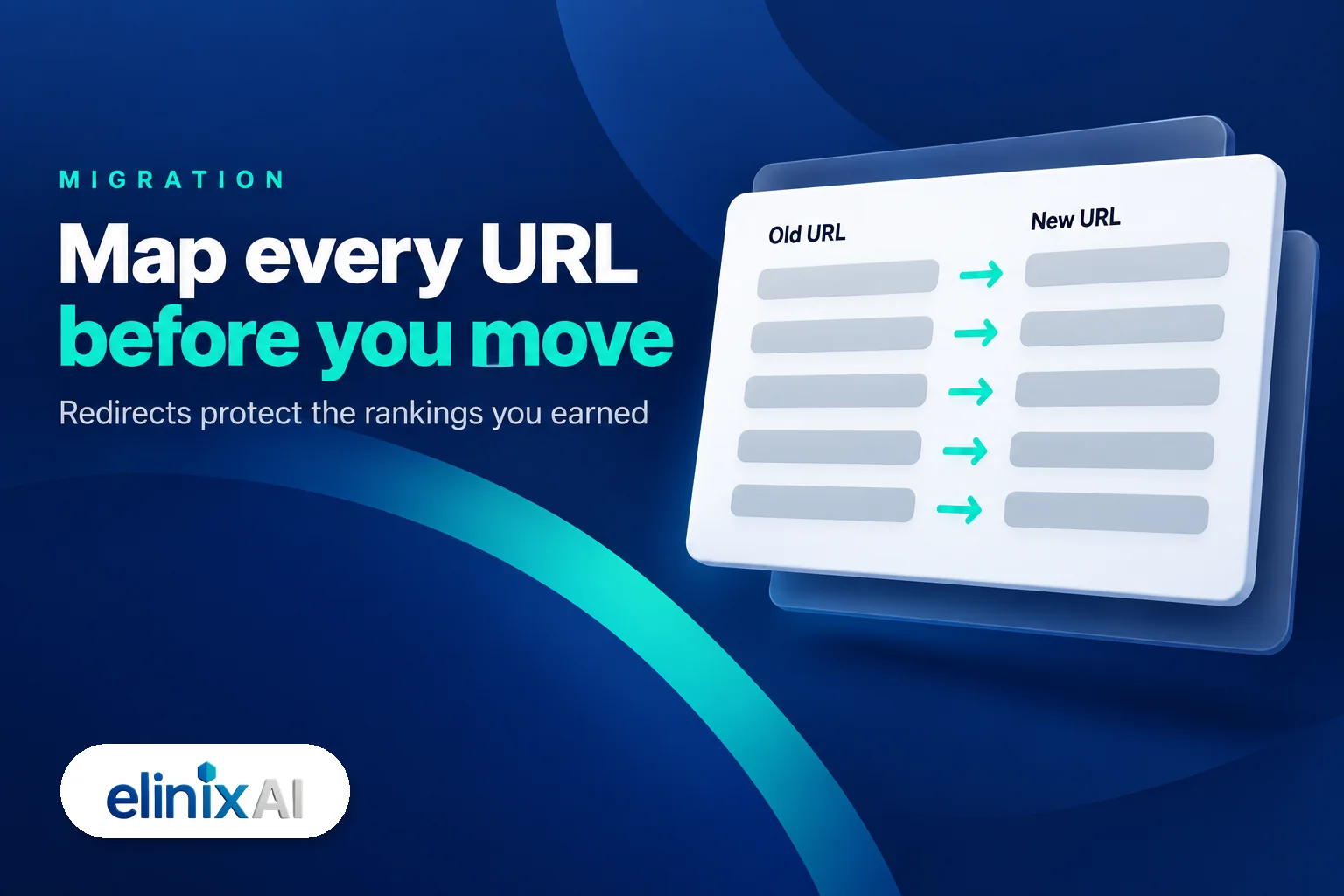
Migrate when the platform costs you money or time you can measure. Another platform sounding better is not a reason. Good reasons are paying a third-party payment fee, a plugin stack nobody can maintain, or a missing feature you need. Redirect mapping protects the Google rankings and links your old product and collection URLs have already earned.
Signs a migration is worth it:
- You pay Shopify's third-party payment fee and cannot switch providers
- Your WooCommerce plugins are out of date because nobody owns updates
- Your checkout is slow or breaks after plugin updates
- You need a feature your current platform cannot do without heavy custom code
Signs it is not worth it yet:
- Your conversion rate is low but you have not tested the product page or checkout
- You are moving because a competitor uses the other platform
- You have no plan for redirects, reviews or order history
What a migration moves, and what it does not
Shopify's own migration guide lists three limits for stores coming from WooCommerce (Shopify Help Center, 2026):
- Product options beyond 3 per product do not import
- Product reviews cannot be exported, so they move through a review app
- Order history moves through a third-party app
URL structure changes too. Shopify uses fixed paths like /products/ and /collections/, and those paths cannot be redirected or renamed. Every old WooCommerce product URL needs a 301 redirect to its new Shopify address. Shopify allows up to 100,000 redirects on standard plans (Shopify Help Center, 2026).
Skip the redirect map and Google finds broken pages where your ranking pages used to be. That is why redirect mapping across every product URL is included in every ecommerce website build we do. Builds start from A$3,500 and typically take 3 to 4 weeks, depending on project size.
Free audit: thinking about a migration? Book a free 15-minute website audit first, and we will tell you honestly if a revamp would get you there faster.
Which platform should you choose?
Choose Shopify if you want the checkout, hosting and security handled, and you sell simple products in Australia. Choose WooCommerce if content drives your sales, your products need complex options, or you already have a developer who owns updates. Either way, the build decides the conversion rate.
| If this is you | Choose |
|---|---|
| Founder-run store, no developer | Shopify |
| Selling mostly to Australians with Australia Post shipping | Shopify |
| Content-led brand with a large blog | WooCommerce |
| Complex products with many options | WooCommerce |
| Already on WooCommerce and it works | Stay, and fix the checkout first |
Before you decide, run these five checks on your own numbers:
- Pull 12 months of sales and split them into Australian cards, overseas cards and Amex.
- Price each platform's card fees on that split, using the tables above.
- List every paid app or extension you need, with its yearly cost.
- Name the person who will update plugins or apps every month.
- List every URL that gets Google traffic today, so a redirect map is possible if you move.
If step 4 has no name, choose Shopify or budget for a developer. If step 5 shows hundreds of ranking URLs, plan the redirects before anything else.
Whichever you choose, the next leak is usually follow-up. A store that converts better still loses most carts, so an abandoned cart flow matters on both platforms. See the essential Klaviyo flows for Shopify stores, which work the same way on WooCommerce.
Want a Shopify store built? Our team designs and builds conversion-first Shopify stores for ecommerce brands, starting from A$3,500. Book a time with us or contact us to talk through your store.
Frequently Asked Questions
Is Shopify or WooCommerce cheaper in Australia?
WooCommerce is cheaper to start because the plugin is free, but you pay for hosting, extensions and upkeep. Shopify Basic costs A$42 a month billed yearly, with hosting included. For a store doing A$20,000 a month, card fees are within about A$10 a month of each other.
Is WooCommerce really free?
The WooCommerce plugin and the WooPayments plugin are free to install. You still pay for hosting, a domain, card fees of 1.75% + 30c on WooPayments, and any paid extensions. WooCommerce Subscriptions, for example, costs A$395 a year.
Do I have to use Shopify Payments?
No, but Shopify charges an extra fee if you use another payment provider. The fee is 2% on Basic, 1% on Grow and 0.6% on Advanced. If you plan to use another provider, add that fee to your costs.
Does Shopify charge GST on its fees?
Yes. Shopify charges 10% GST on its subscription and shipping labels for Australian stores. If you are registered for GST and add your ABN to your Shopify account, Shopify stops charging it on future invoices.
Which converts better, Shopify or WooCommerce?
Shopify usually converts better out of the box, because its checkout and Shop Pay are built and maintained for you. The published conversion figures come from Shopify's own study, not an independent test. A well-built WooCommerce checkout can match it.
Which is better for SEO and AI search?
Both can rank well in Google. Shopify is easier for AI search by default, because its agentic storefronts list products in AI channels for eligible stores. WooCommerce offers similar features through extensions such as Stripe for WooCommerce.
Can I move from WooCommerce to Shopify without losing my Google rankings?
Yes, if every old URL is redirected to its new Shopify URL with a 301 redirect. Shopify allows up to 100,000 redirects on standard plans. Without a redirect map, old ranking pages return errors and rankings drop.
Will my product reviews move across?
Not automatically. Shopify's migration guide says WooCommerce reviews cannot be exported or migrated directly. They move through a third-party review app from the Shopify App Store.
Does Australia Post work with both platforms?
Yes. Australia Post's MyPost Business connects to Shopify directly through Shopify's shipping settings. WooCommerce connects through a shipping platform such as Starshipit, ShipStation or Sellerdash.
Should I switch platforms to improve my conversion rate?
Usually not first. Test the product page, delivery costs and checkout on your current platform before you migrate. One Australian beauty brand we revamped on Shopify lifted its conversion rate 78% without changing platform.