To migrate from eBay to Shopify in Australia, download your active listings from Seller Hub, import the file with Shopify's free Store Migration app, then add the images and descriptions eBay's file leaves out. Set up payments, delivery and GST, and test before launch. Shopify Basic costs A$50 a month billed yearly (Shopify Australia, 2026).
Most sellers do not need to close their eBay shop to do this. You can run both, and many do while the new store builds its own traffic. This guide covers what moves and what stays on eBay, the five steps, why eBay listings cannot be redirected, eBay's rules on contacting buyers, the cost in Australian dollars, and when a tool is enough.
Key facts
- Shopify's free Store Migration app imports eBay listings from a Seller Hub CSV, but eBay's report leaves out descriptions and images (Shopify Help Center, 2026)
- eBay does not offer a customer list export, and Seller Hub reports hold only the last 90 days of orders (Shopify Help Center, 2026)
- eBay bans using contact details from an eBay sale to offer to sell outside eBay (eBay Australia, 2026)
- A migration to Shopify typically costs A$3,000 to A$15,000 in Australia as a market range (What's The Damage, November 2026)
- Marketing messages need consent first, and inferred consent does not cover someone who has just bought from you (ACMA, 2026)
- Australians spent A$18.9 billion on pure online marketplaces in 2025, or 23% of all online spend (Australia Post, 2026)
What can you move from eBay to Shopify?
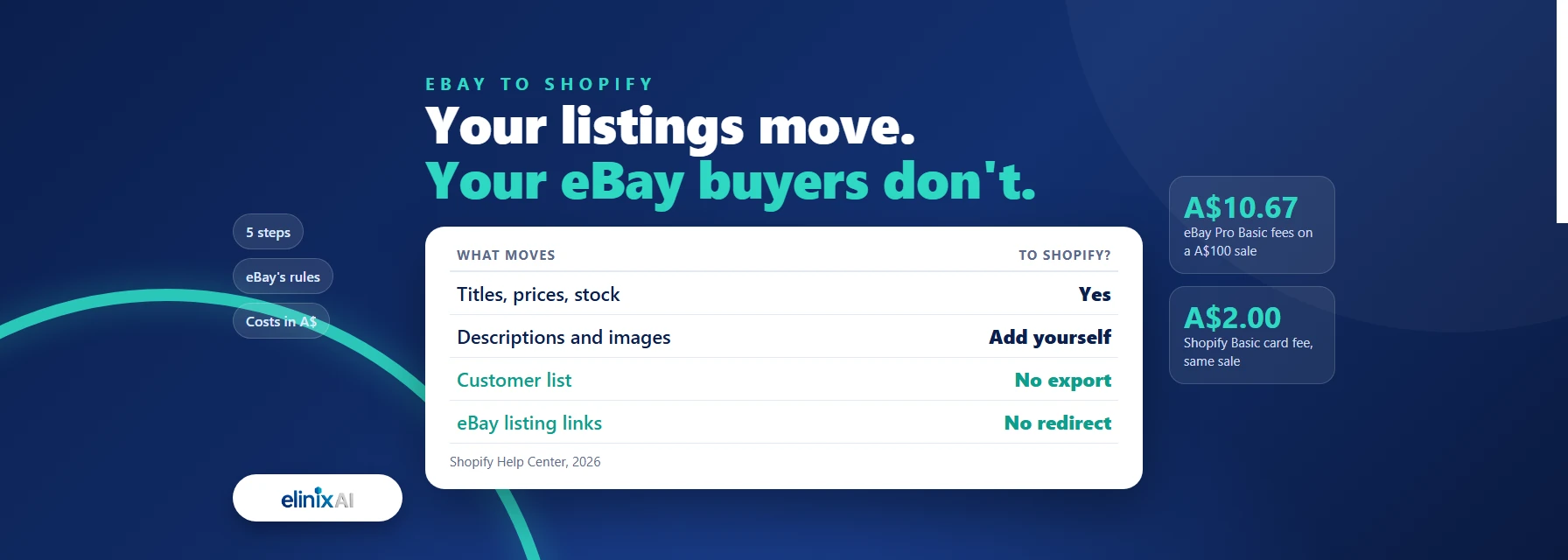
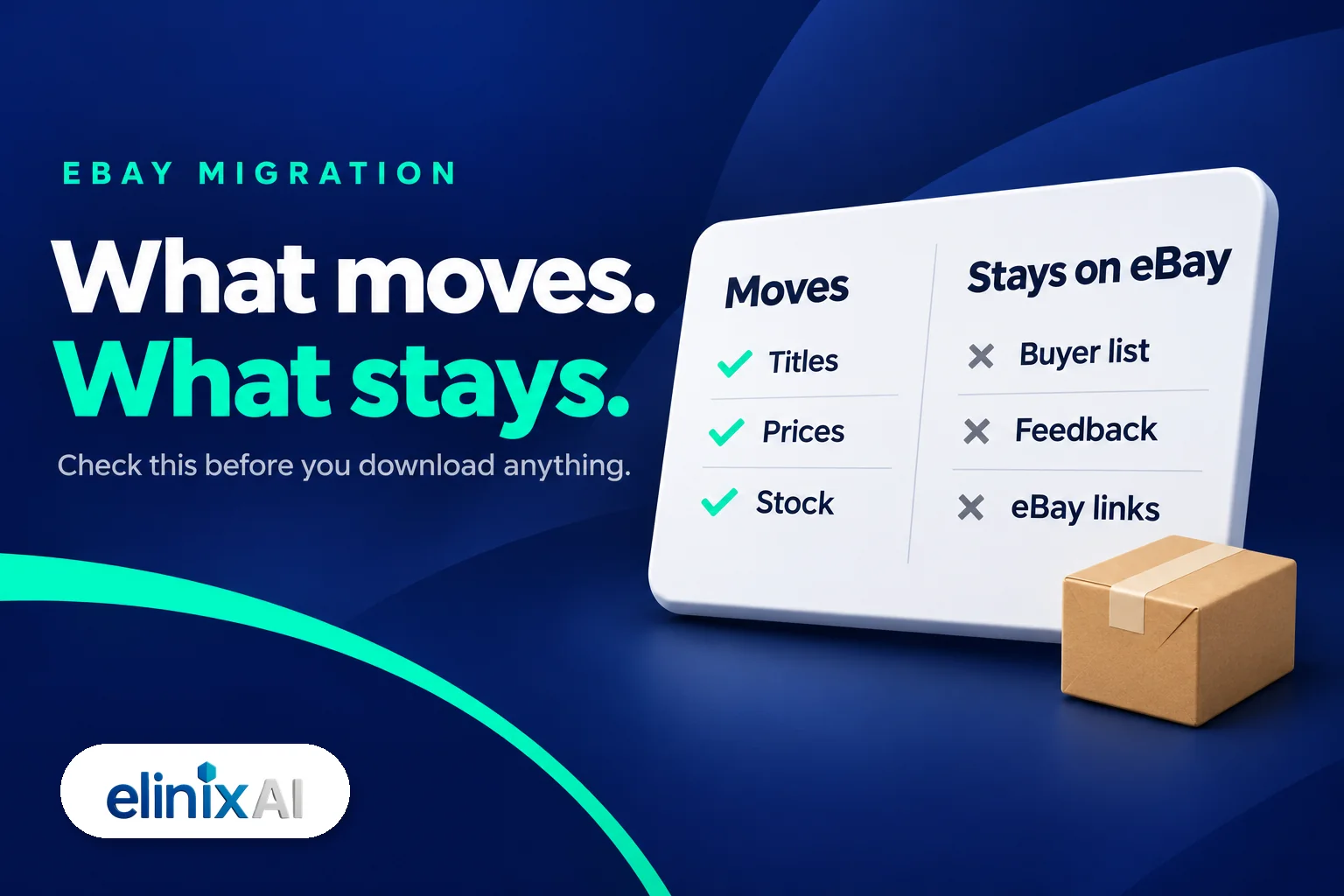
You can move product titles, prices, SKUs, quantities and most variants from eBay to Shopify with a Seller Hub report. Descriptions and images are not in that report, so you add them separately. Customer lists do not move, because eBay does not export them. Your feedback, listing links and eBay Store page stay on eBay.
| Data | Moves? | How, or what to do instead |
|---|---|---|
| Titles, prices, SKUs, quantities | Yes | Seller Hub listings report into Store Migration |
| Variants | Mostly | Listings with 4 or more options, or 101 or more variations, arrive as one product |
| Descriptions | Not in the report | Paste them in, or use a paid migration tool |
| Product images | Not in the report | Upload your originals, or use a paid migration tool |
| Draft listings | No | Publish or rebuild them in Shopify |
| Customer list | No | eBay has no customer export |
| Past orders | Last 90 days | Older orders need an eBay data request and an app |
| Feedback | Not directly | A third-party app, or new reviews on your store |
| eBay links and Store page | No | They stay with your eBay account |
Shopify's eBay migration guide spells out each of these limits. It also says imported products arrive as drafts, so nothing goes live until you publish it.
Paid tools fill some of the gaps. LitExtension, for example, lists descriptions and additional images among the fields it moves, and offers a free demo. Run the demo on your own eBay account before you pay, and check one product with many variations by hand.
How do you migrate from eBay to Shopify, step by step?
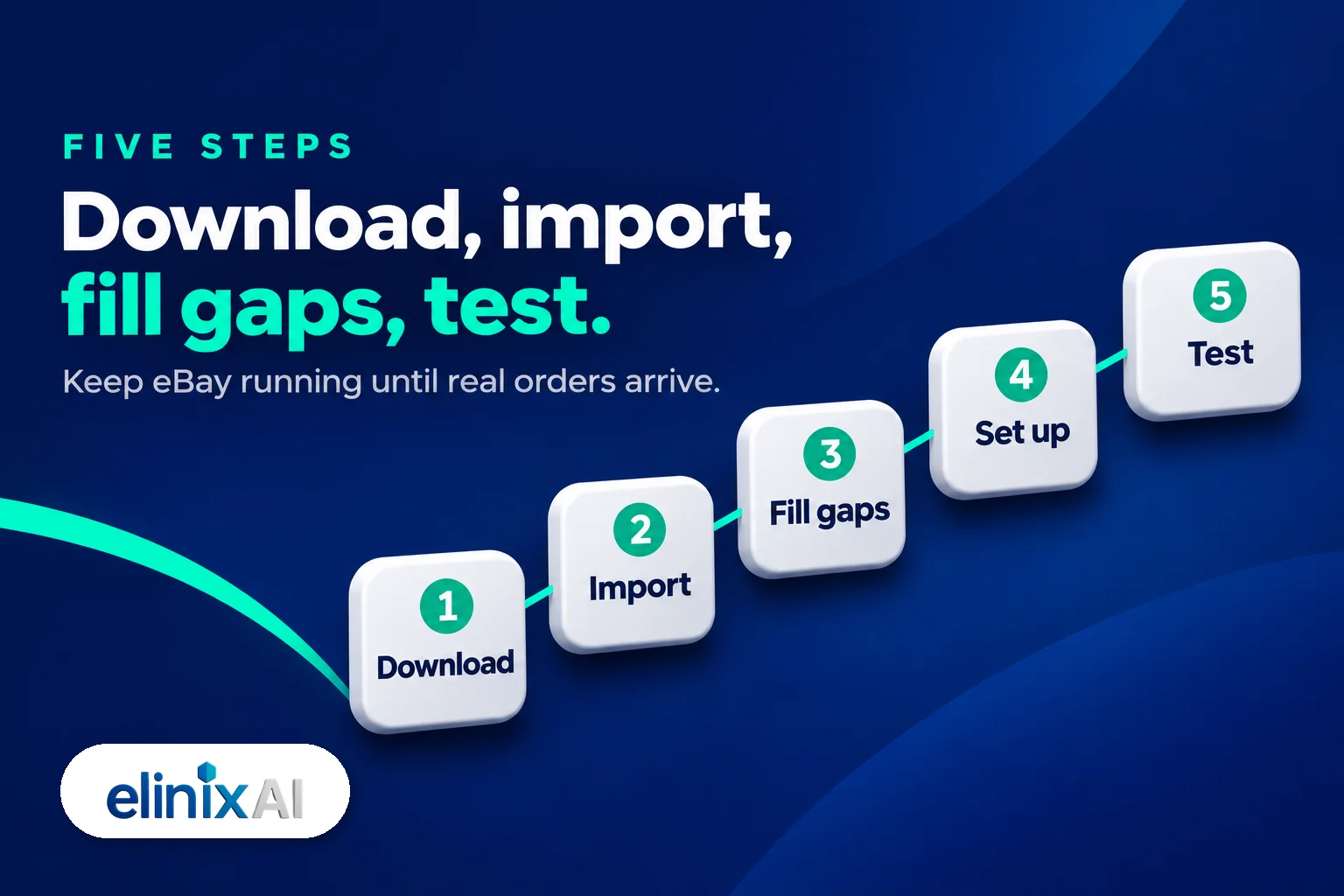
Migrate in five steps: download your listings from Seller Hub, import them with Store Migration, fill in descriptions and images, set up payments, delivery and tax, then test with real orders. Keep your eBay listings live until the Shopify store has taken its first real orders. That way a mistake costs you an evening and no sales.
- Download. In Seller Hub, open Reports, then Downloads, and click Download report. Set Source to Listings and Type to All active listings. Download a second report for unsold listings if you want those too. Draft listings cannot be exported.
- Import. Install Store Migration, which Shopify publishes for free, and upload the CSV as it is. Shopify says you do not need to edit the file first. Read the import report for anything that failed.
- Fill the gaps. Add descriptions and your original photos to each product. Rewrite titles while you are there. eBay titles are often packed with search terms, which read badly on a brand's own store. Then check every product that had many variations.
- Set up. Choose a theme, then set up delivery, tax and payments. Shopify Payments is available for businesses located in Australia. Connect your domain last.
- Test. Publish the products, then place test orders on a phone. Check stock, delivery prices, emails and your largest product. Fix what breaks before you tell anyone the store exists.
Then write your store's own policy pages. On eBay, buyers lean on eBay's Money Back Guarantee and your feedback score. On your own store, delivery times, returns and contact details have to be in plain sight.
The migration checklist
| Stage | Task | Done when |
|---|---|---|
| Download | Active and unsold listing reports saved, original photos saved | Every live listing is in a file |
| Import | Store Migration run, import report read | Product count matches eBay |
| Fill gaps | Descriptions, images and titles added | No product shows a blank description |
| Set up | Theme, payments, delivery, GST | A test order shows the correct total |
| Compliance | Privacy policy and unsubscribe process live | Only opted-in contacts are on your email list |
| Test | Phone checkout, largest product, emails | A real order is shipped and received |
| Launch | Domain connected, eBay listings left untouched | First real orders arrive |
Can you redirect your eBay listings to your new store?
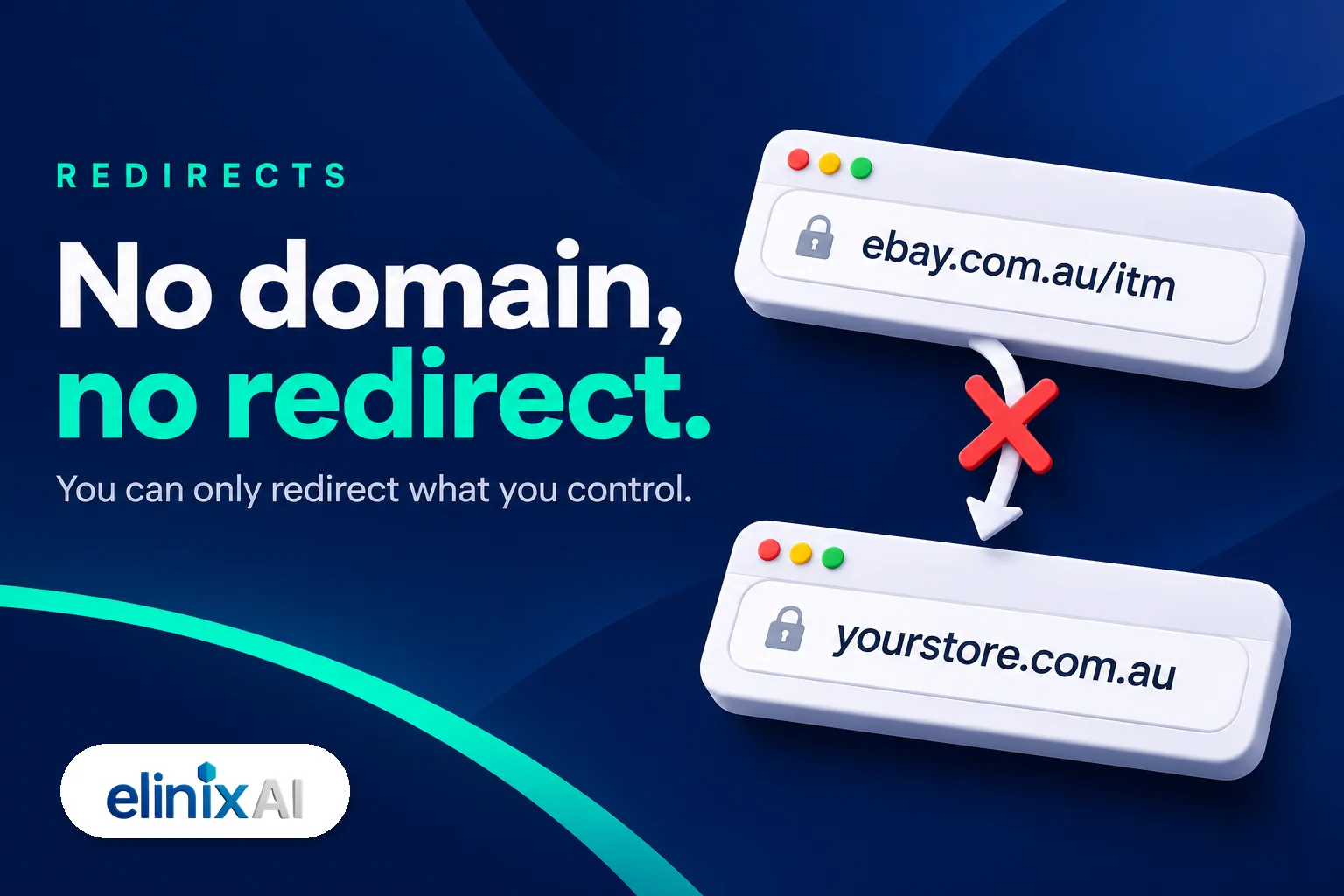
No. A 301 redirect has to be set on the old address, and eBay controls its own addresses. Shopify's redirect tool works only from broken URLs on your own store. So any rankings your eBay listings earned stay with eBay, and your new store builds its own from the start.
eBay also stops you pointing buyers there from a listing. Its fee avoidance policy bans linking to or promoting sites that can be used to order outside eBay. So your listings cannot carry a link to the new store either.
This is where a marketplace move differs from a platform move. Going from WooCommerce to Shopify keeps your domain, so a redirect map protects what you already rank for. Moving from eBay gives you nothing to redirect. Three things take the place of redirects:
- Own your brand search. Use the same brand name, product names and photos on Shopify, so people searching for you find the new store.
- Build collection pages for real searches. Our complete guide to ecommerce SEO, AEO and GEO covers where to start.
- Be readable by AI tools. Our 12 checks for Shopify AI search cover what ChatGPT and others need from a new store.
If you already run your own website and are moving that to Shopify as well, then redirects do matter. Shopify allows up to 100,000 of them on standard plans. Set them up before you move the domain.
Can you bring your eBay customers with you?
No, not as a list. eBay does not export customer lists, and its rules ban using contact details from an eBay sale to offer to sell outside eBay. Australian spam law adds a second barrier: the ACMA says you must have consent before sending marketing. Plan to win eBay buyers over through your own store's sign-up form.
eBay's policy on offers outside eBay is specific. Members cannot share contact details, including website addresses, before a sale is complete. They cannot promote external websites that sell outside eBay in their messages. And sellers cannot list an item, then link to the same or related items sold elsewhere. eBay lists listing removal, account restrictions and suspension among the actions it may take.
Two ACMA rules catch marketplace sellers out as well:
- A past purchase is not enough. The ACMA says inferred consent does not cover sending messages after someone has just bought from you.
- You cannot email to ask. A message asking for consent is itself a marketing message, the ACMA says.
The clean way to build a list is on the new store. Add a sign-up form with a clear offer, then let Klaviyo do the follow-up. Our guides to email marketing in Australia and the essential Klaviyo flows for Shopify show the setup.
Free audit: moving off eBay and not sure what to do first? Book a free 15-minute website audit and we will go through your catalogue and your plan together.
What does an eBay to Shopify migration cost in Australia?
An eBay to Shopify migration typically costs A$3,000 to A$15,000 when a specialist does the work, according to What's The Damage's market range, verified November 2026. Doing it yourself costs your time and a Shopify plan from A$50 a month. A new design adds to that. Catalogue size, variations and design choices move the price most.
| Route | Market cost in A$ | What you get |
|---|---|---|
| DIY with Store Migration | Shopify plan only, A$50 to A$56 a month on Basic | Your own time, full control |
| Paid migration tool | Priced per record, billed in US dollars | Data moved, no store built |
| Migration by a specialist | A$3,000 to A$15,000 | Data, setup and testing |
| Template store build | A$2,000 to A$8,000 | New store on a paid theme |
| Custom Shopify theme | A$10,000 to A$30,000 | Design built for your brand |
Source: What's The Damage, verified November 2026, Shopify Australia, LitExtension. Those are market bands, not quotes.
The running costs work differently on each side. eBay takes a share of every sale. Shopify charges a plan fee and card fees, and leaves the traffic to you.
| Running cost | eBay Australia | Shopify Basic |
|---|---|---|
| Monthly fee | None on Pro Starter, A$27.45 on Pro Basic | A$50 billed yearly, A$56 monthly |
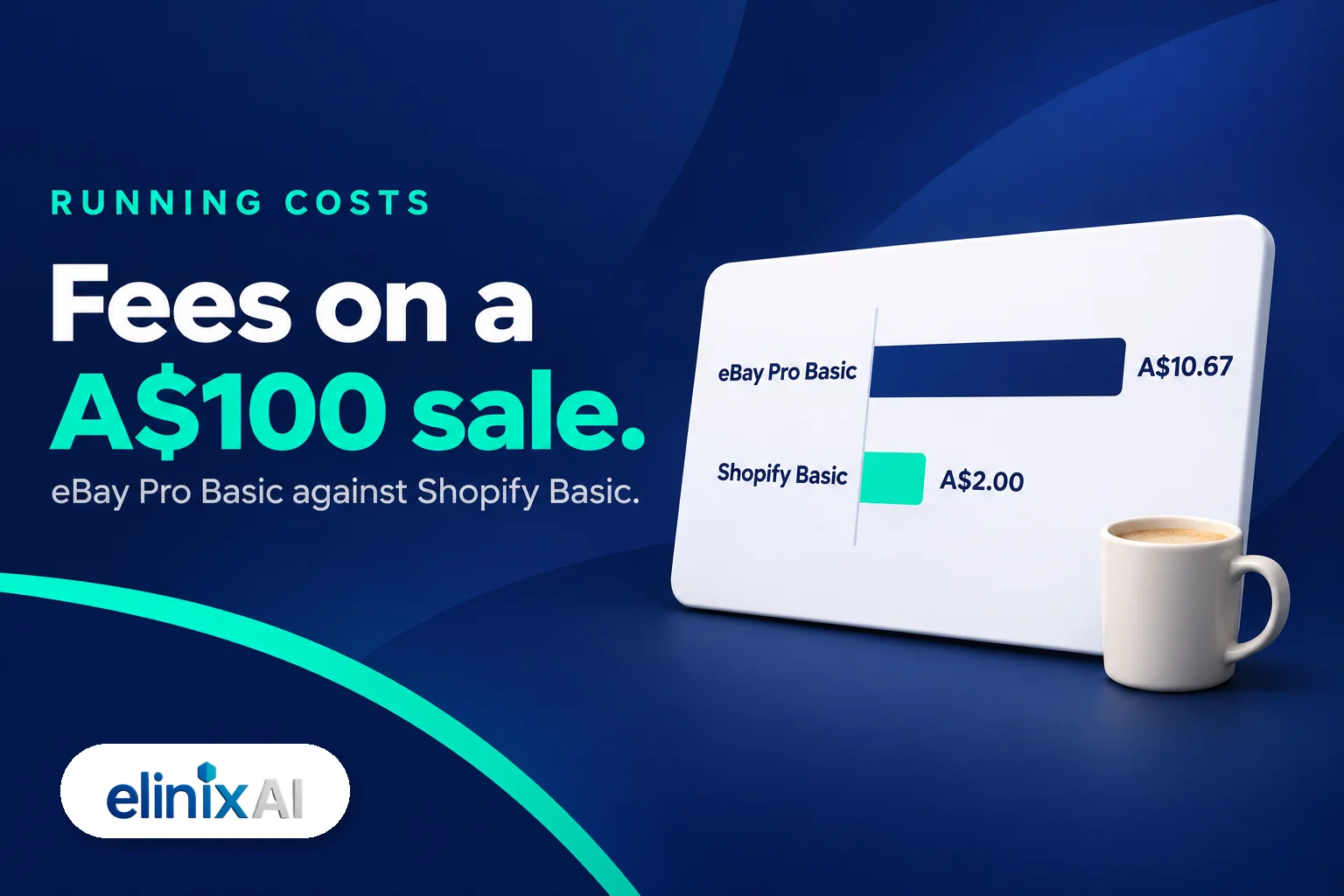
| Fee per sale, most categories | 11.44% + 30c on Pro Starter, 10.34% + 33c on Pro Basic | 1.7% + 30c for online cards on Shopify Payments |
| On a A$100 sale | About A$10.67 on Pro Basic | A$2.00 |
| Shoppers | eBay brings them to your listing | Your store has to earn them |
Source: eBay Pro selling fees, updated 1 November 2026, and Shopify Australia. Fees include GST. eBay's rates vary by category and change often, so check its fee page on the day. Smaller sellers may pay nothing: eBay says selling is free for Australia-based sellers without a Pro plan who sold A$25,000 or less in the past 12 months.
That last row is the honest test of the move. Australians spent A$18.9 billion on pure marketplaces in 2025, 23% of the A$82.6 billion spent online (Australia Post, 2026). So most online spend happens elsewhere, but your own store has to go and get it. You also need to register for GST once your GST turnover reaches A$75,000, according to the ATO, and your eBay and Shopify sales both count towards it.
Should you keep selling on eBay after you move?
Usually yes, at least at first. eBay keeps earning while your Shopify store builds traffic, and you can manage both from Shopify. Shopify's free Marketplace Connect app syncs listings, orders and stock with eBay. The first 50 synced orders a month are free, then 1% per order, capped at US$99 a month.
Check that it supports your eBay site before you rely on it. Shopify's page lists eBay but does not name eBay Australia. If you would rather not sync, keep stock counts in step by hand so you do not oversell, and close eBay only when your own numbers justify it.
Should you use a migration tool or an agency?
Use Store Migration if your catalogue is simple and you are happy to fill in descriptions and images yourself. Use a paid tool or a specialist if you have hundreds of listings, many variations, or need a new design. A tool moves data. It does not write your policies, set up delivery or decide what your store should look like.
| Your situation | Usually suits |
|---|---|
| Under 10 simple listings, you run everything | Store Migration, then add images by hand |
| Hundreds of listings with many variations | Paid tool, plus someone to check the result |
| You need a new design and brand pages | Specialist or agency |
| You are an agency moving a client's shop | White-label partner |
| eBay works well and you want a test | Keep eBay, open Shopify alongside it |
Before you commit, also read our Shopify vs WooCommerce comparison. It is worth two minutes if your brand is content-led.
We move stores from marketplaces to Shopify as part of our store migrations and custom builds, covering the catalogue, payments and delivery. Our ecommerce website design service covers the store itself. Each one is quoted after a free audit. An ecommerce build typically takes 3 to 4 weeks from the start of the build, though a large catalogue takes longer. Agencies can hand us the work under their own name through our agency partner programme. We do not promise a sales figure, because that depends on your product, your margins and your traffic.
Free audit: get a second opinion before you pay for a move. Book a free 15-minute website audit and we will tell you honestly whether a migration is worth it yet.
Frequently Asked Questions
Can I import my eBay listings into Shopify for free?
Yes. Shopify's Store Migration app is free and imports eBay listings from a Seller Hub report. The report does not include descriptions or images, so you add those yourself. Imported products arrive as drafts, which gives you time to check them before anything goes live.
Can I keep my eBay shop after moving to Shopify?
Yes. Importing products into Shopify does not close your eBay shop. Running both for a while is the safer plan, because eBay keeps earning while your new store builds traffic. Shopify's Marketplace Connect app can sync listings, orders and stock between the two.
Can I export my eBay customers' email addresses?
No. Shopify's guide says eBay does not offer a customer list export. eBay's own rules also ban using contact details from an eBay sale to offer to sell outside eBay. Build a new list through a sign-up form on your Shopify store instead.
Can I put a link to my Shopify store in my eBay listings?
No. eBay's fee avoidance policy bans linking to or promoting sites that can be used to order outside eBay. Its policy on offers outside eBay also bans linking to the same or related items sold elsewhere. Breaking these rules can lead to listing removal or account restrictions.
Does my eBay feedback move to Shopify?
Not directly. Shopify's guide says eBay leaves feedback out of Seller Hub reports, so moving it needs a third-party app. Your feedback score stays with your eBay account either way. Set up a review request after purchase on your new store, so product pages have their own proof.
How long does an eBay to Shopify migration take?
There is no fixed figure, because it depends on catalogue size and how much setup you need. The import itself is quick. Adding descriptions and images, setting up the store and testing take longer. An Elinix AI ecommerce build typically takes 3 to 4 weeks from the start of the build.
What does it cost to move from eBay to Shopify?
Market ranges put a migration to Shopify at A$3,000 to A$15,000, according to What's The Damage (November 2026). DIY costs your time plus a Shopify plan, from A$50 a month billed yearly on Basic. At Elinix AI, each migration is quoted after a free audit, because catalogues differ so much.
Will I lose my eBay search rankings?
Your eBay rankings stay on eBay, and they do not carry over to your new store. You cannot place a redirect on an eBay address. Your Shopify store starts as a new website, so it needs its own product pages, collection pages and links. Keeping your eBay listings live covers the gap.
Do I need to register for GST to sell on Shopify?
You must register for GST once your GST turnover reaches A$75,000, according to the ATO. Your eBay and Shopify sales both count towards that turnover. Shopify says tax is your responsibility, even though it offers a tax service for Australian stores. Ask your accountant if you are close to the threshold.