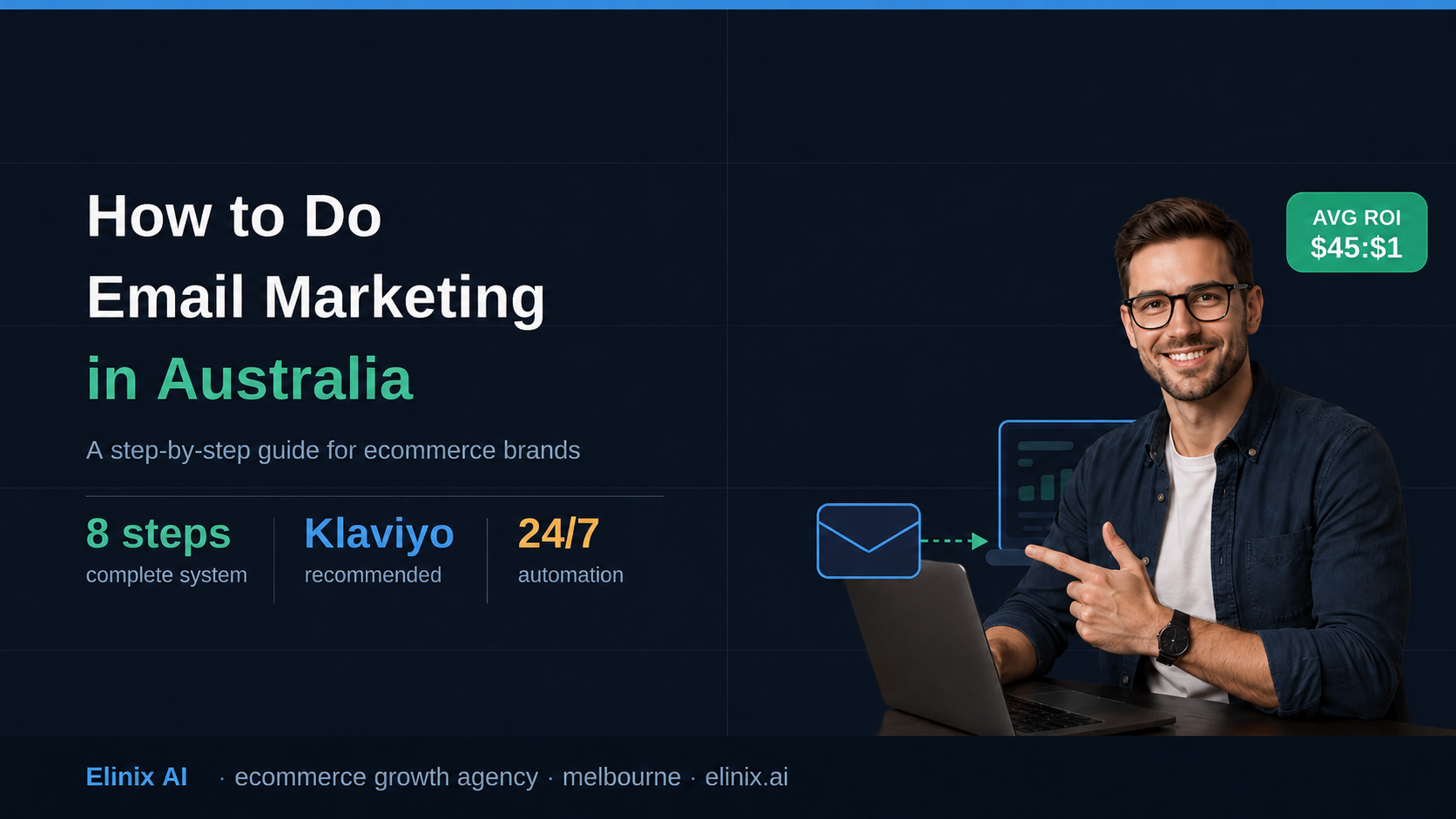
Email marketing in Australia is one of the most powerful and cost-effective growth channels available to ecommerce brands — delivering an average ROI of $36–$45 for every dollar spent, the highest of any digital marketing channel. If you run a Shopify or WordPress store and you're not yet generating at least 30% of your revenue from email, this guide will show you exactly how to fix that. We'll walk through every step: choosing the right platform, building your core email flows, writing campaigns that convert, and scaling with SMS — all tailored for the Australian market.
Why Email Marketing Still Matters for Australian Ecommerce Brands
Before we get into the how, it's worth understanding why email deserves your full attention.
Paid advertising costs in Australia continue to rise. Meta and Google CPMs are higher than ever, and the brands that are winning — the ones growing sustainably — all have one thing in common: a strong, automated email marketing system generating revenue in the background.
Unlike Instagram or TikTok, where an algorithm decides who sees your content, your email list belongs to you. It's a direct, owned communication channel that no platform update can take away. When someone gives you their email address, you have permission to speak to them directly — and that's extraordinarily valuable.
The numbers support this. According to a 2026 Constant Contact survey of over 1,500 small business owners across Australia and New Zealand, 41% expect email marketing to be their most valuable marketing channel this year. Meanwhile, research from Statista shows that ecommerce and retail brands achieve an average email ROI of up to $45 for every dollar invested — the highest of any industry.
For growing ecommerce brands in Melbourne and across Australia, email marketing isn't optional. It's essential infrastructure.
Step 1: Choose the Right Email Marketing Platform
The foundation of successful email marketing in Australia is choosing a platform built for ecommerce — not a generic bulk email tool.
For Shopify and WooCommerce stores, Klaviyo is the clear market leader. It's purpose-built for ecommerce with native integrations to Shopify, WooCommerce, and BigCommerce, pulling in real-time data on purchase history, browsing behaviour, cart activity, and predicted customer lifetime value.
What sets Klaviyo apart from standard email platforms:
For brands just starting out or with smaller lists, platforms like Klaviyo also offer a generous free tier based on contact count — making Klaviyo email marketing accessible even in the early stages of growth.
Step 2: Set Up Your Technical Foundations (Don't Skip This)
Before you send a single email, your technical infrastructure needs to be correctly configured. This is the step most brands skip — and it's the reason their emails end up in spam folders instead of inboxes.
The three technical essentials are:
DKIM (DomainKeys Identified Mail) — authenticates that your emails are genuinely being sent from your domain, not an impersonator.
SPF (Sender Policy Framework) — tells receiving mail servers which IP addresses are authorised to send email on behalf of your domain.
DMARC (Domain-based Message Authentication, Reporting and Conformance) — ties DKIM and SPF together and tells receiving servers what to do with emails that fail authentication.
Setting these up correctly — which involves updating your domain's DNS records — dramatically improves deliverability. Without them, even perfectly written emails will end up in spam for a significant portion of your list.
Beyond authentication, you'll also need to:
At Elinix AI, we handle all of this technical setup as part of our done-for-you email marketing service — so you don't have to become a DNS expert to get your system working properly.
Step 3: Build Your Core Email Flows (The Revenue Engine)
Email automation — also called email flows — is where the real money in email marketing lives. Unlike one-off campaigns, flows run 24/7 and respond automatically to what your customers do (or don't do).
Research from Omnisend shows that automated emails outperformed manually scheduled campaigns in 2024 by 52% on opens, 332% on clicks, and an extraordinary 2,361% on conversions. Welcome emails, abandoned cart flows, and browse abandonment campaigns alone accounted for 87% of all automated orders.
Here are the core flows every Australian ecommerce brand needs:
Welcome Series
The welcome flow is triggered the moment someone subscribes to your email list. It's typically your highest-performing automation because new subscribers are most engaged immediately after signing up.
Welcome series emails typically see open rates of 45–50% and conversion rates of 8–12% when properly optimised. A strong welcome series runs 5–7 emails over 7–14 days and should cover:
One important nuance for Australian brands using Klaviyo: under the Spam Act 2003 and ACMA guidelines, you must ensure subscribers have given express or inferred consent before receiving commercial emails. Your pop-up forms and sign-up pages should have clear, compliant language about what people are subscribing to.
Abandoned Cart Flow
Approximately 76% of online shopping carts are abandoned before purchase. The abandoned cart flow is your safety net — designed to recapture shoppers who were close to buying but left before completing checkout.
According to Klaviyo's benchmarks, abandoned cart flows generate an average of $3.65 revenue per recipient — compared to just $0.11 for a standard campaign email. That's more than 33 times more effective.
Best practice timing for the abandoned cart sequence:
Having multiple abandoned cart emails results in 69% more orders than sending just one, according to email marketing research from Klaviyo.
Browse Abandonment Flow
Not everyone who abandons a cart was ready to buy. Browse abandonment targets visitors who viewed products but didn't add anything to their cart — catching potential customers earlier in the decision-making process.
This mid-funnel flow is particularly effective for higher-ticket products where the research phase is longer, and it works best when the email surfaces the specific product(s) the customer viewed.
Post-Purchase Flow
The sale isn't the end — it's the beginning of the customer relationship. A well-structured post-purchase flow should:
~ Confirm the order and set delivery expectations
~ Provide tips on getting the most from the product
~ Request a review once the order has been received and used
~ Cross-sell complementary products 7–14 days after delivery
This is how you increase both average order value (AOV) and customer lifetime value (LTV) — two metrics that compound significantly over time for ecommerce brands.
Customer Win-Back Flow
Not every customer will come back on their own. The win-back flow targets lapsed customers — those who haven't purchased in 60, 90, or 120 days — with personalised messages and a time-sensitive incentive to bring them back.
Winning back an existing customer costs far less than acquiring a new one, making this flow exceptional for long-term LTV. Klaviyo's future of consumer marketing research found that 50% of consumers are willing to give a brand a second chance if they're offered appropriate compensation.
Review Request Flow
A dedicated review request flow triggers automatically after an order is delivered, prompting customers to share their experience. These reviews then feed your website, Google Business profile, and ad creative — multiplying the value of every sale you make.
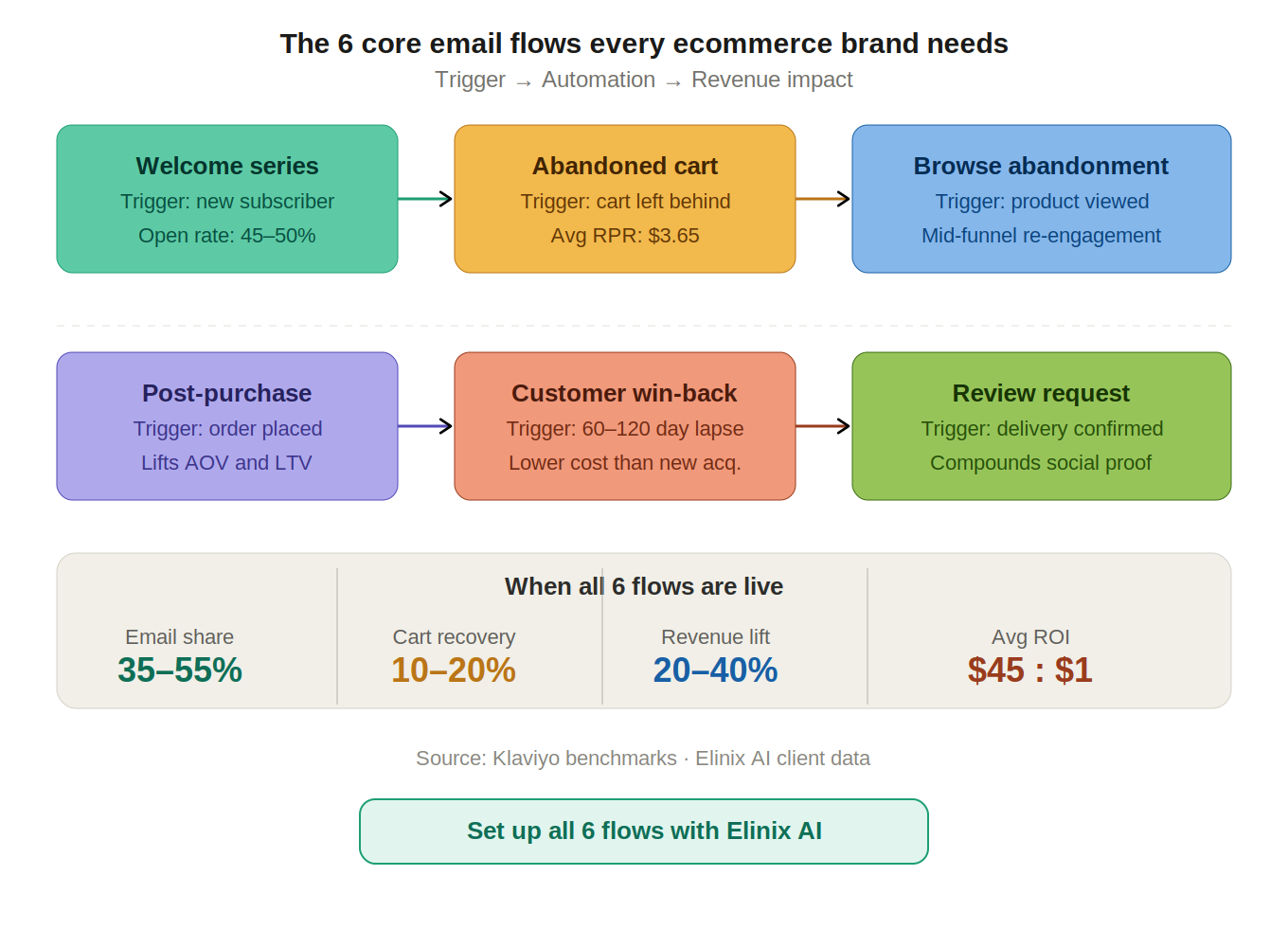
To learn more about how these flows work together to generate consistent revenue, read our in-depth guide on how email marketing automation can drive 30% more revenue for your ecommerce store.
Step 4: Plan and Send High-Converting Email Campaigns
Beyond automated flows, regular email campaigns keep your list warm, your brand top of mind, and your revenue spiking around key events.
For most Australian ecommerce brands, a minimum of 4 campaigns per month is the benchmark — roughly once a week. High-performing brands send 8–12 campaigns per month.
What to send:
The golden rule for campaigns: segment before you send. Rather than blasting your entire list with every email, send each campaign only to the subscribers most likely to find it relevant. Segmented campaigns consistently outperform unsegmented sends across every metric — open rate, click rate, and revenue per recipient.
Step 5: Add SMS Marketing to Unlock a Second Revenue Channel
Once your email flows are running, layering in SMS is the natural next step. And for ecommerce brands in Australia, it's a significant revenue unlock.
SMS messages have an open rate of approximately 98% — compared to 30–40% for email — making them ideal for time-sensitive communications where immediacy matters.
The most effective ecommerce marketing systems use email and SMS in a complementary way:
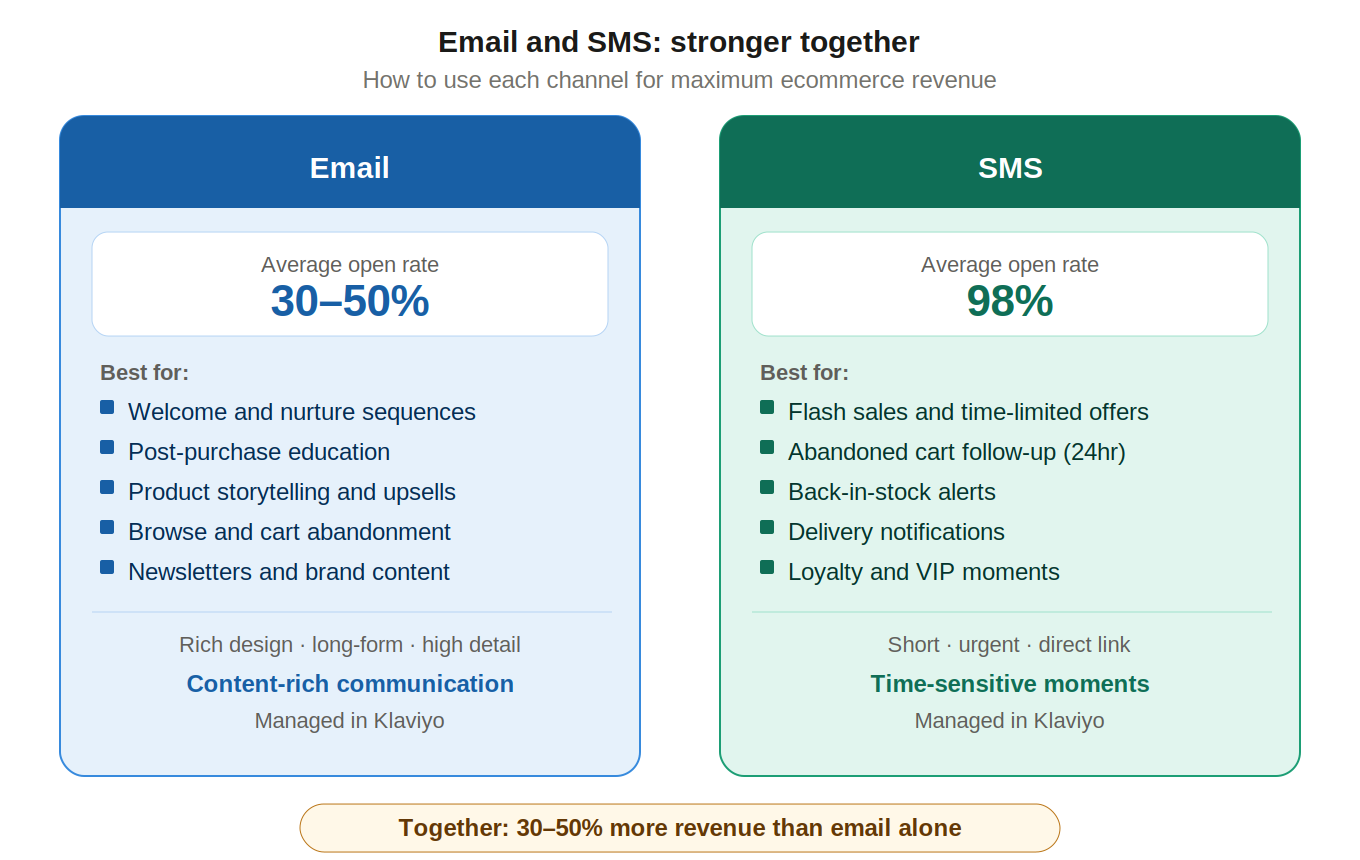
| Channel | Best Use Cases |
|---|---|
| Welcome series, post-purchase nurture, browse abandonment, win-back, content-rich campaigns | |
| SMS | Flash sale alerts, abandoned cart reminders, restock notifications, delivery updates |
For example: send an abandoned cart email at the 1-hour mark with product details and a soft reminder, then follow up with an SMS at the 24-hour mark with a short, direct link back to their cart. This multi-channel approach typically generates 30–50% more revenue than email alone.
One important note for Australian brands: SMS marketing is subject to the Spam Act 2003 and ACMA regulations. You must have explicit consent from subscribers before sending marketing SMS messages, and every message must include an easy way to opt out.
At Elinix AI, our email and SMS marketing automation service is built specifically around this multi-channel approach, using Klaviyo's unified platform to manage both channels seamlessly.
Step 6: Grow Your Email List Consistently
Your email flows and campaigns are only as powerful as the list they send to. A consistent list-growth strategy is essential for long-term performance.
The highest-converting list-building tactics for Australian ecommerce brands:
Exit-intent pop-ups — shown when a visitor moves to close the browser tab, these recover a portion of visitors who would otherwise leave without converting. Offer a meaningful incentive: 10–15% off the first order, free shipping, or a useful content download.
Embedded sign-up forms — place forms at the footer, on product pages, and in your blog content. Readers who engage with your content are high-quality subscribers.
Post-purchase opt-in — at checkout or on the order confirmation page, invite customers to join your email list if they haven't already.
Referral and loyalty programme integration — use email sign-up as part of your loyalty or referral programme to drive sign-ups with clear value exchange.
Paid traffic to a lead magnet landing page — run low-cost ads driving traffic to a dedicated sign-up page offering a free guide, checklist, or discount in exchange for an email address.
Pair your list-growth strategy with a well-optimised website to maximise the conversion of every visitor into a subscriber. Our guide on 5 website conversion fixes every ecommerce brand should implement covers how your site structure directly affects email sign-up rates.
Step 7: Track the Right Metrics (Not Just Open Rates)
Many brands make the mistake of optimising for vanity metrics like open rate while ignoring the numbers that actually reflect revenue performance. Here's what to track:
| Metric | Benchmark (Ecommerce) | What It Tells You |
|---|---|---|
| Open Rate | 35–50% | Subject line quality and list health |
| Click-Through Rate | 1.4–2.6% | Email content relevance and CTA strength |
| Revenue Per Recipient (RPR) | $0.11 (campaigns) / $3.65 (flows) | The most important ecommerce metric |
| Conversion Rate | 2–3% (flows) | How many recipients complete a purchase |
| Unsubscribe Rate | Under 0.5% | List quality and content relevance |
| Deliverability Rate | 95%+ | Technical health and list hygiene |
The benchmark open rate for ecommerce brands in Australia sits between 35–50%. If you're falling below 25%, it's worth reviewing your subject line strategy, list hygiene practices, and sending frequency. For more detail, see our breakdown of what is a good open rate for email marketing in 2026.
Revenue Per Recipient is the single most important metric for ecommerce. Klaviyo makes this visible at the flow and campaign level, so you can see exactly which emails are generating revenue and which ones need attention.
Step 8: Optimise Continuously with A/B Testing
The best email programmes are never finished. A/B testing is what separates brands that plateau from brands that compound.
Research shows that brands incorporating A/B testing into their email strategy see a 42:1 ROI compared to 23:1 for those that don't. The effort is minimal; the upside is significant.
What to A/B test:
Run one test at a time, let it reach statistical significance, and document your findings. Over 12 months, these incremental improvements compound into dramatically better performance.
The Full Email Marketing Stack for Australian Ecommerce Brands
To summarise, here's the complete email marketing setup every Australian ecommerce brand should have in place:
Platform: Klaviyo (for Shopify or WooCommerce)
Technical Setup:
Automated Flows (minimum 5):
1- Welcome series (5–7 emails)
2- Abandoned cart (3 emails)
3- Browse abandonment (2–3 emails)
4- Post-purchase (4–6 emails)
5- Customer win-back (3–4 emails)
6- Review request (1–2 emails)
Campaigns: 4–12 per month, segmented by behaviour and lifecycle stage
SMS: Layered in alongside email for time-sensitive touchpoints
List Growth: Pop-ups, embedded forms, post-purchase opt-in, and lead magnets
Optimisation: Monthly A/B testing and performance reviews
For a complete breakdown of what this costs for Australian brands at different stages of growth, read our guide on how much email marketing costs in Australia.
Do It Yourself vs. Working With an Email Marketing Agency in Melbourne
For founders and marketers considering their options, there are two realistic paths:
DIY — Klaviyo's interface is user-friendly, and there's extensive documentation available. If you have the time and willingness to learn the platform, copywriting, design, and strategy, you can build a solid system yourself. Expect to invest 20–40+ hours for the initial setup, plus 5–10 hours per month ongoing.
Done-for-you agency — If you'd rather not become an email specialist, working with an experienced ecommerce email marketing agency means the system gets built correctly the first time, without the learning curve. You also benefit from strategic input on what flows and campaigns to run based on your specific product category, customer data, and growth stage.
At Elinix AI, we specialise in exactly this. Our done-for-you service builds a complete Klaviyo system — 8 automated flows, 36 emails, full SMS integration — inside your account in 21 days. We handle strategy, copywriting, design, technical setup, and ongoing optimisation so you can focus on running your business.
Brands that run our system typically see:
For example, one of our Australian beauty brand clients went from generating 12% of revenue from email to 38% within 60 days of launching our system — an increase of $8,200 in email-attributed revenue in the first month alone.
Ready to Build a Revenue-Generating Email System?
Email marketing in Australia isn't complicated, but it does require the right platform, the right flows, and a commitment to continuous improvement. Get it right, and email becomes the most reliable, cost-effective revenue channel in your marketing stack — running 24/7 whether you're working, sleeping, or launching your next product.
If you're ready to stop leaving revenue on the table and start turning your email list into a predictable growth engine, book a free strategy session with Elinix AI today. We'll audit your current email setup, identify where revenue is being lost, and give you a clear roadmap to fix it.
Learn more about our services:
Elinix AI is a Melbourne-based ecommerce growth agency specialising in email and SMS marketing automation, high-converting website design, and influencer marketing. With 16+ years of experience and $50M+ in revenue generated for clients, we help ecommerce brands on Shopify and WordPress scale sustainably.