What Is Email Marketing? A Complete Guide for Ecommerce Brands
Email marketing is the practice of sending targeted, commercial messages directly to a group of people via email — with the goal of driving sales, building customer relationships, and growing your business. For ecommerce brands, it remains one of the highest-ROI channels available, with research showing it delivers an average return of $36–$45 for every $1 spent. If you are running a Shopify or WordPress store and email is not generating at least 30% of your revenue, you are leaving significant money on the table.
In this guide, we break down exactly what email marketing is, how it works for ecommerce, which automation flows drive the most revenue, and why platforms like Klaviyo have become the go-to tool for growing Australian brands.
Why Email Marketing Still Matters in 2026 (And Beyond)
In a world flooded with social media ads, influencer content, and paid search, email remains the most direct and owned channel a brand has. Unlike Instagram or TikTok — where algorithms decide who sees your content — your email list belongs to you. When someone gives you their email address, you have a direct line of communication that no platform can cut off or charge you to access.
The numbers speak for themselves: • There were 4.48 billion global email users in 2024, projected to reach 4.8 billion by 2027 (Statista) • Ecommerce brands see an average ROI of $45 per dollar spent on email marketing — the highest of any industry • In 2024, 50% of consumers said they purchased directly from an email — more than from social media posts or ads • Email is 40 times more effective than social media for customer acquisition • Automated emails generate up to 30x more revenue per recipient than standard one-off campaigns (Klaviyo benchmarks)
For growing ecommerce brands in Australia, email marketing is not optional — it is essential infrastructure. It is what turns a single purchase into a loyal repeat customer, and a new subscriber into a long-term revenue source.
How Does Email Marketing Work for Ecommerce?
At its core, email marketing works by collecting the email addresses of potential and existing customers, then sending them strategic, relevant messages designed to move them through your customer journey.
There are two main types of email marketing:
1. Email Campaigns
These are broadcast emails sent to your entire list (or a segment of it) at a scheduled time. Think promotional newsletters, new product launches, seasonal sales, and weekly content updates. Campaigns require manual creation and scheduling, but they are powerful for driving spikes in revenue around key events and keeping your brand top of mind.
2. Email Automation (Flows)
Automations — also called email flows — are pre-built sequences that trigger automatically based on what a customer does (or does not do). These are the real workhorses of ecommerce email marketing. A welcome flow triggers the moment someone joins your list. An abandoned cart flow fires when a shopper leaves without buying. A post-purchase flow starts after an order is placed.
The beauty of email automation is that it works 24/7 without any ongoing manual effort. Once set up correctly, your flows generate revenue around the clock — whether you are running ads, sleeping, or working on your next product launch. At Elinix AI, our email and SMS marketing automation service is built entirely around this principle: install the system once, and let it work for you.
The Most Important Email Flows Every Ecommerce Brand Needs Not all emails are created equal. Based on industry benchmarks and our own experience working with 100+ brands, these are the flows that drive the most revenue:
Welcome Series The welcome flow is triggered when someone subscribes to your email list. It is typically your single highest-revenue automated flow because new subscribers are most engaged right after signing up. According to Klaviyo benchmarks, welcome emails average a 1.97% placed order rate, with the top 10% of brands converting at nearly 10%. A strong welcome series typically runs 5–7 emails over 7–14 days and covers: delivering the promised discount or offer, showcasing bestsellers, sharing your brand story, and building trust through social proof.
Abandoned Cart Recovery Approximately 76% of online shopping carts are abandoned before purchase. The abandoned cart flow is your safety net — designed to recapture shoppers who were close to buying but left before completing checkout. According to Klaviyo's email marketing benchmarks, abandoned cart flows generate an average of $3.65 revenue per recipient — compared to just $0.11 for standard campaigns. That is more than 33x more effective. The first email should go out within 1–4 hours of the abandonment event, with dynamic content showing the exact products left behind.
Browse Abandonment Not everyone who abandons a cart was ready to buy — some people were just browsing. The browse abandonment flow targets visitors who viewed products but did not add anything to their cart. This middle-of-funnel flow gently re-engages people who showed interest but need a nudge.
Post-Purchase Flow The sale is not the end — it is the beginning of the relationship. A well-built post-purchase flow does several things: confirms the order, sets delivery expectations, provides product usage tips, requests a review, and eventually cross-sells complementary products. This is how you increase average order value (AOV) and customer lifetime value (LTV).
Customer Win-Back Not every customer will repurchase on their own. The win-back flow targets lapsed customers — those who have not bought in 60, 90, or 120 days — with personalised messages and sometimes a time-sensitive offer to bring them back. Winning back an existing customer is far cheaper than acquiring a new one, making this flow excellent for LTV.
Review Request Social proof is one of the most powerful conversion tools available. A review request flow automatically sends an email after an order is delivered, asking the customer to share their experience. These reviews then feed your website, Google profile, and ad creative — compounding the value of every single sale. At Elinix AI, our done-for-you email marketing package builds all 8 of these flows — 36 emails in total — inside your Klaviyo account in just 21 days. Learn more about our email marketing service here.
What Is Email and SMS Marketing? Why Combine Them?
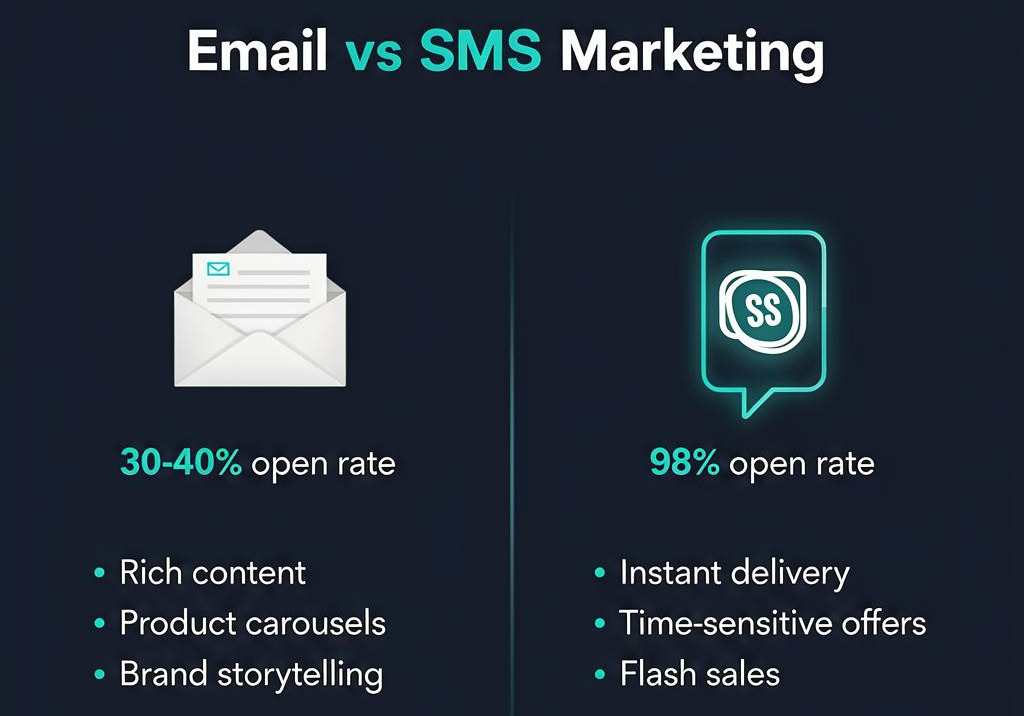
Email and SMS marketing work best together. While email allows for rich, detailed content like product carousels, brand storytelling, and personalised recommendations, SMS is short, immediate, and commands near-instant attention. SMS messages have an open rate of around 98%, compared to 30–40% for email — making it ideal for time-sensitive communications.
The most effective ecommerce marketing systems use both channels in a complementary way: • Send an abandoned cart email at the 1-hour mark with product details and a soft reminder • Follow up with an SMS at the 24-hour mark with a short, urgent message and a direct link to their cart • Use email for post-purchase education and upsells (content-rich) • Use SMS for flash sales, restock alerts, and delivery confirmations (time-sensitive)
Our email and SMS marketing automation system at Elinix AI is built specifically to leverage this multi-channel approach. Clients typically see 30–50% more revenue from their email and SMS channels combined compared to running email alone.
Klaviyo Email Marketing: The Platform Built for Ecommerce
If you run a Shopify or WooCommerce store, there is one platform that stands above the rest for email and SMS marketing: Klaviyo. Klaviyo is not a generic email tool. It was designed specifically for ecommerce, with native integrations to Shopify, WooCommerce, BigCommerce, and more. This means it can pull in real-time customer data — purchase history, browsing behaviour, cart activity, predicted next order date — and use it to power highly personalised automations at scale.
Here is what makes Klaviyo email marketing uniquely powerful for ecommerce brands:
Behaviour-Based Triggers Every flow in Klaviyo is triggered by what your customer actually does — not just a timer. Viewed a product? Trigger a browse abandonment flow. Added something to cart then left? Trigger the abandoned cart sequence. Made a purchase? Start the post-purchase nurture. This means every email is contextually relevant, which dramatically improves open rates, click rates, and conversions.
Advanced Segmentation Klaviyo lets you segment your audience based on purchase frequency, average order value, last purchase date, product categories bought, predicted lifetime value, and more. Rather than blasting your entire list with the same message, you can send the right email to the right person at exactly the right time.
Revenue Reporting Unlike most email platforms that report on vanity metrics like open rates and clicks, Klaviyo shows you exactly how much revenue each flow and campaign generates. You can see precisely which emails are driving sales, which ones need optimising, and where your list is converting best.
Unified Email and SMS Klaviyo handles both email and SMS within the same platform, giving you a complete view of every touchpoint a customer receives. This is critical for managing send frequency, avoiding over-communication, and ensuring a seamless customer experience across channels. For more on how this works, see Klaviyo's email marketing best practices.
Key Email Marketing Metrics Every Ecommerce Brand Should Track
Understanding your email performance means knowing which numbers to watch. Here are the metrics that matter most: • Open Rate: The percentage of recipients who open your email. Industry average sits around 26–36%, depending on your list health and subject line quality. • Click-Through Rate (CTR): The percentage who click a link inside the email. Average CTR across ecommerce is around 1.4–2.6%. • Revenue Per Recipient (RPR): The most important metric for ecommerce — how much revenue, on average, each email generates. Automated flows significantly outperform campaigns here. • Conversion Rate: The percentage of email recipients who complete a purchase. Automated flows average 2–3% conversion rates, with top performers exceeding 10%. • Unsubscribe Rate: A healthy list sees under 0.5% unsubscribes per send. High unsubscribe rates signal poor segmentation or irrelevant content. • Deliverability: Whether your emails actually reach the inbox. Proper domain authentication (DKIM, SPF, DMARC) and list hygiene are essential for maintaining strong deliverability.
Our team at Elinix AI monitors all of these metrics as part of our ongoing email marketing retainer service, with monthly reporting and continuous A/B testing to improve performance over time.
Common Email Marketing Mistakes Ecommerce Brands Make
After working with 100+ Australian ecommerce brands, we have seen the same mistakes crop up repeatedly.
Here is what to avoid:
No Automations in Place The biggest mistake is relying entirely on manually sent campaigns. Without automated flows running in the background, you are missing the most profitable part of email marketing. Welcome flows, abandoned cart sequences, and win-back campaigns should be live before you send a single campaign.
Sending to Your Entire List Every Time Blasting every subscriber with every email kills your deliverability and alienates customers. Segmentation is what separates average email marketing from exceptional results. Personalised emails achieve open rates of 29% and click-through rates of 41%, compared to far lower averages for unsegmented sends.
Ignoring Mobile Optimisation More than 56% of all emails are opened on mobile devices. If your emails are not optimised for small screens — with single-column layouts, large buttons, and short subject lines — you are losing conversions before the customer even reads your message.
No Clear Strategy for Growing the List Your email list is only as valuable as its size and quality. Without a consistent strategy for capturing new subscribers — through pop-ups, lead magnets, post-purchase sign-ups, and landing pages — your list will stagnate and your email channel will plateau.
How to Get Started with Email Marketing for Your Ecommerce Brand
If you are starting from scratch or looking to upgrade your current email marketing setup, here is the practical path forward: • Step 1 — Choose the right platform. For ecommerce brands on Shopify or WooCommerce, Klaviyo is the clear choice. • Step 2 — Set up your technical foundations. Domain authentication (DKIM, SPF, DMARC) and list segmentation architecture come first. Skipping this step destroys deliverability. • Step 3 — Build your core flows. Welcome series, abandoned cart, browse abandonment, post-purchase, and win-back sequences should be your first priorities. • Step 4 — Start sending campaigns. Aim for at least 8–12 campaigns per month to keep your list warm and your brand top of mind. • Step 5 — Add SMS. Once your email system is running, layer in SMS for time-sensitive communications to unlock even higher open and conversion rates. • Step 6 — Test and optimise continuously. A/B test subject lines, send times, email designs, and CTAs. The best email programs are never 'done' — they improve month on month.
Not sure where to start? Our team at Elinix AI offers a done-for-you email marketing setup that installs a complete Klaviyo system — 8 automated flows, 36 emails — inside your account in just 21 days. We handle strategy, design, copywriting, technical setup, and ongoing optimisation so you can focus on running your business.
What Results Can You Expect from Email Marketing?
The results brands see from well-built email and SMS marketing systems are consistently strong. Based on industry benchmarks and our own client results, here is what to expect once a complete email automation system is running: • 20–40% increase in total store revenue attributable to email • 10–20% cart recovery rate from abandoned cart flows • 35–55% of total store revenue generated through email and SMS combined • 30–50% increase in repeat purchase rate through lifecycle nurture flows • Average email marketing ROI of $36–$45 per dollar invested (Litmus, Statista)
One of our clients in the health and beauty category went from generating 12% of revenue from email to 38% within 60 days of launching The Revenue Engine™ — our complete email automation system. Another client recovered $18,000 in the first month through the abandoned cart flow alone. Final Thoughts: Email Marketing Is Your Brand's Most Reliable Revenue Channel Email marketing is not a trend — it is a foundational growth channel that has consistently outperformed every other form of digital marketing on ROI for decades. In 2026 and beyond, its power only grows stronger as paid advertising costs rise and social media reach becomes increasingly unreliable. For ecommerce brands on Shopify or WooCommerce, the combination of Klaviyo email marketing, strategic automation flows, and SMS marketing represents the highest-leverage investment you can make in your marketing stack. Get it right, and email becomes the engine that drives consistent, predictable, and scalable revenue — even while you sleep.
If you are ready to stopleaving money in your cart abandonment rates and start turning your email list into a reliable revenue machine, book a free strategy session with Elinix AI today. We will audit your current email setup, identify where revenue is being lost, and give you a clear roadmap to fix it.
About Elinix AI Elinix AI is an Australian ecommerce growth agency specialising in high-converting website design, email and SMS marketing automation, and influencer marketing. With 16+ years of experience and $50M+ in revenue generated for clients, we help ecommerce brands on Shopify and WordPress scale sustainably. Learn more at elinix.ai