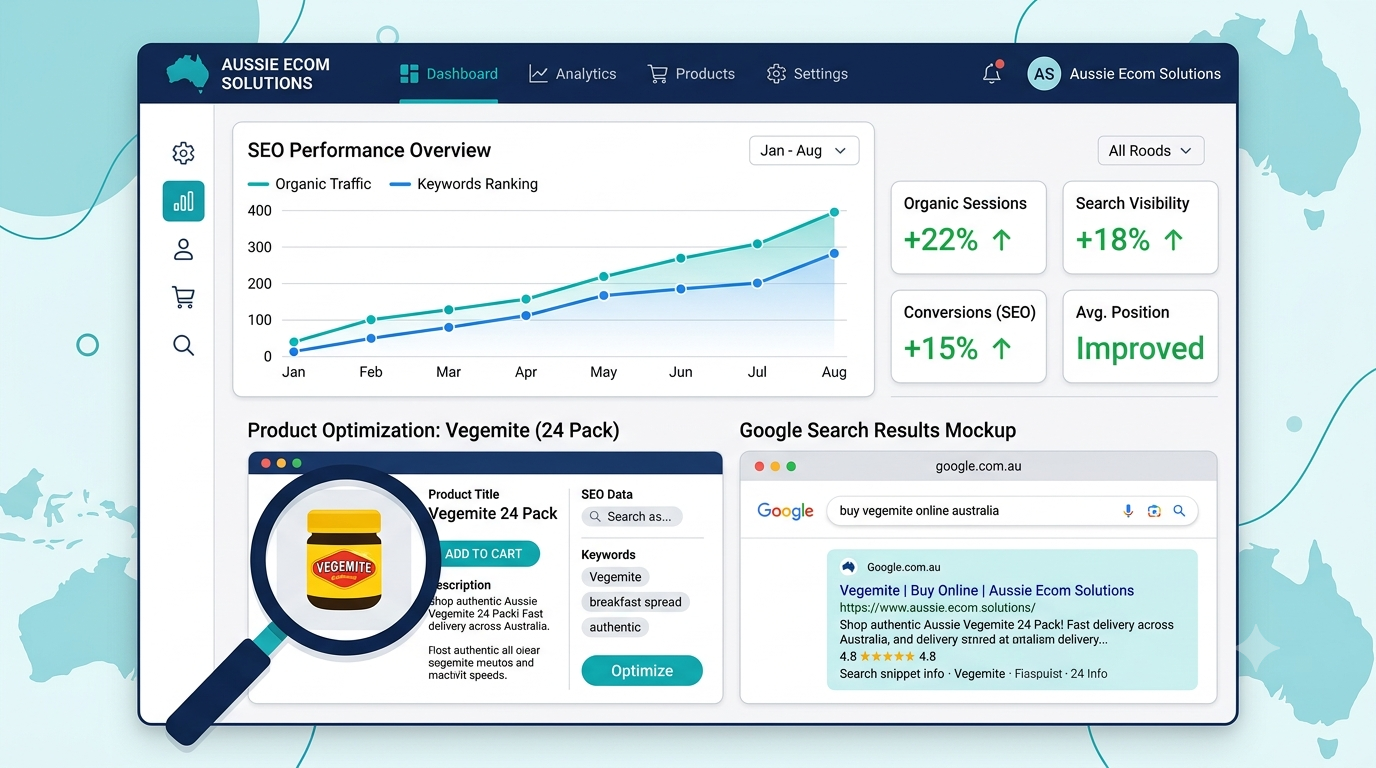
Ecommerce SEO, AEO and GEO are three connected practices for making an online store visible everywhere buyers now search. Ecommerce SEO optimises a store's technical foundation, product and category pages, and content so it ranks in Google. Answer Engine Optimisation (AEO) structures that same content so AI answer engines, Google AI Overviews, AI Mode, Bing Copilot, can extract a clean, standalone answer from it. Generative Engine Optimisation (GEO) is the layer that makes a brand more likely to be cited by name inside conversational AI tools such as ChatGPT, Perplexity, Gemini and Claude when a shopper asks a product question directly. Treating these as three separate projects is the most common mistake Australian ecommerce brands make in 2026, an under-optimised product page loses a Google ranking and an AI citation at the same time, because both systems increasingly read the same technical and content signals. This guide covers what's changed in how stores get found, the technical and on-page fundamentals that power both rankings and citations, how to build topical authority, and a practical roadmap for Australian Shopify and WooCommerce brands.
What Is Ecommerce SEO, AEO and GEO and How Do They Differ?
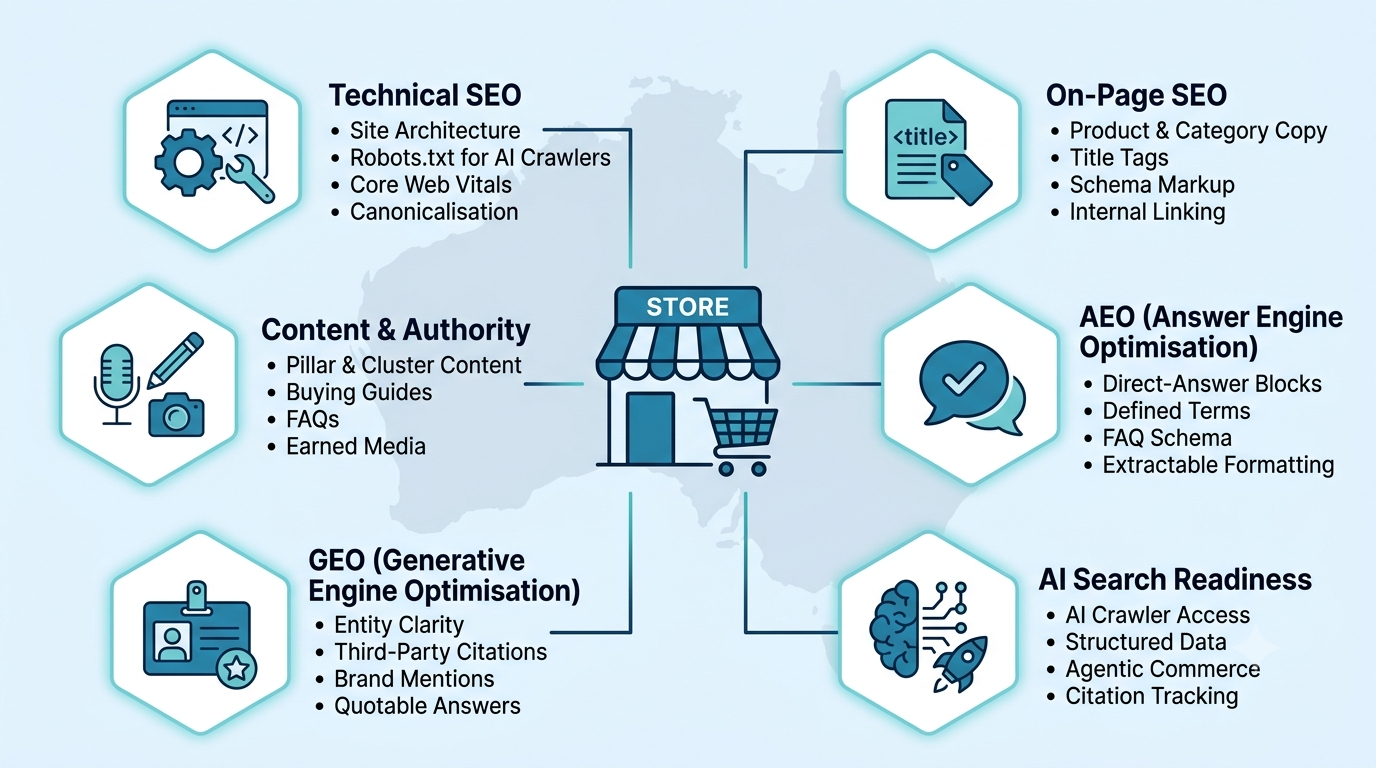
Ecommerce SEO ranks a store's pages on Google through technical health, on-page content and authoritative links. AEO structures that content into extractable direct answers for AI Overviews and AI assistants. GEO increases the odds a brand gets cited or recommended inside generative AI conversations. All three now depend on the same underlying signals, which is why they are best run as one connected programme rather than three separate ones.
Ecommerce SEO: The practice of optimising a store's technical structure, product and category pages, and content so buyer-intent searches on Google send qualified traffic to the store. It covers crawlability, page speed, on-page copy, schema markup, internal linking and authority building.
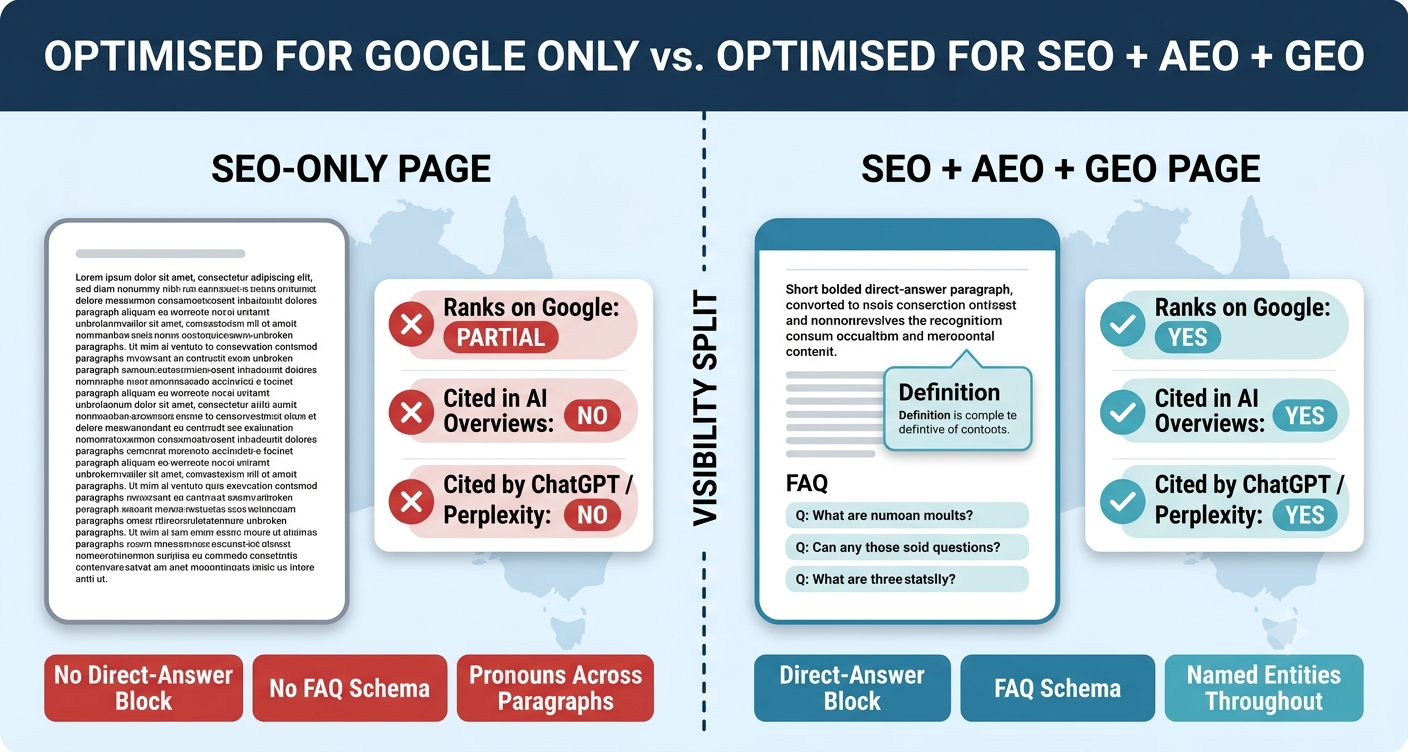
Answer Engine Optimisation (AEO): The practice of structuring content so AI systems can extract a clear, self-contained answer, direct-answer paragraphs, defined terms, FAQ blocks and structured data, rather than requiring the reader to piece an answer together from scattered prose.
Generative Engine Optimisation (GEO): The practice of increasing a brand's odds of being mentioned, cited or recommended inside generative AI answers, through entity clarity, credible third-party citations and content that AI models can confidently attribute to a named, trustworthy source.
| Discipline | What It Optimises | Primary Goal | Where It Shows Up |
|---|---|---|---|
| Ecommerce SEO | Technical foundation, product and category pages, on-page content, internal links and authority | Rank store pages for buyer-intent searches and drive qualified traffic | Google organic results, image and shopping listings, Bing organic results |
| Answer Engine Optimisation (AEO) | Content structure, direct-answer paragraphs, defined terms, FAQ blocks and structured data | Be extracted as the clean, self-contained answer to a question | Google AI Overviews and AI Mode, Bing Copilot, featured snippets, voice assistants |
| Generative Engine Optimisation (GEO) | Entity clarity, brand consistency, third-party mentions, reviews and citable sources | Be mentioned, cited or recommended by name inside AI-generated answers | ChatGPT, Perplexity, Gemini, Claude and other conversational AI tools |
Ecommerce SEO carries added complexity that most websites don't have: a store might run hundreds or thousands of product pages, seasonal collections that come and go, colour and size variants that create near-duplicate URLs, and faceted navigation that can generate huge numbers of low-value URL combinations if left unmanaged. This complexity affects AI citation just as much as it affects Google rankings, a faceted navigation system that confuses Googlebot with duplicate URLs will confuse GPTBot and ClaudeBot in exactly the same way. Most ecommerce search queries also carry transactional intent, meaning the page needs to satisfy a buyer, not just an informational reader, whether that buyer arrives via a blue link or an AI-generated answer.
How Google and AI Answer Engines Rank and Cite Ecommerce Content in 2026
Google's ranking systems and the AI answer engines built on top of them now evaluate ecommerce content against four connected factors: helpful content, E-E-A-T, page experience, and structural clarity for AI extraction. A store that satisfies all four is positioned to both rank in traditional results and get cited when a shopper researches the same query through an AI tool.
Helpful, people-first content: Google's helpful content guidance rewards pages written for shoppers, not search engines, genuinely useful category descriptions, buying guides and product information rather than thin, templated text copied from a manufacturer feed.
E-E-A-T (Experience, Expertise, Authoritativeness, Trustworthiness): for ecommerce, this shows up as real product photography, genuine customer reviews, clear business information, secure checkout and transparent policies.
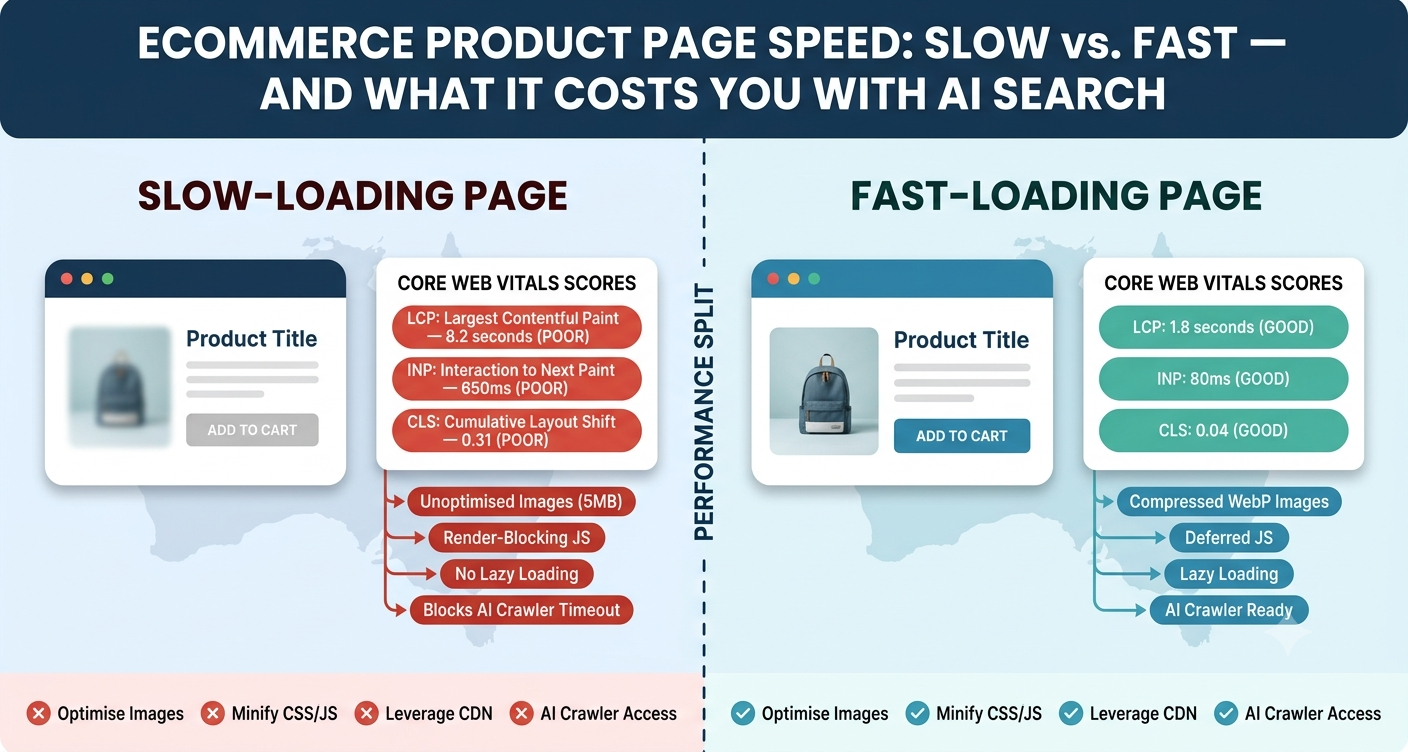
Core Web Vitals and page experience: Google uses loading speed, interactivity and visual stability as ranking inputs, and slow product pages measurably lose both rankings and sales.
Structural clarity for AI extraction: whether content is organised clearly enough to be lifted directly into Google AI Overviews and used by AI assistants like ChatGPT, Gemini and Perplexity when people research purchases conversationally.
AI Overview presence has grown quickly across most search categories but not evenly. Google's AI Overviews now appear on close to half of all tracked search queries as AI Overviews approach their two-year mark, yet ecommerce is one of the few verticals where that presence has grown more slowly than categories like healthcare, education and B2B technology over the same period (BrightEdge, 2026). That's a genuine opportunity rather than a warning sign: ecommerce brands that structure content for AI extraction now are moving into a category where AI Overview coverage is still expanding, not one that's already saturated.
Technical SEO Foundations That Also Control AI Crawler Access
A clean technical foundation is the base layer for both search rankings and AI citation, because the crawlers behind AI Overviews, ChatGPT and Perplexity read the same site architecture as Googlebot.
Crawlability and indexation: a clear robots.txt, an accurate XML sitemap, and control over which filtered or faceted URLs are indexed, so crawl budget isn't wasted on near-duplicate pages.
AI crawler access: explicit allow or disallow rules in robots.txt for AI crawlers — Google-Extended, GPTBot, ClaudeBot and PerplexityBot, since blocking them by default removes a store from GEO consideration entirely, while leaving them fully open with no content strategy invites low-quality scraping without citation.
Site architecture: a logical structure (Home > Category > Subcategory > Product) that keeps every page within a few clicks of the homepage.
Page speed and Core Web Vitals: compressed images, minimal render-blocking scripts, and a theme or app stack that doesn't bloat load times.
Canonicalisation: correct canonical tags on colour and size variants and filtered views, so the store isn't competing with itself in search results or splitting AI citation signals across duplicate URLs.
Mobile-first design and HTTPS: non-negotiable baseline requirements for any store in 2026.
On-Page Optimisation for Category and Product Pages: Written for Shoppers, Structured for AI
This is where most Australian stores lose the most opportunity, because on-page content built for Google alone leaves easy AEO gains on the table. Category pages need a unique, genuinely useful block of copy above or below the product grid, opening with a direct 40 to 60-word answer to what the category is and how to choose within it, not a meta description stretched into a paragraph. That opening block is what an AI Overview or AI assistant lifts directly when a shopper asks a comparable question. Product pages need descriptive, benefit-led copy rather than manufacturer-supplied text duplicated across dozens of competing stores.
Title tags and meta descriptions should be templated for efficiency at scale but customised for the highest-value pages. Product schema markup, Product, Offer, AggregateRating, should be implemented so listings are eligible for price, availability and review star rich results, and so AI systems can extract price and availability with confidence rather than guessing from unstructured text. Every product and category page should link to related products, categories and relevant guide content; internal linking remains one of the most underused levers in ecommerce SEO, and it also gives AI crawlers a clear path to the store's most authoritative pages.
Content Strategy: Building Topical Authority for Search and AI Citation
Individual blog posts rarely move the needle on their own. What works is a pillar-and-cluster model: a comprehensive pillar guide, like this one, that links out to focused supporting content, while those supporting posts link back to the pillar. This signals topical depth to Google, keeps readers moving through the site, and lets a store rank for a much wider set of keywords than any single page could capture alone.
The same structure compounds for GEO. AI models weigh third-party, independently published sources far more heavily than brand-owned content when deciding what to cite: earned media, journalism, academic research, government data and independent commentary, accounts for 84% of all AI citations across ChatGPT, Claude and Gemini, while paid and advertorial content accounts for just 0.3% (Muck Rack, 2026). In practice, that means a brand's own blog content builds the topical foundation and internal linking structure, but genuine PR coverage, founder commentary in trade publications, and third-party reviews are what actually tip the scales toward being the brand an AI system names. Buying guides, comparison posts and practical how-tos tend to perform best in both channels because they match genuine buyer research behaviour.
Schema Markup and Structured Data: The Shared Language of SEO, AEO and GEO
Structured data is how a store explicitly tells Google, AI Overviews and generative AI systems what's on a page, rather than leaving them to infer it from unstructured copy. For ecommerce, the most valuable schema types are Product and Offer (price, availability, condition), AggregateRating and Review (star ratings in search results), BreadcrumbList (clear site hierarchy), FAQPage (common questions, which also improves AI citation), and Organization (business details, logo, social profiles). Person schema linking to the author's credentials adds a further entity signal that AI models use to assess trustworthiness.
Correctly implemented markup materially increases both rich-result eligibility on Google and the odds of being cited in AI-generated answers, because it removes the ambiguity that otherwise forces an AI system to either guess at a fact or skip the source altogether.
Answer Engine Optimisation (AEO): Structuring Content So AI Can Extract It
AEO is not a separate content strategy from good ecommerce copywriting, it's a formatting discipline layered on top of it. The goal is to make every section of a page readable and useful in isolation, because that's exactly how an AI Overview or assistant uses it: as an extracted fragment, not as part of a continuous narrative.
Three formatting habits do most of the work:
Answer the question in the first sentence, every time: A shopper asking "how much does express shipping cost" doesn't want three sentences of context before the number appears.
Define terms where they're used, not in a glossary: A short, standalone definition block reads naturally to a human and lifts cleanly into an AI answer.
Name the subject explicitly on every reference: Avoid pronouns carrying meaning across paragraphs — AI extraction works on isolated chunks, and "it" loses its referent the moment a paragraph is lifted out of context.
FAQ sections built around the actual questions shoppers type into Google and ask ChatGPT — not invented questions chosen for keyword density, are one of the highest-leverage AEO tools available, because they match the conversational, question-based way people now research purchases.
Generative Engine Optimisation (GEO): Getting Cited by ChatGPT, Perplexity and Gemini
GEO asks a different question from traditional SEO: not "does this page rank," but "would an AI model trust this source enough to name it." Three things drive that trust.
Entity clarity: A brand needs a consistent, unambiguous identity across the web, the same business name, the same author credentials, the same factual details about location, founding and specialisation, so AI models can confirm who is speaking rather than guessing.
Credible third-party citations: Because earned media so heavily outweighs brand-owned content in what AI systems actually cite (Muck Rack, 2026), a genuine GEO strategy includes seeking coverage in trade publications, contributing expert commentary, and earning customer reviews on independent platforms, not just publishing more on-site content.
Direct, quotable answers: Content written in clear, standalone statements is easier for a generative model to paraphrase accurately and attribute correctly, which lowers the risk of an AI system skipping a source because its position is unclear or overqualified.
Search behaviour is changing fast enough that Australian retailers are being told directly to prepare: 85% of Australian businesses are already taking steps to prepare for an agentic commerce future, in which AI agents research, compare and in some cases purchase on a shopper's behalf, and industry forecasts estimate agentic AI could influence up to 30% of digital commerce transactions by 2030 (Australia Post eCommerce Report 2026; Deloitte Digital, 2025). The stores that win in AI search are the ones already doing traditional SEO well, plus adding this extra layer of clarity and citability for both AI Overviews and agentic AI systems.
Ecommerce SEO, AEO and GEO Considerations Specific to Australian Businesses
A few things are specific to selling online in Australia, and they affect all three disciplines at once. Displayed prices should clearly include GST where required, handled consistently across product and checkout pages rather than only appearing at the cart stage — inconsistent pricing is exactly the kind of ambiguity that makes an AI system hesitant to cite a price with confidence. Shipping expectations shaped by Australia Post delivery timeframes should be stated clearly on product pages, since shipping uncertainty is a well-documented cause of cart abandonment. Seasonal search demand spikes around EOFY sales, Black Friday and Boxing Day are predictable and worth planning content and technical capacity around in advance. Where relevant, referencing Australian Consumer Law obligations around refunds and guarantees on policy pages builds genuine trust with local shoppers, which feeds directly into E-E-A-T.
The scale of the opportunity is real. Australians spent a record $82.6 billion online in 2025, up 14% year-on-year, with online purchases now making up 24% of total retail spend and 9.8 million Australian households, 82% of all households, shopping online during the year (Australia Post eCommerce Report 2026). Search and AI-assisted discovery sit right at the front of that spending, which is exactly why visibility across both channels compounds rather than competes.
Measuring Success Across SEO, AEO and GEO
The metrics that matter go beyond rankings, and they now split across two connected tracking systems. Traditional SEO metrics, organic sessions and organic revenue tracked in GA4, revenue per organic session, the number of indexed and ranking pages, Core Web Vitals pass rate across templates, and branded versus non-branded search growth — remain the backbone of measurement. Google Search Console and GA4 together give the full picture: Search Console for visibility and technical health, GA4 for what that visibility actually converts into.
AI visibility needs a second layer of measurement: how often a brand is mentioned or cited across AI Overviews, ChatGPT, Perplexity and Gemini for relevant category queries, whether those mentions are accurate, and whether referral traffic from AI platforms is showing up in GA4's channel reports as a distinct, growing source. Brands that only watch Search Console rankings are already missing half the picture in 2026.
Common Mistakes That Block Both Search Rankings and AI Citation
The same handful of mistakes show up across almost every Australian ecommerce audit: thin or duplicated category page content, uncontrolled faceted navigation creating large numbers of near-duplicate indexable URLs, ignoring page speed on product pages with heavy imagery, publishing content with no internal linking strategy connecting it back to commercial pages, blocking AI crawlers by accident through an outdated robots.txt file, and treating content as a one-off task rather than an ongoing pillar-and-cluster programme. Each of these costs a store twice over in 2026, once in Google rankings, and again in AI Overview and generative AI citations that depend on the same clean technical and content signals.
Your Ecommerce SEO, AEO and GEO Implementation Roadmap
Weeks 1–2: Technical audit covering crawlability, indexation, Core Web Vitals, canonicalisation and AI crawler access in robots.txt.
Weeks 3–4: On-page fixes including title tags, meta descriptions, category page direct-answer blocks and schema markup (Product, Offer, AggregateRating, FAQPage, Person).
Weeks 5–8: Content foundation, this pillar guide plus the first cluster of supporting posts, each opening with a direct-answer block.
Weeks 9–12: Internal linking pass, AEO readiness (FAQ sections, structured data, quick-answer formatting), early GEO groundwork (entity consistency checks, outreach for third-party coverage), and measurement setup across GA4, Search Console and AI mention tracking.
Ongoing: Monthly content additions, quarterly technical health checks, continuous internal linking as new pages publish, and regular checks on how the brand is being represented in AI-generated answers.
DIY vs Working With an Ecommerce SEO, AEO and GEO Agency
Store owners generally have two realistic paths. DIY works if there's the technical skill and time to handle crawl management, schema implementation, ongoing content production and AI visibility monitoring, expect a genuine, sustained time investment, not a weekend project, particularly now that AEO and GEO add a second measurement and outreach workload on top of traditional SEO. A done-for-you ecommerce SEO, AEO and GEO agency makes sense for brands that would rather have an experienced team handle the technical, content and AI search layers correctly the first time, with strategy tailored to a specific platform, category and growth stage. At Elinix AI, this is exactly what our ecommerce SEO and AI search service does: technical fixes, on-page optimisation, content strategy, schema implementation and AI search readiness, built specifically for Australian Shopify and WooCommerce stores.
Frequently Asked Questions
What is ecommerce SEO, AEO and GEO?
Ecommerce SEO is the process of improving an online store's visibility in Google through technical optimisation, content and structured data. AEO structures that content so AI answer engines can extract a clear answer from it. GEO increases the odds a brand is cited or recommended inside generative AI tools like ChatGPT and Perplexity. Together they cover how a store gets found across search and AI.
How is ecommerce SEO different from regular SEO?
It applies the same fundamentals at a much larger scale, with added complexity from product variants, faceted navigation, seasonal collections, and mostly transactional search intent across potentially thousands of pages.
Is GEO replacing traditional SEO?
No. AI Overviews and generative AI tools are largely built on the same crawling, indexing and ranking infrastructure as traditional search, and AI Overview presence in ecommerce is still growing rather than having replaced blue-link results. GEO is an additional layer on top of solid SEO, not a substitute for it.
Can Australian ecommerce brands realistically get cited by ChatGPT or Perplexity?
Yes, though earned, third-party coverage matters more than on-site content alone, 84% of AI citations across ChatGPT, Claude and Gemini come from earned media rather than brand-owned pages (Muck Rack, 2026), so genuine PR and independent reviews are part of a realistic GEO strategy.
How long does ecommerce SEO, AEO and GEO take to show results?
Technical fixes can show impact within weeks, but meaningful organic revenue growth from content and authority building typically takes three to six months and compounds from there. AI citation tends to follow shortly after a page earns consistent traditional rankings, since both draw on the same underlying signals.
Do I need SEO and AI search optimisation if I already run paid ads?
Yes. Paid ads stop the moment spending stops, while SEO and AI search visibility build a compounding, owned discovery channel that reduces overall dependence on rising ad costs, across both Google and AI platforms.
What's the most important ranking factor for ecommerce sites in 2026?
There's no single factor. Google and AI answer engines evaluate technical health, content quality, E-E-A-T signals and page experience together, and increasingly whether content is structured clearly enough to be extracted and cited in AI-generated answers.
Ready to Grow Your Ecommerce Store's Visibility Across Google and AI Search?
Ecommerce SEO, AEO and GEO aren't three separate projects, they're one connected visibility programme built on the same technical foundation, and it compounds the longer a store invests in it. Get the technical foundation right, build genuine topical authority with content, and structure that content for AI extraction and citation, and organic and AI-assisted discovery become the most reliable, cost-effective growth channels available to an ecommerce business.
If you're ready to find out exactly where your store is losing visibility across Google and AI search, book a free SEO and AI search audit with Elinix AI.
Learn more about our services:
Ewen Ling is the Founder of Elinix AI and has over 16 years of ecommerce industry experience across website conversion optimisation, email and SMS marketing automation, retention marketing, and ecommerce growth strategy. Elinix AI helps Australian ecommerce brands fix revenue leaks, improve conversion, and build sustainable customer retention systems.