Choose an AI SEO agency in Australia on evidence, not on the engines it name-drops. Ask for a live visibility test on your own buyer queries, a written method, a price, and a date to judge it by. Google says plainly that "No one can guarantee a #1 ranking on Google" (Google Search Central, June 2026), so a guaranteed result is your cue to walk.
The category is new enough that much of what is sold as AI SEO is last year's SEO with a new label on the invoice. This guide gives you the five questions that separate the two and the warning signs worth ending a call over. It also covers what the work costs here, how long it takes, and who should not buy it yet.
Key facts
- Google states there are no additional requirements and no special markup needed to appear in AI Overviews or AI Mode (Google Search Central, December 2025)
- "No one can guarantee a #1 ranking on Google" (Google Search Central, June 2026)
- In the US in March 2025, people who saw an AI summary clicked a search result on 8% of visits, against 15% who did not (Pew Research Center, 2025)
- 61.7% of AI citations never name the brand anywhere in the answer (Semrush, June 2026)
- Only 6 to 27% of the most mentioned brands in AI answers also rank as top sources (Semrush, September 2025)
- Australians spent $82.6 billion online in 2025, up 14% year on year (Australia Post eCommerce Report 2026)
What should an AI SEO agency actually do?
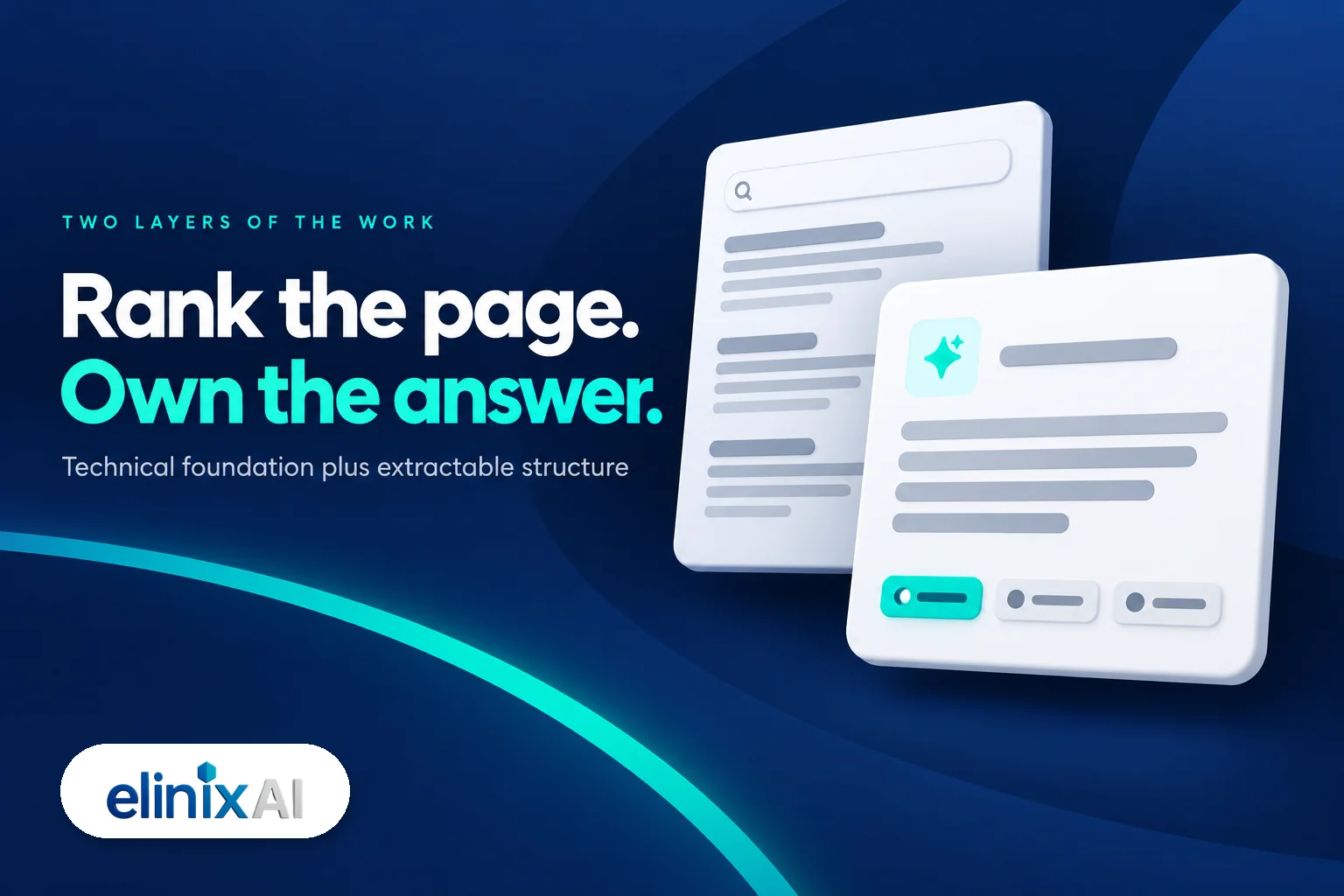
An AI SEO agency should do two jobs at once: make your store rank in Google, and make it easy for an answer engine to quote. The second job is the new one. It runs on structure, sourcing and entity clarity, not on a hidden setting inside ChatGPT.
Start with what Google says, because it removes a lot of sales noise. Its documentation states that "There are no additional requirements to appear in AI Overviews or AI Mode, nor other special optimizations necessary" (Google Search Central, December 2025). The same page says you do not need new machine-readable files, AI text files or special schema.org structured data. For Google's AI surfaces, the lever is not a secret file. It is the same quality bar, applied harder.
What is different is how the answer gets assembled. Engines lift a sentence, a statistic or a table out of a page and drop it into a response, which rewards a particular shape of page. The 2024 Princeton study on generative engine optimisation found these methods "can boost visibility by up to 40% in generative engine responses" (Aggarwal et al., KDD 2024). Inline citations, specific statistics and short attributed quotes did most of that work.
A real programme covers both layers. Ask to see both on the proposal:
- Technical foundation: crawlability, indexation, server-rendered content, speed, internal linking, redirect mapping
- Structured data: Product, FAQ, Article, Organization and LocalBusiness, implemented and validated
- Answer-first structure: a direct, extractable answer near the top of every page that matters
- Citable facts: claims carried by specific, dated, named-source numbers rather than adjectives
- Entity consistency: the same name, address, service list and claims across your site, Google Business Profile, socials and third-party listings
- Question coverage: the queries buyers type into an assistant, not only the keywords with volume
- Third-party presence: reviews, listings and mentions on sites the engines already trust
If an agency only talks about the last three, it has a content plan rather than a programme. If it only talks about the first two, it is doing traditional SEO under a new name.
What questions should you ask before you sign?
Five questions will tell you more than an hour of pitch. Each has an answer a real practitioner gives easily, and a weak one that should end the call.
1. Will you run a live visibility test on my buyer queries, on this call? A real practitioner opens ChatGPT, Perplexity, Claude and Gemini and asks the questions your customers ask, in front of you. A weak answer defers to a dashboard nobody can see. Run the test yourself first: we published the exact prompts, and it takes five minutes.
2. How do you count a win? This is the one that separates the field. Being cited and being named are different outcomes. Semrush analysed 3,981 domain appearances across 115 prompts and found 61.7% were "ghost citations": the page was used as a source link, but the brand never appeared in the answer (Semrush, June 2026). A good agency reports mention rate and citation rate separately, per engine, against a named set of buyer queries. A weak one shows a Google rank report and calls it AI visibility.
3. What does your Google rank report prove about AI? Less than you would hope. Semrush found that "Only 6-27% of the most mentioned brands also rank as top sources" (Semrush, September 2025). Ranking and being quoted are related, not the same. An agency that measures only one is reporting on half the job.
4. Can I see an audit you have run? Ask for a redacted one from a real client. You want named checks with pass or fail results, not a slide of logos. Our 12-point AI visibility audit is published in full, so you can hold any proposal against it line by line.
5. What happens if this does not work? The honest answer names a review point, a set of numbers, and an exit. Retainers with 30 days notice are normal here. A 12-month lock-in on a channel nobody can guarantee is a risk transfer onto you.
Free audit: bring those five questions to a free 15-minute AI visibility audit and we will answer them on your own store, on a call.
What are the warning signs of a bad AI SEO agency?
Four warning signs matter more than the rest, and three of them come from Google's own guidance on hiring an SEO. Any one of them is reason enough to stop.
A guaranteed result. Google's documentation is direct. No one can guarantee a #1 ranking, and be wary of anyone claiming guaranteed rankings or a special relationship with Google (Google Search Central, June 2026). In Australia there is a second layer. The ACCC states that "Claims should be true, accurate and based on reasonable grounds". A claim about a future matter needs those grounds at the time it is made, and the business carries the burden of showing them. A promise that ChatGPT will name you by March is a claim about a future matter. Ask what the grounds are, in writing.
A secret AI lever. If the pitch involves a proprietary file, a special AI schema, or a setting that gets you into AI Overviews, hold it against Google's documentation above. Google says no such markup exists. An llms.txt file may still be worth publishing for other engines, but it is housekeeping, not a ranking lever, and nobody should charge a retainer for it.
Secrecy about method. Google advises caution with any company that will not clearly explain what it intends to do, and warns against link schemes and bulk submissions to thousands of search engines. The modern version is a citation-building service that will not name where the citations come from. If they will not show you the sites, assume you would not want your brand on them.
A diagnosis nobody earned. Google says to be wary of SEO firms that email you out of the blue. Read that as a reason to check, not as proof that outbound is disqualifying. We send outreach ourselves. The test is whether the sender did the work before hitting send. An email claiming your store is invisible in ChatGPT, naming no query and no engine, is a template that went to a thousand stores. One that quotes the exact question it tested and what came back spent ten minutes on you before asking for thirty. The same test applies to a price quoted before anyone has looked at your site. Scope cannot be known before the problems are.
How much does AI SEO cost in Australia?
Most Australian AI SEO programmes are priced as a one-off foundation month followed by a monthly retainer. At Elinix AI, that starts from A$1,500 for the foundation and technical fix month, then from A$950 per month, quoted after a free audit rather than from a rate card. Treat any number, ours included, as a starting point rather than a quote.
Getting a comparison is harder than it should be. We read the pages ranking for "AI SEO agency Australia" on 23 September 2026. None of the ones we read in full published a price, a timeline, or a statement of who should not buy. That is not a reason to distrust them. It is a reason to ask all three on the call.
Two things move the price more than anything else:
- Catalogue size. A 40-product store and a 900-product store are different jobs. Product and collection pages hold most of the extractable content, so the count drives the hours.
- Query count. The number of buyer questions you want to compete for sets the content volume. Ten questions is a quarter of work. A hundred is a year.
After those, the variables are category competitiveness and how much technical debt the site carries. A store that renders its content in JavaScript and has no structured data needs a foundation month that a clean Shopify build does not.
One warning about cheap. Australians spent $82.6 billion online in 2025 (Australia Post eCommerce Report 2026), so the competition for those buyers is real. A A$300 per month retainer buys a few hours, and a few hours will not move a channel that compounds over quarters.
Should you hire in-house, a freelancer or an agency?
The right answer depends on how much internal time you have, not on which option is best in the abstract.
| Option | Typical cost | Speed to start | Main risk |
|---|---|---|---|
| Do it in-house | Your time, plus tools | Slow, weeks to learn | Needs real technical skill, and stops the first busy month |
| Freelance SEO | Lowest cash cost | Fast | One person, no technical and content cover |
| Generalist digital agency | Mid to high | Medium | AI search is one line on a broad service list |
| AI search specialist | Mid to high | Medium | Newer category, fewer long case studies |
If you have a marketing manager with time, start in-house and buy help for the technical layer only. If nobody owns it internally, a specialist is usually cheaper than a generalist doing it slowly. We made the same comparison for email in our Klaviyo agency guide.
How long before AI engines start naming your brand?
Expect 3 to 6 months for meaningful movement, and longer in a competitive category. Anyone offering 30 days is describing something else. The lag is not the agency being slow. It is how long it takes for changed pages to be recrawled, re-indexed and pulled into live retrieval.
The normal shape: month 0 is the audit and a recorded baseline across your buyer queries on every engine, so there is something to measure against later. Month 1 is technical and structural work. Months 2 and 3 restructure commercial pages for extraction and publish content worth citing. From month 3 it compounds, because each citable page raises the odds on the next query.
Two honest caveats belong in any proposal, including ours.
First, AI visibility is a demand channel before it is a click channel. Pew Research Center tracked 900 United States adults across 68,879 Google searches in March 2025. People who saw an AI summary clicked a link inside it on just 1% of visits, and clicked any search result on 8% of visits against 15% without a summary (Pew Research Center, 2025). Being named still works, because the buyer arrives later and arrives convinced. An agency selling AI search on click volume alone has not read the data.
Second, ours is a newer programme than our email and website work, with no published multi-year client case study yet. What we have is a documented method and our own site as the test bed, plus a client result on ChatGPT traffic and our own citation rate tracked monthly. If an agency claims a long track record in a channel that only became measurable in the last two years, ask to see the dates.
Free audit: if you want the baseline before you hire anyone, the 12-point audit is free and yours to keep.
Who should not hire an AI SEO agency yet?
Three types of business should spend the money elsewhere first. We publish this on our own AI search service page because it costs us work and saves both sides a bad engagement.
You need revenue this month. This channel compounds over quarters. If cash is tight, email and SMS retention will return faster on the traffic you already have.
Your store converts poorly. Sending more qualified visitors to a leaky store makes the leak bigger. Fix checkout, mobile and product pages first, then send traffic into a store that holds it.
You are not willing to publish anything. Being cited requires something worth citing. If nobody internally will sign off on publishing specific numbers, methods or opinions, the content layer never happens and you are paying for the same technical audit on repeat.
A fourth case is about scale rather than readiness. Australia Post's 2026 report notes that 6 in 10 Australians use AI and expects it to influence up to 30% of ecommerce transactions by 2030. That is an expectation, not a result. If almost nobody in your category researches with an assistant today, do the cheap structural work now and revisit the retainer in six months.
Frequently Asked Questions
What is the difference between AI SEO, GEO and AEO?
SEO gets a page ranked in a list of links. Answer engine optimisation (AEO) structures that page so a direct answer can be lifted out of it. Generative engine optimisation (GEO) works on whether your brand gets named inside an AI answer at all, which depends on structure, sourcing and how often trusted sites mention you. Most Australian agencies use AI SEO as the umbrella term for all three. Ask one to define them and say which it actually does, because the answer tells you what you are buying.
Can any agency guarantee my brand will be cited by ChatGPT?
No, and you should treat the offer as a warning sign. Google states that no one can guarantee a #1 ranking on Google, and AI answers are less predictable than rankings, not more. Under Australian Consumer Law, a claim about a future matter needs reasonable grounds at the time it is made, and the business making it carries the burden of showing those grounds (ACCC). An agency that promises a citation date should be able to produce those grounds in writing.
Do I need an llms.txt file to appear in AI answers?
Not for Google's AI features. Google's documentation states you do not need to create new machine-readable files, AI text files or special structured data to appear in AI Overviews or AI Mode (Google Search Central, December 2025). Publishing an llms.txt file is cheap and harmless, and some other engines may use it, so it is reasonable housekeeping. It is not a ranking lever and no agency should be pricing it as one.
How do I know the agency's work is actually working?
Agree the measurement before you sign. A useful monthly report names the buyer queries tested, the engines tested, whether your brand was mentioned in the answer, and whether your page was cited as a source. Those last two are different numbers, and Semrush found 61.7% of citations never mention the brand at all (Semrush, June 2026). Add organic sessions and organic revenue from your own analytics, because visibility that never turns into orders is a report rather than a result.
Should I choose a Melbourne or Sydney agency, or does location not matter?
It does not matter where the agency sits. Every part of this job happens on your website and in your listings, and both are worked on remotely, so a Melbourne agency can rank a Sydney store for Sydney searches and the other way round. What changes for a business with local demand is the work, not the postcode: ranking in a place needs entity consistency across your Google Business Profile, local directories and your site, all of which are done from anywhere. So ask whether they have done local entity work and can show you it. Do not filter by which city they happen to be in.
How much should a small Australian store budget in the first year?
Plan for a one-off foundation month plus 9 to 12 months of retainer, because a 3-month trial ends just as the work starts landing. Ours starts from A$1,500 for the foundation month and from A$950 per month after that, quoted after a free audit. If that is beyond budget, do the audit anyway, fix the technical items yourself, and come back when the store can carry a retainer.
Is AI search worth it if my competitors are not doing it?
Usually yes, and the gap is the reason. Citations are won page by page, so an early page in an uncovered category is far cheaper to win than the same page in a crowded one. The test is whether your buyers ask assistants at all. Run it on your category before you spend anything.
Can I just do this myself?
Partly, and it takes more technical skill than most guides admit. Running the visibility test and writing answer-first content need nothing but time. Acting on what the test finds means working in your theme code, server-side rendering, structured data and redirect mapping, and a mistake in any of those can cost you rankings you already have. Do the audit and the content yourself. Hand the technical layer to someone who has done it before, unless you have a developer who has. The other thing that kills a do-it-yourself programme is ownership: the work dies the first busy month when it is nobody's named job.