Can a Shopify store get traffic from ChatGPT without a blog? Based on one of our AI SEO clients, yes. The store is small, Australian, and sells everyday consumables with an average order of $51.34. From 18 August to 14 September 2026, visits from AI tools rose from 23 to 98, and ChatGPT sent 95 of them. The store has published zero blog posts.
The rise came during a month when the store's Google Ads spend and ad revenue barely moved. Google organic visits rose 22.8%, organic orders rose 62%, and organic search revenue more than doubled over two months. For context, AI-referred traffic to US retail sites grew 138% year on year in May 2026, according to Adobe Analytics data reported by Digital Commerce 360.
This article shows the numbers, the four changes we made to the store's pages, and what one month of data can and cannot prove. The store is anonymised for confidentiality.
Key facts
- AI assistant visits to the store rose from 23 to 98 in 28 days, with ChatGPT sending 95 (Google Analytics 4, 18 Aug to 14 Sep 2026)
- Google organic orders rose from 37 to 60, up 62%, in the same 28 days (Google Analytics 4)
- Organic search revenue rose from $2,222 to $4,682 across two 28-day windows two months apart (Google Analytics 4 purchase revenue)
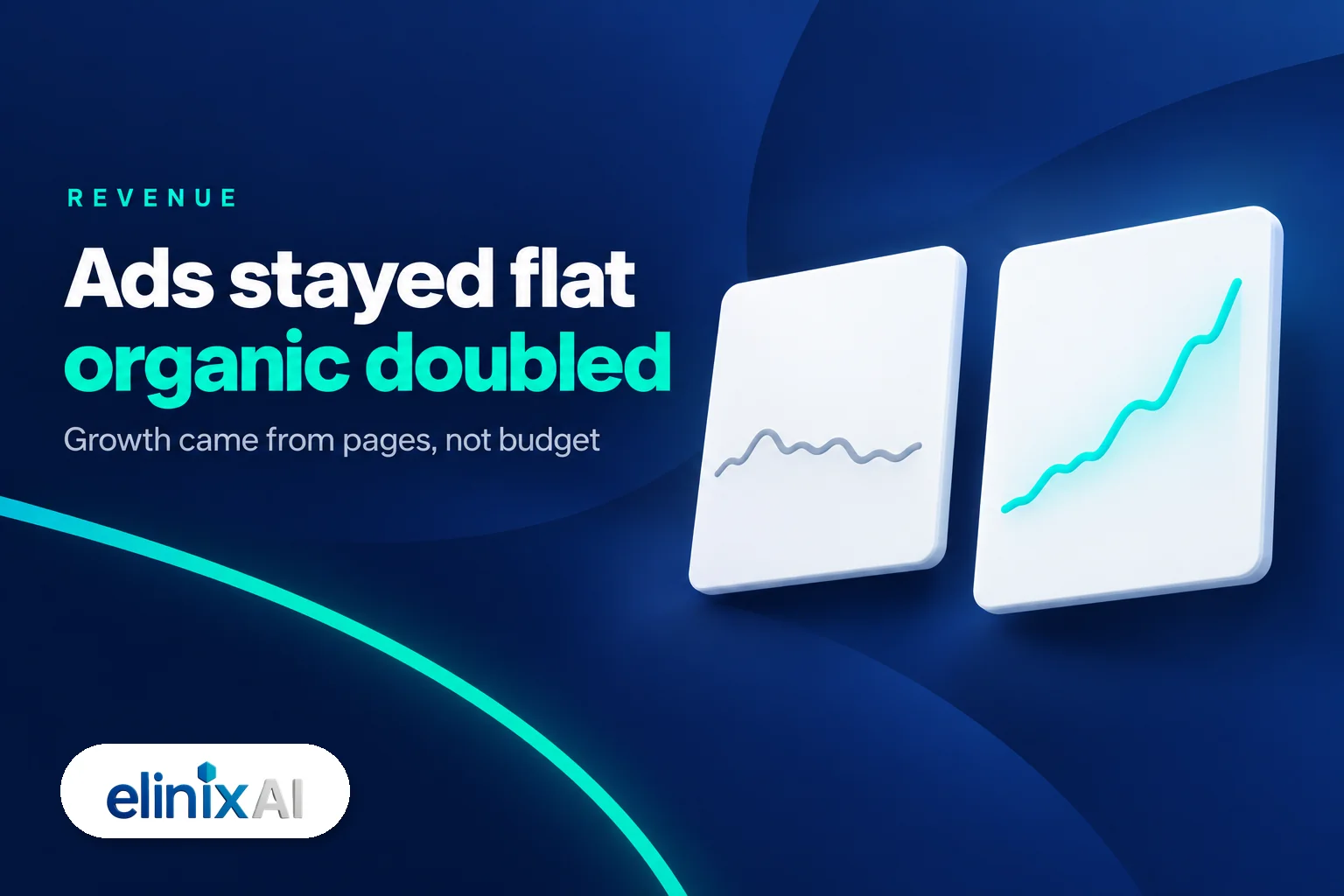
- Google Ads revenue stayed flat at $8,660, $8,573 and $8,542 across three 28-day windows (Google Analytics 4)
- AI-referred traffic to US retail sites grew 138% year on year in May 2026 (Adobe Analytics, via Digital Commerce 360)
- Google says no special schema.org structured data is needed to appear in AI Overviews or AI Mode (Google Search Central, 2025)
What did the store look like before the work?
Before the work, the store was a small Shopify business that relied on Google Ads. In the 28 days to 17 August 2026, Google Ads brought 62% of all visits. AI tools sent 23 visits and one order. The blog existed but held no posts, and it still holds none.
Here is the store in plain numbers for the latest 28 days, 18 August to 14 September 2026:
| Measure | Figure |
|---|---|
| All visits | 3,853, up 3.3% |
| Orders | 320 |
| Average order value | $51.34 |
| Share of visits from Google Ads | 53%, down from 62% |
| Blog posts published | 0 |
This is the kind of store that is often told AI search is a big-brand problem. It has under 4,000 visits a month, a modest catalogue, and no content team.
What changed on the site?
Four changes went live between the store's August and September monthly reports. All four were on commercial pages that already existed. None of them added new pages, and none of them was a blog post.
- Four collection pages were rebuilt to one layout. Each now opens with a plain-English intro that names the products, then a how-to-choose section, then an FAQ.
- FAQPage schema went live on the FAQ page (23 questions), the homepage (4 questions) and one collection page (5 questions).
- The homepage opening lines now name the products. Before, the opening line was a mission statement.
- Product pages carry question-style headings. The best-selling product page has nine, each one a question a buyer asks before purchasing.
The layout copies how a good shop assistant talks. It says what the range is, helps you pick, and answers the questions people hesitate on. An AI tool answering "which one should I buy" needs the same three things in text it can read.
How much did AI traffic grow?
AI assistant visits rose from 23 to 98 between the 28 days to 17 August and the 28 days to 14 September 2026. ChatGPT sent 95 of the 98 visits, Gemini sent 3, and Perplexity sent 1. AI orders rose from 1 to 5. That growth is more than four times in one month.
| AI tool | Visits, 21 Jul to 17 Aug | Visits, 18 Aug to 14 Sep |
|---|---|---|
| ChatGPT | 22 | 95 |
| Gemini | 0 | 3 |
| Perplexity | 1 | 1 |
| Claude | 1 | 0 |
| Copilot | 0 | 0 |
The visitors were engaged, not accidental. AI visits had a 44.9% engagement rate, against 39.2% for the site as a whole. In Google Analytics 4 (GA4), an engaged visit lasts at least 10 seconds, views two or more pages, or includes a key action.
ChatGPT's dominance matches the wider market. In August 2026, ChatGPT sent 72.32% of AI chatbot referrals to Australian websites (Statcounter). On this store, ChatGPT's share was higher still.
Free audit: want to see which buyer questions your store is missing from? Book a free AI search audit and we will walk through it together.
Did Google organic search improve too?
Google organic search improved in the same month, and by more money than AI search. Organic visits rose from 718 to 882, up 22.8%. The organic engagement rate rose from 35.1% to 45.0%. Organic orders rose from 37 to 60, up 62%. In this store's GA4, key events and purchases matched in every window, so key events are counted as orders.
The revenue shows where the growth came from. These are GA4 purchase revenue figures in Australian dollars, before refunds, across three 28-day windows:
| Channel | 23 Jun to 20 Jul | 21 Jul to 17 Aug | 18 Aug to 14 Sep |
|---|---|---|---|
| Google Ads | $8,660 | $8,573 | $8,542 |
| Organic search | $2,222 | $2,461 | $4,682 |
| AI assistants | $57 | $253 | $280 |
| All channels | $14,469 | $13,581 | $16,428 |
Google Ads revenue stayed flat for three windows. Organic search revenue rose 110.8% over two months. Total revenue rose 13.5% against two months earlier, from about 10% fewer visits. Revenue per visit rose from $3.39 to $4.26.
The organic buyer also spent more. The average organic search order was $78.04. The average Google Ads order was $42.71.
Why did this work without a blog?
The most likely reason is that the pages buyers land on now answer buyer questions directly. We cannot prove cause from one month. But the timing lines up, and two signals moved together: AI visits and Google organic orders.
Three points explain our read of it.
First, AI tools answer shopping questions. A shopper who asks which product suits them needs a page that states who each option is for. The rebuilt collection pages now say that in plain text, near the top.
Second, the answers sit in the page HTML. The FAQs are visible on the page and mirrored in FAQPage schema. Google's own guidance says there is no special schema needed to appear in AI Overviews or AI Mode, and that structured data should match the visible text. So we treat schema as a tidy copy of good visible answers, not a shortcut.
Third, the changes hit pages that already had traffic. The best-selling product page is the landing page for about one in three visits. Improving pages people already reach is faster than waiting for a new article to rank.
This does not mean blogs are useless for AI search. In the store's own tracking of five buyer questions, the site now appears for 2 of 5, up from 1 of 5 in August. The one question it wins is won by product pages. The three it still loses are won by articles from other brands. The blog is the next lever for this store.
What can one month of data not prove?
One month of data cannot prove that the page changes caused the growth. AI referral traffic is rising across the market, so some of the lift may have come from more people using ChatGPT to shop. Adobe Analytics measured AI-referred traffic to US retail sites growing 138% year on year in May 2026.
Four caveats sit on these numbers:
- The AI numbers are small. 98 visits and $280 in revenue is a signal, not a revenue channel yet.
- GA4 revenue is not Shopify revenue. GA4 does not subtract refunds, so it will not match Shopify to the dollar.
- Some traffic is noise. The store's report flagged 221 low-engagement visits from the United States and 106 visits with no landing page recorded.
- Google AI Overviews are not in these AI numbers. GA4 counts clicks from Google's AI features as organic Google, not as AI assistant traffic (Conductor, 2026).
We will re-run the same five buyer questions in October and compare the same GA4 channels. If the trend holds for a second month, the case for page-first AI search work gets much stronger.
How can you apply this to your own Shopify store?
Start with the page that already gets the most visits, usually a best-selling collection or product page. Check four things on your phone. Fixing a page that already has traffic is the fastest test you can run, and it costs no ad spend.
Then measure it properly. In GA4, open Reports, then Acquisition, then Traffic acquisition, and look for the AI Assistant row in the default channel group. Record the number monthly, alongside organic orders. For a quick manual check of whether ChatGPT names your store, use our 5 minute ChatGPT brand test.
If you want the full technical list, our 12 checks for Shopify AI search optimisation covers crawl access, rendering and structured data in detail.
Free audit: we run the buyer questions your category actually gets and show you what keeps you out of the answer. Book a free AI search audit.
Frequently Asked Questions
Do you need a blog to get traffic from ChatGPT?
No, not to start. The store in this case study went from 23 to 98 AI assistant visits in 28 days with zero blog posts. Articles still help with broader research questions, which is why this store's blog is the next step.
Does FAQ schema help with AI search?
Google says no special schema is needed to appear in AI Overviews or AI Mode. FAQ schema is still useful when it mirrors real, visible questions and answers. On this store, schema went live alongside visible FAQs, so the effect of the schema alone cannot be separated.
How much traffic does ChatGPT send to a small Shopify store?
Expect tens of visits a month, not hundreds. This store got 98 AI assistant visits in 28 days, and ChatGPT sent 95 of them. That was up from 23 visits the month before.
How long does AI search optimisation take to show results?
On this store, AI visits moved within one monthly reporting cycle of the page changes. That is faster than usual. Meaningful movement in SEO and AI search usually takes 3 to 6 months, and competitive categories take longer.
Where do I find AI traffic in Google Analytics 4?
Open Reports, then Acquisition, then Traffic acquisition, and set the table to the default channel group. Look for the AI Assistant row. Google lists ChatGPT, Gemini, Deepseek, Copilot and Grok as example sources for that channel.
Is AI referral traffic worth the effort for a small store?
It is small today, and it is growing. On this store AI visitors engaged at 44.9% against a 39.2% site average. The same page changes also lifted Google organic orders by 62%, so the work paid off in two channels at once.