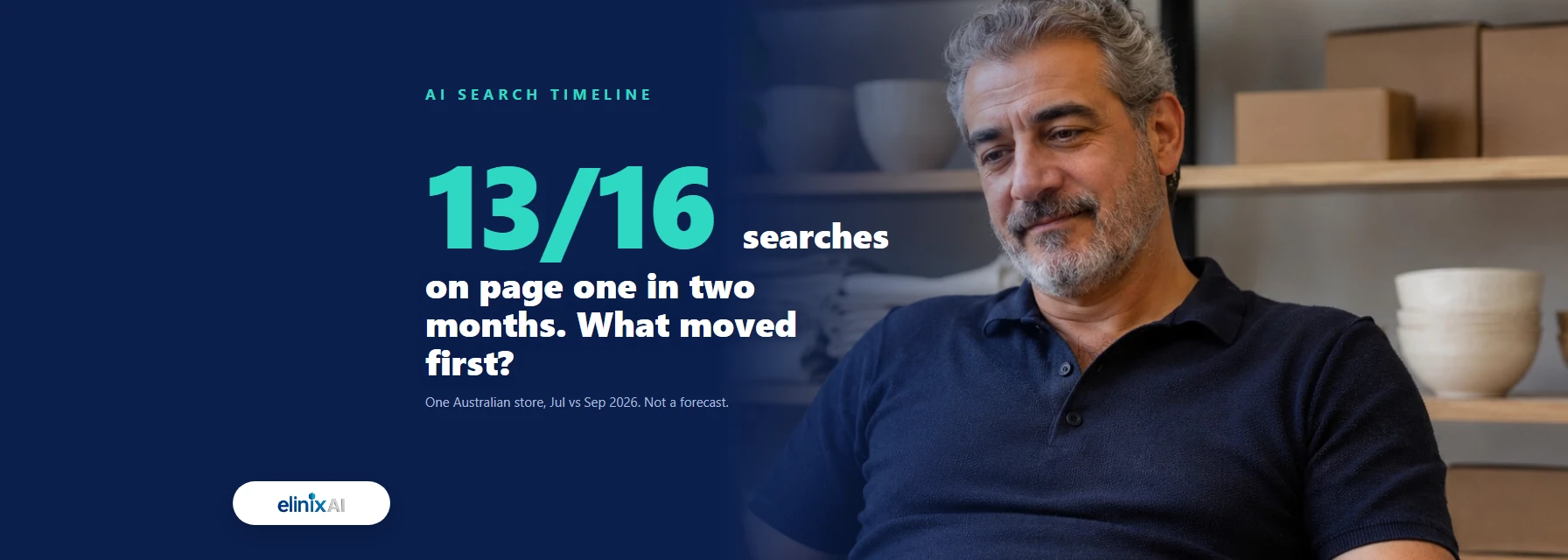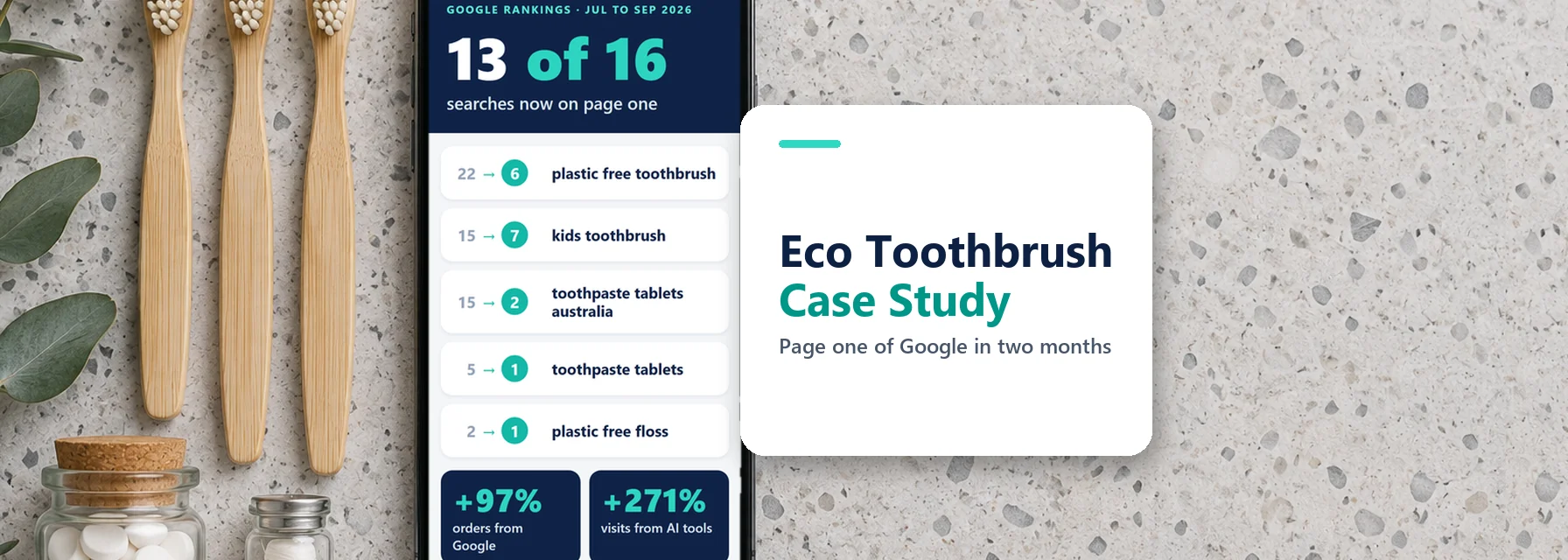
An Australian eco toothbrush brand moved onto page one of Google for 13 of its 16 main searches in two months, and its orders from Google search rose 97%. Revenue grew 20.1% and visits from AI tools like ChatGPT rose 271%, comparing September 2026 with July in the store's own Google Analytics 4 data. The work was collection page rewrites, FAQ schema and one answer-first article, while visits from paid ads fell.
This is a case study from one of our AI search and SEO clients, a small Shopify store selling bamboo toothbrushes, silk floss and toothpaste tablets. The brand is not named until the client approves it. Below is where the store ranks now, where it started, the seven things we changed, what happened, and the parts that did not go to plan.
Key facts
- 13 of 16 tracked searches now rank on page one of Google Australia, four of them at number one (SE Ranking, September 2026)
- "plastic free toothbrush" climbed from 22nd to 6th, from page three to page one (SE Ranking, September 2026)
- Orders from Google organic search rose 97% (store GA4, 1 to 28 July vs 1 to 28 September 2026)
- The share of Google visits that ended in a sale almost doubled, from 3.3% to 6.1% (store GA4)
- Visits from AI tools rose 271%, nearly four times July's level (store GA4, AI Assistant channel)
- Revenue rose 20.1% and average order value rose 30% (store GA4)
Where does the store rank on Google now?
The store now ranks on page one of Google Australia for 13 of the 16 buyer searches we track, up from 10 on 1 September. Four of those sit at number one. The biggest moves came on the store's most valuable product searches, which it had been missing on page two and three.
| Search on Google Australia | 1 September 2026 | Late September 2026 |
|---|---|---|
| plastic free toothbrush | 22nd (page 3) | 6th (page 1) |
| kids toothbrush | 15th (page 2) | 7th (page 1) |
| toothpaste tablets australia | 15th (page 2) | 2nd |
| bamboo toothbrushes | 12th (page 2) | 2nd |
| toothpaste pills | 7th | 2nd |
| toothpaste tablets | 5th | 1st |
| plastic free floss | 2nd | 1st |
| silk floss | 1st | 1st |
| silk dental floss | 1st | 1st |
| bamboo electric toothbrush | 2nd | 2nd |
Source: SE Ranking daily rank tracking, Google Australia. Tracking began on 11 August, so the table starts from 1 September.
"kids toothbrush" is the biggest search the store tracks, at about 1,900 searches a month, and it moved from page two to 7th. "plastic free toothbrush", at about 880 searches a month, jumped 16 places onto page one.
The traffic is now coming from people who do not know the brand yet. In Search Console, 85% of Google clicks came from people who did not type the brand name. They found the store by searching for what it sells.
Where did the store start?
In July 2026, paid ads were carrying the store. Only 24.9% of visitors from Google engaged with the site, and just 3.3% of Google visits led to a sale. AI tools like ChatGPT were barely sending anyone.
The pages did not answer the questions people type into Google and ChatGPT, so most Google visitors landed on a page and left. At the same time, the store sat on page two or three for searches with real volume, such as "kids toothbrush" and "plastic free toothbrush".
As ads were doing most of the selling, every month of growth cost more ad budget. Moving those near-miss searches onto page one was the opportunity.
What did we change?
We made seven changes between late July and September. None of them needed a new website or a bigger ad budget. Most of the work sat on pages the store already had.
1. Mapped buyer searches to pages
We tracked 16 buyer searches in Google Australia and matched each near-miss search to the page that should rank for it. A near miss is a search where the store shows up often but sits just below the top few results. Small moves on those searches bring the most new visits.
2. Rewrote the collection pages
We rewrote the toothbrush, floss, toothpaste and kids collections. The floss, toothpaste and kids pages got new titles, intros that answer the shopper's question first, and FAQ sections built from what people actually search. Collection pages hold most of the buying intent on a small Shopify store, so this is where we started.
3. Fixed the homepage heading
The homepage heading and the line under it now say plainly what the brand sells. Before the change, the heading did not name the products, which left first-time visitors and AI tools to work it out.
4. Added FAQ schema
The FAQ page now carries FAQ schema covering 23 questions, plus Organization schema. Schema is code that labels the answers so Google and AI tools can read them without guessing. Google's own guidance says "There are no additional requirements to appear in AI Overviews or AI Mode" (Google Search Central, December 2025), so the schema is there to make clear answers easy to read.
5. Published one answer-first article
The store published a bamboo versus plastic toothbrush article. It opens with a short answer, uses questions as headings, cites two peer-reviewed studies, and has a named author, the brand's co-founder, who is a qualified nutritionist. A real person standing behind the advice matters to both readers and AI tools.
6. Started on the top product page
The sonic electric toothbrush page is the store's biggest page from Google. It has a new title, meta description and web address so far. The body rewrite is the next job.
7. Set up monthly tracking
We report every month from Google Analytics 4, Google Search Console and SE Ranking. We also ask the same five buyer questions in AI search every month to see whether the brand shows up. That way each change is measured against the same baseline.
Free audit: we are able to run the same search-to-page mapping on your store. Book a free AEO, GEO and SEO audit, no obligation.
What happened to sales and traffic?
Google now sends better visitors, and far more of them buy. Orders from Google rose 97%, and the share of Google visits that ended in a sale almost doubled. Average order value rose 30%, which lifted revenue 20.1% on July.
The table compares 1 to 28 July, the last 28 days before work began, with 1 to 28 September 2026. All figures are from the store's Google Analytics 4.
| Measure | Change, September vs July |
|---|---|
| Orders from Google search | +97% |
| Engaged visits from Google | +91% |
| Google visits that led to a sale | 3.3% to 6.1%, almost double |
| Engagement rate of Google visitors | 24.9% to 44.5% |
| Visits to the rewritten collection pages | +231% |
| Visits from AI tools | +271% |
| Revenue | +20.1% |
| Average order value | +30% |
Google visits themselves rose only 7%. The growth came from the quality of those visits, because the rewritten pages now match what people searched for.
The rewritten pages grew the most. Visits to the toothbrush collection rose 320%, the toothpaste collection 224% and the floss collection 113%. Those are the pages we rewrote, which is the clearest link between the work and the result.
Mobile matters here. Seven in ten visits came from phones in September, and phones brought 77% of the orders. That is why every page change should be read on a phone first.
What did AI search do?
Visits from AI tools rose 271% on July, and visits from ChatGPT alone rose 280%. Perplexity sent visitors for the first time. Visitors from AI tools also stayed more than three times longer than in July, at 4 minutes 19 seconds on average against a store average of 2 minutes 35 seconds.
These numbers come from the AI Assistant channel in Google Analytics 4, which Google defines as visits from sources like ChatGPT, Gemini, DeepSeek, Copilot or Grok (Google Analytics Help, 2026). Perplexity is not in that list, so we check it separately by source.
Google's AI Overviews already trust the store's product pages. SE Ranking found AI Overviews in Australia linking to the store for product searches like "silk dental floss" and "bamboo electric toothbrush heads" (SE Ranking, 1 September 2026 snapshot).
We also ask the same five buyer questions in AI search every month. The store's presence doubled, from one of the five in August to two in September. The questions it still misses are "which is better" and "how to" questions, and every answer to them comes from an article on another site. That is why more articles are the next step.
Being named matters even when nobody clicks. Pew Research Center found that when a Google search showed an AI summary, people clicked a result on 8% of visits against 15% without one (Pew Research Center, US, March 2025). A shopper who sees the brand named in the answer often comes back later through search or direct.
What did not go to plan?
Total orders fell 7.7% on July, as orders from paid ads fell 31% over the same months. So the revenue growth came from Google search and bigger orders. Paid ads sit outside this programme, but it would be wrong to show the search results without this one.
Four other things are worth being honest about:
- Orders from AI tools have not grown yet. Visitors from AI tools are still mostly researching, and they land on product pages that need clearer answers to win the sale.
- Three tracked searches moved down. The biggest was "bamboo toothbrush", which dropped from 4th to 47th on 26 September, because Google kept switching between two product pages for it. We are pointing it at the toothbrush collection now.
- The new article was not yet in the store's site map at the end of September, so Google had not picked it up. The October plan fixes that first.
- A block of visits from the United States had 8% engagement and looks like bots. It is left in the totals above, which slightly understates the September engagement rate.
This is also two months of data. We cannot prove that every change caused every number. The timing lines up, and the pages we rewrote are the pages that grew, which is as close to cause as one store can get.
We wrote about the same store's first month in how a small Shopify store quadrupled its ChatGPT traffic without a blog. That post used a mid-month reporting window, so its numbers cover different dates and should not be added to these.
What can your store take from this?
Most small Shopify stores already have the pages they need. What they are missing is a clear answer at the top of each page, and FAQs that match what shoppers ask. As collection pages carry most of the buying intent, that is where we would start.
Three things you can do this week:
- Open your best-selling collection page and read the first paragraph. If it does not answer the question a shopper would ask ChatGPT, rewrite it so it does.
- Add four to six real customer questions underneath, with short plain answers.
- Run the 5-minute ChatGPT test on your own category, so you know where you start.
The full method is the same 12-point AI visibility audit we ran on this store. We cannot promise the same numbers for your store, as every catalogue and category is different. We are able to show you exactly where you stand and what we would change first. Our AI search and SEO service follows the same process for every store.
Free audit: book a complimentary AEO, GEO and SEO audit and we will go through the report with you on a call. No obligation.
Frequently Asked Questions
How long did it take to reach page one?
It took two months. Work began in late July 2026, and by late September 13 of the store's 16 tracked searches ranked on page one of Google Australia. Google visits dipped in August while the rewritten pages settled in, then recovered in September with much better engagement. For AI search and SEO in general, we tell clients to expect 3 to 6 months for meaningful movement, and longer in competitive categories.
Did paid ads drive the growth?
No. Visits from paid ads fell 19% between July and September, and orders from ads fell 31%. The growth in orders from Google happened while the ads were doing less.
Why did revenue rise when total orders fell?
Average order value rose 30% between July and September. Orders from Google rose 97%, and buyers placed bigger orders. Together that lifted revenue 20.1% on July, even with 7.7% fewer orders in total.
What made the biggest difference?
The collection page rewrites made the biggest difference. Visits to the rewritten collections rose 231%, and they are the pages that now rank on page one for searches like "plastic free toothbrush" and "toothpaste tablets australia". Each page got a direct answer at the top and an FAQ built from real searches.
Did the brand need a blog to get AI traffic?
The store did not need one to start. Visits from AI tools rose 271% before the first article was indexed, mostly through product and collection pages. The questions the store still misses in AI answers are all won by articles on other sites, so articles are the next step to close that gap.
How do you measure visits from ChatGPT?
Google Analytics 4 has a default channel called AI Assistant, which covers visits from sources like ChatGPT, Gemini, DeepSeek, Copilot and Grok (Google Analytics Help, 2026). Perplexity is not in Google's list, so we check it by source as well. We also test the same five buyer questions in AI search every month.
Would this work on my Shopify store?
Every store is different, so we cannot promise the same numbers. The method works best when a store already has traffic from Google and pages that sit just below the top results. A free audit shows whether your store has those near misses, and which pages to fix first.
Why is the brand not named?
The client has not yet approved being named, so we describe it as an Australian eco toothbrush brand. Every figure in this case study comes from the store's own Google Analytics 4, Search Console and SE Ranking data, compared across the same 28-day windows.