An AI SEO (GEO) programme for an Australian small business typically costs $2,000 to $5,000 a month, according to an independent Australian cost guide checked in October 2026. The price moves mainly with how many products and buyer questions you want covered, which is why Elinix AI quotes every programme after a free audit.
Those are starting points, not quotes. A 40-product store chasing ten buyer questions and a 900-product store chasing a hundred are different jobs, and no honest agency can price either before it has looked at the site. This guide shows what a generative engine optimisation (GEO) programme includes, what pushes the price up or down, how it compares with a traditional SEO retainer, and how to tell in your own analytics whether the money is working.
Key facts
- Standalone AI search programmes for Australian small businesses run $2,000 to $5,000 a month (What's The Damage, October 2026)
- One-off AI visibility audits in Australia run $1,500 to $5,000 (What's The Damage, October 2026)
- Most Australian small businesses pay $1,500 to $3,000 a month for traditional SEO (What's The Damage, October 2026)
- The most common SEO retainer worldwide is US$501 to US$1,000 a month, charged by 20.4% of 439 providers surveyed (Ahrefs, 2024)
- 61.7% of AI citations never name the brand in the answer (Semrush, June 2026)
- Google Analytics now groups ChatGPT, Gemini, DeepSeek, Copilot and Grok visits into an AI Assistant channel (Google Analytics Help, 2026)
What is included in an AI SEO (GEO) programme?
A GEO programme pays for two layers of work. The first makes your store rank in Google. The second makes your pages easy for ChatGPT, Gemini, Perplexity and Google's AI features to quote and name. A proposal that only covers one layer is either traditional SEO with a new label, or a content plan with no technical base.
Every Elinix AI engagement starts with the same 12-point AI visibility audit. It is free, and we walk through it together on a call:
- Live AI visibility test across ChatGPT, Perplexity, Claude and Gemini
- Competitor citation share
- Crawlability and indexation
- Rendering and machine readability
- Answer-first content structure
- Citation-worthiness
- Structured data coverage
- Entity consistency
- Buyer-intent keyword coverage
- Product and collection page optimisation
- Internal linking and topical clustering
- Technical health and Core Web Vitals
We have published every one of the 12 checks in full, so you can hold any proposal, ours included, against the list.
After the audit, the paid work runs in a set order. Month 1 is technical and structural fixes: crawlability, rendering, schema, entity consistency, internal linking and page speed. Months 2 and 3 restructure the pages closest to revenue so an answer can be lifted out of them, and start publishing content worth citing. From month 3 the work compounds, with monthly reporting on organic revenue and AI visibility.
One thing you should not pay for is a secret AI setting. Google's own documentation says "There are no additional requirements to appear in AI Overviews or AI Mode" (Google Search Central, December 2025). The same page says no special AI text files or schema are needed. For Google's AI features, the money buys the same quality work, done more thoroughly.
What drives the price up or down?
Five things set the price of a GEO programme, and the first two do most of the work: how many products need optimising, and how many buyer questions you want to compete for. After those come technical debt, category competition and how much content you need. The agency's brand name moves the price far less than scope does.
Catalogue size. Product and collection pages hold most of an ecommerce store's extractable content. A 40-SKU catalogue can be restructured in weeks. A 900-SKU catalogue needs templates, bulk structured data and a priority order, because nobody rewrites 900 pages by hand in a quarter.
Buyer questions. Each question you want to be named for needs a page that answers it well. Ten questions is roughly a quarter of work. A hundred is closer to a year.
Technical debt. A clean Shopify build with product schema already in place needs a short foundation month. A store that loads its content with JavaScript, has no structured data and carries years of broken redirects needs a longer one, and that is where foundation fees differ most.
Category competition. If three national retailers already own the answers in your category, winning a mention takes more content and more third-party presence. A narrow Australian niche can move with far less.
Content volume. GEO rewards pages with specific, dated, sourced facts. If you can supply product knowledge, customer data and opinions, the agency writes less from scratch. If every page starts from nothing, you pay for the research.
Two of these you can control before you ask for a quote. List your top 20 products by revenue, and write down the ten questions your customers ask most. That list cuts the audit short and makes every quote you receive comparable.
Free audit: bring that list to a free 15-minute AI visibility audit and we will show you which of those questions name your competitors today.
What does each scope level cost?
GEO work in Australia is sold at four scope levels, from a one-off audit to a full programme in a competitive category. The market prices below come from What's The Damage, an independent Australian cost guide that says its figures were last verified in October 2026. The last column is how Elinix AI handles each level.
| Scope level | What you get | Australian market range | At Elinix AI |
|---|---|---|---|
| Audit only | AI visibility test, technical review, priority list | $1,500 to $5,000 one-off | Free, walked through on a call |
| Add-on to existing SEO | AI crawler access, answer blocks, citation monitoring | $500 to $1,500 a month | Quoted after the audit |
| Standalone programme | Technical base, answer-first content, entity work, tracking | $2,000 to $5,000 a month | Quoted after the audit |
| Competitive category | All of the above plus digital PR across more platforms | $4,000 to $8,000+ a month | Quoted after the audit |
Read the table as bands, not prices. The same guide says the add-on level suits a store whose SEO retainer is already working, while a store starting from scratch needs the standalone level to fund the technical base and the content together.
Also check what sits outside the fee. Content writing, product photography and developer time on theme code are often billed separately. Ask every agency for the same list: what is in the monthly fee, what is extra, and what you would need to supply yourself.
In the mid-September 2026 search panel for our own monthly report, none of the six AI search agencies we tracked published a price. That is not proof they overcharge. It is a reason to ask for a written scope before you compare numbers.
How does GEO pricing compare with traditional SEO pricing?
A standalone GEO programme usually costs more than a traditional SEO retainer, because it adds a second layer of work on top. What's The Damage puts most Australian small-business SEO at $1,500 to $3,000 a month, against $2,000 to $5,000 for a standalone AI search programme (October 2026). The gap pays for answer-first content, entity work and citation tracking.
The global picture is lower at the bottom and similar in the middle. Ahrefs surveyed 439 SEO providers and found the most common monthly retainer was US$501 to US$1,000, charged by 20.4% of them. The average across all of them was US$2,917 a month, and US$3,209 for agencies (Ahrefs, August 2024). Those are US dollars, and that survey predates GEO as a separate line item.
| Traditional SEO retainer | AI search (GEO) programme | |
|---|---|---|
| Typical Australian small-business price | $1,500 to $3,000 a month | $2,000 to $5,000 a month |
| Main output | Rankings in Google's list of links | Being named and cited inside AI answers, plus rankings |
| Core work | Technical fixes, keywords, links | The same, plus answer-first pages, entity consistency, third-party mentions |
| How you measure it | Rankings, organic sessions, organic revenue | The same, plus mention rate, citation rate and the AI Assistant channel |
| Time to meaningful movement | Several months | 3 to 6 months, longer in competitive categories |
Sources: What's The Damage (October 2026) for Australian prices; Google Search Central and the Elinix AI programme for timing.
A cheap GEO retainer is usually a traditional SEO retainer with a new line on the invoice. Ask how many hours a month go to the AI layer specifically, and what those hours produce.
The honest reason to pay the difference is where buyers now look. Pew Research Center found that when a Google search showed an AI summary, people clicked a result on 8% of visits against 15% without one (Pew Research Center, United States, March 2025). Ranking first below that summary is worth less than being named inside it.
Who should not buy a GEO programme yet?
Three kinds of business should spend the money somewhere else first. We publish these same three on our AI search service page, because turning away the wrong engagement is cheaper for both sides than a year of reports nobody can act on.
You need revenue this month. GEO compounds over quarters. If cash is tight now, email and SMS flows on the traffic you already have will return faster.
Your store converts poorly. Sending more qualified visitors to a store that loses them at checkout makes the leak bigger. Fix conversion first, then pay to send traffic into a store that holds it.
You will not publish anything. Being cited needs something worth citing. If nobody will sign off on specific numbers, methods or opinions, you are paying for the same technical audit every month.
If one of these fits, the free audit still helps. It gives you the technical list to fix yourself, and a baseline to measure against when you are ready.
How do you measure whether it is working?
Measure a GEO programme with three numbers, agreed before you sign: AI Assistant sessions in Google Analytics 4 (GA4), mention rate across a fixed list of buyer questions, and organic revenue. Rankings alone cannot tell you whether an answer engine names your brand.
AI Assistant sessions in GA4. Google Analytics now has a default channel called AI Assistant. Google defines it as visits from sources like ChatGPT, Gemini, DeepSeek, Copilot or Grok (Google Analytics Help, read September 2026). Open Reports, then Acquisition, then Traffic acquisition, and look for the AI Assistant row. Two gaps to know: the channel excludes Google's AI Overviews and AI Mode, and Perplexity is not in Google's named list, so check your Referral channel for perplexity.ai.
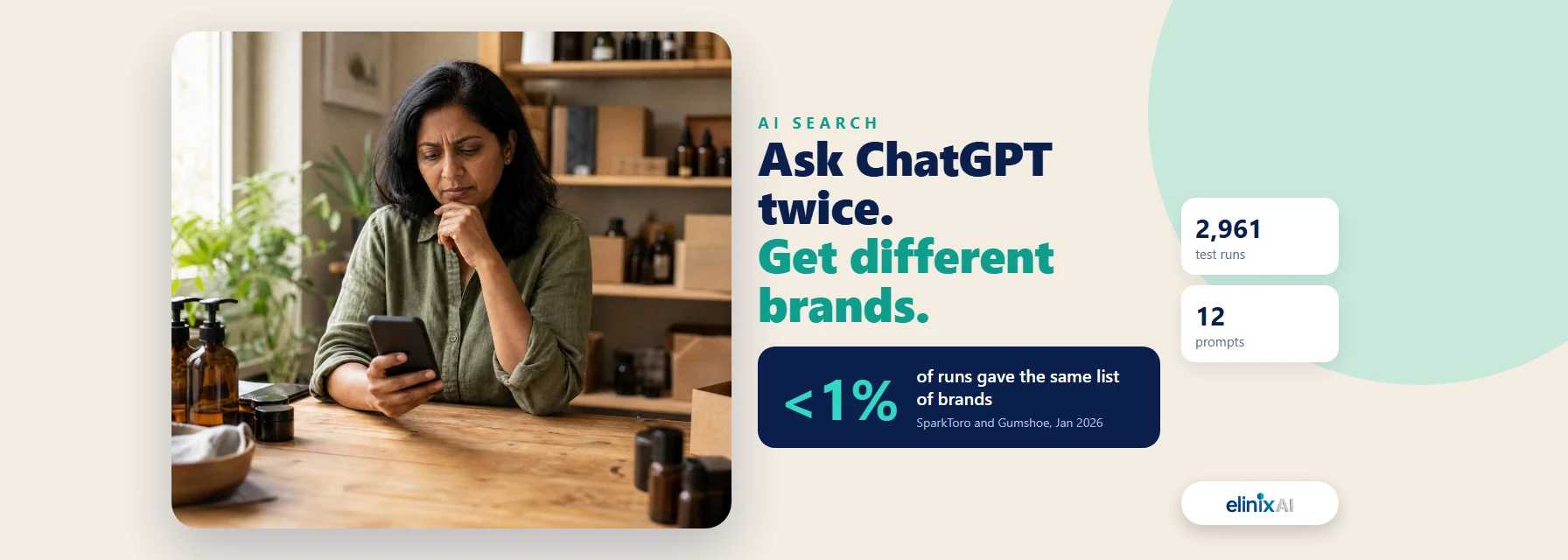
Mention rate and citation rate. Test the same buyer questions in the same engines every month and record two things: whether your brand is named in the answer, and whether your page is cited as a source. They are different outcomes. Semrush analysed 3,981 domain appearances across 115 prompts and found 61.7% of AI citations never named the brand in the answer (Semrush, June 2026). You can run the first test yourself with our 5-minute ChatGPT test.
Organic revenue. Visibility that never turns into orders is a report, not a result. Track organic and AI Assistant revenue in GA4 or Shopify against the same period before the work started.
Expect small numbers at first. AI Assistant sessions are a fraction of most stores' traffic today, and Pew's data shows many people read the AI answer without clicking at all. A buyer who saw your brand named often arrives later, through search or direct. That is why the brand mention rate matters as much as the click count.
We published one anonymised client result on this: a small Shopify store that grew its ChatGPT traffic without a blog. It is one store over a short period, so read it as an example of what to measure, not a promise.
What should the first year cost?
At the market band of $2,000 to $5,000 a month, a standalone programme costs roughly $24,000 to $60,000 over a first year, before any one-off audit. Budget for the full year rather than a three-month trial. Google says some SEO changes could take several months to show (Google Search Central, December 2025), so a short trial usually ends just as the work lands.
Plan the year in three stages:
- Months 0 to 1. Audit, baseline and technical fixes. Most of the first month's budget goes here.
- Months 2 to 3. Commercial pages restructured and the first citable content published. This is where AI Assistant sessions should start to appear.
- Months 4 to 12. Compounding. More buyer questions covered each month, more third-party mentions, and a monthly read of mention rate and organic revenue.
Set a review point at month 6 with numbers agreed in advance. If mention rate, AI Assistant sessions and organic revenue are all flat by then, ask why in writing. Ask for a short notice period in writing, so you are never locked into a channel that is not working for your store.
For a budget below that, do the audit, fix the technical items yourself or with your developer, and come back when the store can carry a retainer. For how to judge the agencies themselves, see our guide on how to choose an AI SEO agency in Australia.
Free audit: before you budget anything, get the free 12-point AI visibility audit. You will know which questions you are missing and what fixing them would take.
Frequently Asked Questions
How much does AI SEO cost per month in Australia?
A standalone AI SEO or GEO programme for an Australian small business typically costs $2,000 to $5,000 a month, according to What's The Damage (October 2026). Adding AI search work to an existing SEO retainer runs $500 to $1,500 a month on the same guide. At Elinix AI, every programme is quoted after a free audit, because the scope sets the price.
Is GEO more expensive than regular SEO?
Usually yes, because a GEO programme does the SEO work and adds a second layer on top. Most Australian small businesses pay $1,500 to $3,000 a month for traditional SEO, against $2,000 to $5,000 for a standalone AI search programme (What's The Damage, October 2026). The extra pays for answer-first content, entity consistency, third-party mentions and citation tracking.
What does a one-off AI visibility audit cost?
One-off AI visibility audits in Australia run $1,500 to $5,000, according to What's The Damage (October 2026). A useful audit tests your buyer questions live in ChatGPT, Perplexity, Claude and Gemini, and reviews the technical and content reasons behind the result. The Elinix AI 12-point audit is free and walked through together on a call.
Why do so many AI SEO agencies not publish a price?
Scope varies so much between stores that a single number can mislead. In our mid-September 2026 search panel, none of the six AI search agencies we tracked published a price. That is why this guide gives independent market bands: a founder should be able to work out roughly what this costs before booking a call. We quote only after an audit.
Can I add GEO to my existing SEO retainer?
Yes, if your current SEO is already working. What's The Damage puts an AI search add-on at $500 to $1,500 a month on top of an existing retainer (October 2026). An add-on usually covers AI crawler access, answer blocks and citation monitoring. It does not fund a technical rebuild, so a store with rendering or schema problems needs those fixed first.
Why does the number of products change the price?
Product and collection pages hold most of an ecommerce store's content that an AI engine can quote. A 40-product catalogue can be restructured page by page in weeks. A 900-product catalogue needs templates, bulk structured data and a priority order, which takes more technical time. Catalogue size is one of the two biggest drivers of GEO price, alongside the number of buyer questions targeted.
How long before I know whether GEO is worth the money?
Expect 3 to 6 months for meaningful movement, and longer in a competitive category. Google says some SEO changes could take several months to show (Google Search Central, December 2025). Agree a review point at month 6, with AI Assistant sessions, brand mention rate and organic revenue measured against a baseline recorded before the work started.
Can any agency guarantee AI citations for the price?
No agency controls what ChatGPT or Google's AI features say, and Google states that no one can guarantee a #1 ranking on Google (Google Search Central, June 2026). Under Australian Consumer Law, a claim about a future result needs reasonable grounds at the time it is made (ACCC). If an agency promises a citation by a date, ask it to put those grounds in writing.
Does Google Analytics show traffic from ChatGPT?
Yes. Google Analytics 4 has a default channel called AI Assistant, covering visits from sources like ChatGPT, Gemini, DeepSeek, Copilot and Grok (Google Analytics Help, 2026). Find it under Reports, Acquisition, Traffic acquisition. The channel excludes Google's AI Overviews and AI Mode, and Perplexity is not named in Google's list, so check the Referral channel for perplexity.ai as well.
What should a small Shopify store budget for GEO in year one?
At the Australian market band for a standalone programme, $2,000 to $5,000 a month (What's The Damage, October 2026), year one costs roughly $24,000 to $60,000. If that is beyond budget, take a free audit, fix the technical items yourself, and start the retainer when the store can carry it.