An ecommerce website redesign in Australia typically costs $3,000 to $12,000 for an existing Shopify or WooCommerce store, according to an independent Australian cost guide verified in October 2026. A full custom Shopify build runs $10,000 to $30,000, and Shopify Plus projects start around $30,000. The price moves mostly with catalogue size, template versus custom design, and how much content you supply.
Those are bands, not quotes. A 30-product skincare store swapping to a better theme and a 900-product store rebuilding its collections from scratch are different jobs, and nobody can price either honestly before looking at the site. This guide shows what a redesign includes and what it leaves out, why a store costs more than a service site, what two real revamps produced, how to keep your Google rankings through a rebuild, and how long the work takes.
Key facts
- Redesigning an existing Shopify store in Australia typically costs $3,000 to $12,000 (What's The Damage, October 2026)
- A professionally built WooCommerce store costs most Australian businesses $3,000 to $10,000 (What's The Damage, October 2026)
- 70.22% of online shopping carts are abandoned, averaged across 50 studies (Baymard Institute, 2025)
- Better checkout design alone can lift conversion by 35.26% on large ecommerce sites (Baymard Institute, 2025)
- Google recommends keeping redirects from old URLs for at least one year after a move (Google Search Central, 2026)
- Australians spent $82.6 billion online in 2025, up 14% on 2024 (Australia Post eCommerce Report 2026)
How much does an ecommerce redesign cost in Australia?
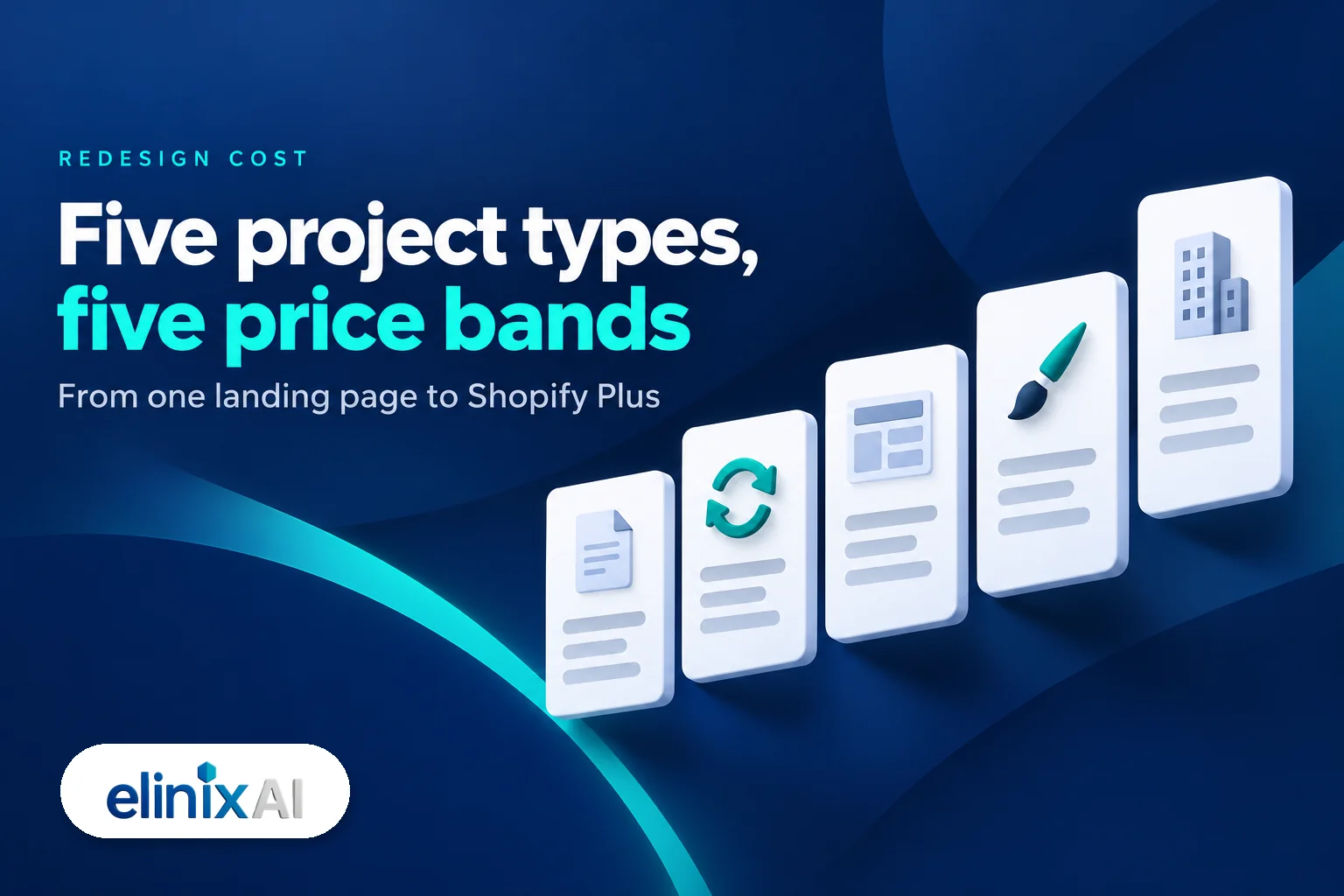
Most Australian ecommerce redesigns land between $3,000 and $12,000 when the store keeps its platform and gets a new theme and page structure. A custom design costs more, and a move between platforms adds migration work on top. The table shows the independent market bands, all in Australian dollars and verified in October 2026.
| Project type | What it usually means | Typical Australian price |
|---|---|---|
| Landing page | One page, one offer, one action | $800 to $3,000 |
| Redesign of an existing store | New theme and page structure, same platform | $3,000 to $12,000 |
| Template store build | New store on a paid theme, set up and styled | $2,000 to $8,000 |
| Custom Shopify theme build | Design and theme built for your brand | $10,000 to $30,000 |
| Shopify Plus or enterprise | Large catalogue, integrations, several markets | $30,000 to $100,000+ |
Source: What's The Damage, Shopify and web design cost guides, verified October 2026.
WooCommerce sits in the same range. The same guide puts a redesign of an existing WooCommerce store at $3,000 to $12,000, and a standard new build at $3,000 to $10,000. If you are still choosing the platform, our Shopify vs WooCommerce comparison covers fees and conversion side by side.
At Elinix AI, every website project is quoted after a free 15-minute audit, because the final figure depends on how many templates, products and integrations the store has. We build on Shopify, WordPress and WooCommerce, in three build types: an ecommerce store, a service or brochure site, and a landing page.
What does a redesign include, and what does it not?
A good ecommerce redesign covers every page a buyer passes through on the way to an order: home, collection, product, cart and checkout. It does not usually include copywriting, product photography, email setup or ongoing SEO. Those four gaps are where most surprise invoices come from, so get each one in writing before you sign.
Here is what our ecommerce builds include, as published on our website design service page:
- A conversion audit of structure, messaging, mobile experience and checkout
- Redesign and build of the home, collection, product, cart and checkout pages
- Mobile-first layout on every template
- Speed and Core Web Vitals work
- Trust signals and reviews placed next to the buying decision
- Redirect mapping so the rebuild does not cost existing rankings
- SEO basics: titles, meta descriptions, one H1 per page, alt text and clean URLs
And here is what sits outside the build fee, at most agencies including ours:
- Copywriting and product photography. If every product needs new copy and new photos, budget for them separately.
- Ongoing maintenance and hosting. Shopify's Basic plan alone is A$50 a month billed yearly, or A$56 billed monthly (Shopify, 2026).
- Email and SMS setup. Klaviyo flows are a separate project. Our email marketing pricing guide covers what that costs.
- An SEO or AI search programme. A build makes your store rankable. An SEO programme makes it rank.
Then there is the monthly stack. What's The Damage puts Shopify's ongoing costs at $250 to $1,500 or more a month once apps, store care and transaction fees are added, and WooCommerce at $150 to $750 or more a month for hosting, extensions and care. Ask every agency which of those it expects your store to need.
Why does an ecommerce build cost more than a service site?
An ecommerce build costs more because a store has far more moving parts. A service site has a handful of pages whose job is an enquiry. A store has product and collection templates, a cart, a checkout, payment and shipping settings, and redirects for every product URL. Each of those can lose a sale if it is built badly.
The independent bands show the gap. A small business site of 5 to 10 pages typically costs $2,000 to $6,000, while ecommerce runs from $5,000 to $60,000 or more (What's The Damage, October 2026).
Four things drive most of that difference:
- Catalogue size. A 30-product store can be restyled page by page. A 900-product store needs collection rules, bulk product data and templates that hold up across every variant.
- Checkout and cart. Baymard Institute's research found the average checkout shows 23.48 form fields when 12 to 14 is the ideal (Baymard Institute, 2025). Cutting that back is design work a service site never needs.
- Payments, shipping and apps. Every payment method, delivery option and review or subscription app has to be set up and tested on mobile.
- Redirect mapping. Every old product and collection URL needs a home on the new site, or the rankings it earned are lost.
Checkout is where the money leaks. Baymard puts average cart abandonment at 70.22%, and 40% of shoppers who abandon at checkout leave over extra costs such as shipping, tax or fees (Baymard Institute, 2025). That is why we show delivery costs and free shipping thresholds before checkout, not at the last step.
Speed matters as well. A study commissioned by Google and run by Deloitte found a 0.1 second improvement in mobile site speed lifted retail conversion rates by 8.4% (web.dev, 2019 study). Speed work takes time on a store with dozens of apps and large product images, and it is time a brochure site does not need.
Free audit: not sure whether you need a full redesign or a few page fixes? Book a free 15-minute website audit and we will show you where your store is leaking orders.
What results can a redesign produce?
A redesign can lift sales on the traffic you already have, because it changes how many visitors buy and how often they come back. Here are two Elinix AI revamps, each measured over 30 days against the prior 30-day period, from each store's own analytics. They are examples of what happened for these clients, not a promise of what will happen for yours.
| Measure | Australian Shopify store | Australian beauty brand |
|---|---|---|
| Sales | +285% (gross sales) | +104% (total sales) |
| Orders | +210% | +120% |
| Conversion rate | Not reported | 2.7%, up 78% |
| Sessions | Not reported | +20% |
| Returning customer rate | 35.7%, up 75% | Not reported |
Source: Elinix AI client data, 30 days against the prior 30-day period. Both clients are anonymised.
Look at the beauty brand's two numbers side by side. Sessions rose 20%. Sales rose 104%. The difference was the store, not the traffic.
The first store's returning customer rate is the number most founders skip. It rose 75%, which shows a revamp changes repeat buying as well as the first order.
A revenue result comes from three of the four levers a store has: conversion rate, average order value and repeat purchase. A website project cannot create traffic. If the store gets very few visitors, fix that first, or pair the redesign with an SEO and AI search programme that brings people in.
Will a rebuild cost you your Google rankings?
A rebuild should not cost your rankings if every old URL is redirected to its new page with a permanent redirect. Rankings drop when product and collection URLs change and nobody maps them. Google says it can take a few weeks or more for a medium-sized site's new URLs to replace the old ones in search.
Google's guidance on site moves recommends server-side permanent redirects, 301 or 308, from each old URL to its new one. It also says to keep those redirects "for as long as possible, generally at least 1 year" (Google Search Central, updated August 2026).
Here is how we protect rankings on every build:
- Export every live URL before the rebuild starts: products, collections, pages, blog posts and images.
- Match each old URL to its closest new page, never to the homepage by default.
- Keep page titles, H1s and the main copy of your best-ranking pages unless there is a reason to change them.
- Set the redirects live at launch, then test a sample of old URLs the same day.
- Watch Search Console for crawl errors and ranking changes over the following weeks.
Platform moves need extra care, and moving off a marketplace like eBay has its own rules. Shopify puts products under /products/ and collections under /collections/, so a WooCommerce store moving to Shopify changes almost every URL. Redirect mapping is part of every Elinix AI build for that reason. A redesign also adds the SEO basics a store needs to be rankable, and our 12 checks for Shopify AI search show what comes after that.

How long does an ecommerce redesign take?
An ecommerce redesign at Elinix AI typically takes 3 to 4 weeks from the start of the build, and a landing page 1 to 2 weeks. Larger custom builds take longer. What's The Damage puts custom website builds at 6 to 12 weeks across the market, and small business sites at 2 to 4 weeks once content is ready.
The biggest delay is rarely the design. It is waiting on content: product copy, photos, policy pages and sign-off. Have those ready, or agree who supplies them, before the build starts.
A typical 3 to 4 week build runs like this:
- Week 1. Audit, page plan and the redirect map. Agree the home, collection and product page layouts.
- Week 2. Design and build of the key templates, mobile first.
- Week 3. Cart, checkout, apps and integrations, then speed work.
- Week 4. Testing on real phones, redirects live, launch, then fixes from the first week of real data.
A launch is a hypothesis, not a result. Plan a review 30 days after launch, measured against the 30 days before, the same way the results above were measured.
Two clients have written about our delivery. James Stephanos, Founder of Optivance, said "The delivery of the website was timely." Elise Yong, owner of Pemberley, said "the experience was seamless from start to finish."
Free audit: before you collect quotes, get a free 15-minute website audit. You will know whether you need a redesign, a rebuild or a few fixes, and every quote you collect will be easier to compare.
Frequently Asked Questions
How much does it cost to redesign a Shopify store in Australia?
Redesigning an existing Shopify store in Australia typically costs $3,000 to $12,000, according to What's The Damage (October 2026). A custom Shopify theme build runs $10,000 to $30,000, and Shopify Plus or enterprise projects $30,000 to $100,000 or more. At Elinix AI, each project is quoted after a free 15-minute audit, because the price depends on catalogue size and integrations.
How much does a WooCommerce store cost to build in Australia?
Most Australian businesses pay $3,000 to $10,000 for a professionally built WooCommerce store, and $3,000 to $12,000 to redesign an existing one (What's The Damage, October 2026). Custom builds with bespoke logic or B2B integrations run $10,000 to $40,000. Hosting, extensions and a care plan add $150 to $750 or more a month once the store is live.
Is it cheaper to redesign my store or rebuild it from scratch?
A redesign on the same platform is usually cheaper, because products, customers and URLs stay where they are. A rebuild makes sense when the platform itself is the problem, such as a slow store held together by plugins. Migration to Shopify typically costs $3,000 to $15,000 on its own (What's The Damage, October 2026), on top of the design work.
What is not included in a website redesign quote?
Copywriting, product photography, hosting, ongoing maintenance, email setup and ongoing SEO are usually outside a redesign quote. At Elinix AI, copy, photography, maintenance and Klaviyo setup are all priced separately. Ask every agency for the same written list of inclusions and exclusions, so you compare like with like.
How long does an ecommerce website redesign take?
An Elinix AI ecommerce build typically takes 3 to 4 weeks, and a landing page 1 to 2 weeks. Across the market, custom website builds take 6 to 12 weeks (What's The Damage, October 2026). The biggest delay is usually content, so have product copy, photos and policies ready before the build starts.
Will I lose my Google rankings if I redesign my website?
Not if every old URL is redirected properly. Google recommends permanent 301 or 308 redirects from each old URL to its new page, kept for at least a year (Google Search Central, 2026). It can take a few weeks or more for a medium-sized site's new URLs to show in search. Redirect mapping is included in every Elinix AI build.
Does a website redesign increase sales?
It can, when it fixes how visitors buy rather than only how the store looks. In one Elinix AI revamp, sales rose 104% while sessions rose only 20%, and in another, gross sales rose 285%, each over 30 days against the prior 30. These are past client results, not a promise, because every store's product, price and traffic differ.
Why do agency quotes for the same redesign vary so much?
Quotes vary because agencies scope different work under the same word. One quote may cover a theme install and styling, another a custom design with checkout changes, speed work and redirect mapping. Give every agency the same brief: number of products, pages to redesign, apps to keep, and who supplies copy and photos.
What are the ongoing costs after a Shopify redesign?
Shopify's Basic plan costs A$50 a month billed yearly, or A$56 billed monthly, and Grow costs A$134 a month billed yearly (Shopify, 2026). Apps, store care and transaction fees bring a typical monthly stack to $250 to $1,500 or more (What's The Damage, October 2026). Ask your agency which apps the new design depends on.
How do I know if my store needs a redesign?
Your store likely needs a redesign if visitors arrive but few buy, if the site is slow or awkward on a phone, or if your checkout asks for more than it needs. Baymard puts average cart abandonment at 70.22% (Baymard Institute, 2025), so some loss is normal. A free audit shows whether your store needs a full redesign or a few targeted fixes.