White-label Shopify development in Australia means a specialist team builds a Shopify store for your agency's client, under your agency's name, while you keep the client relationship and the margin. Your client deals only with you, and the store belongs to the client once it goes live. Shopify's rules back this up, saying that after a partner transfers a client transfer store, "the merchant owns the store and it leaves your organization".
This guide is for Australian agency owners who sell websites but do not build Shopify stores in-house, or who have more Shopify work than their developers can take on. It covers how a white-label build runs step by step, who should own the store and the Partner account, how a partner compares with hiring or a freelancer, and what to ask before you sign. We run a white-label programme for agencies ourselves, so the last section says exactly what we commit to, and nothing more.
Key facts
- After a client transfer store is handed over, the merchant owns it and it leaves the partner's organisation (Shopify Help Center, 2026)
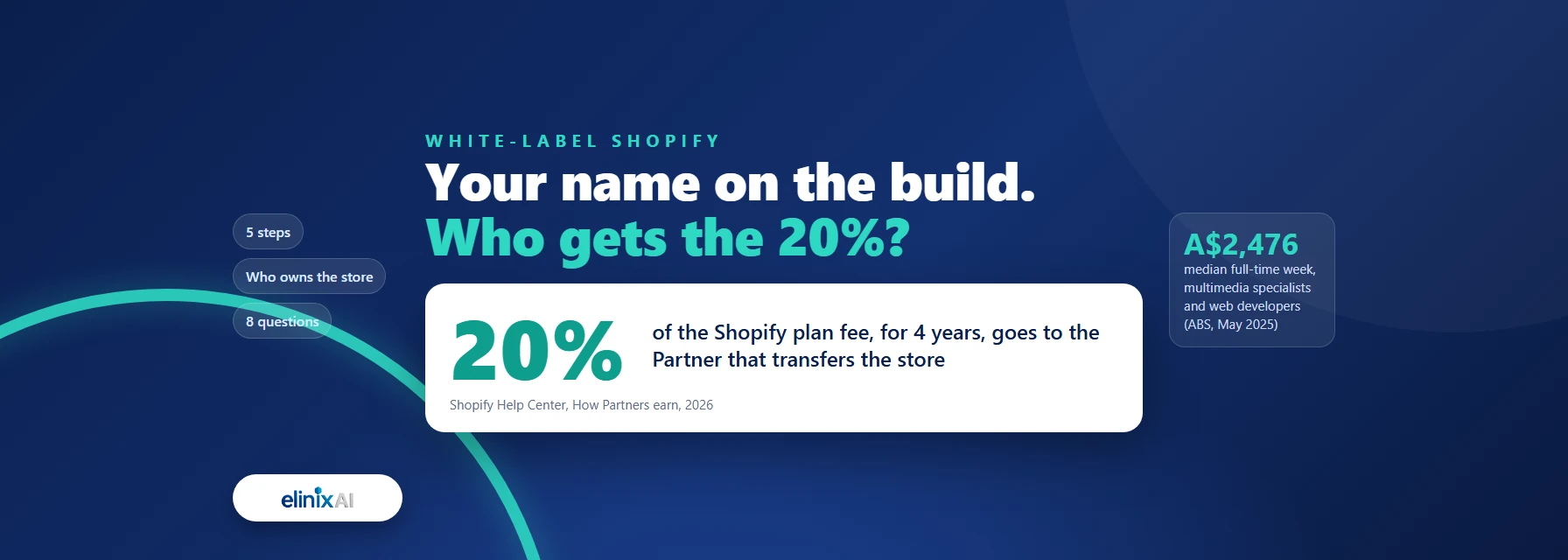
- Shopify pays the transferring Partner 20% of the store's monthly subscription fee plus 0.1% of monthly eligible sales, for 4 years (Shopify Help Center, 2026)
- Collaborator accounts do not count towards a Shopify store's user limit (Shopify Help Center, 2026)
- IP created by a contractor belongs to the contractor unless the contract says otherwise (IP Australia, 2026)
- Median full-time earnings for multimedia specialists and web developers were A$2,476 a week (Jobs and Skills Australia, ABS data for May 2025)
- Consumer guarantees cover services costing A$100,000 or less, including due care and skill (Queensland Government, 2024)
What does white-label Shopify development mean?
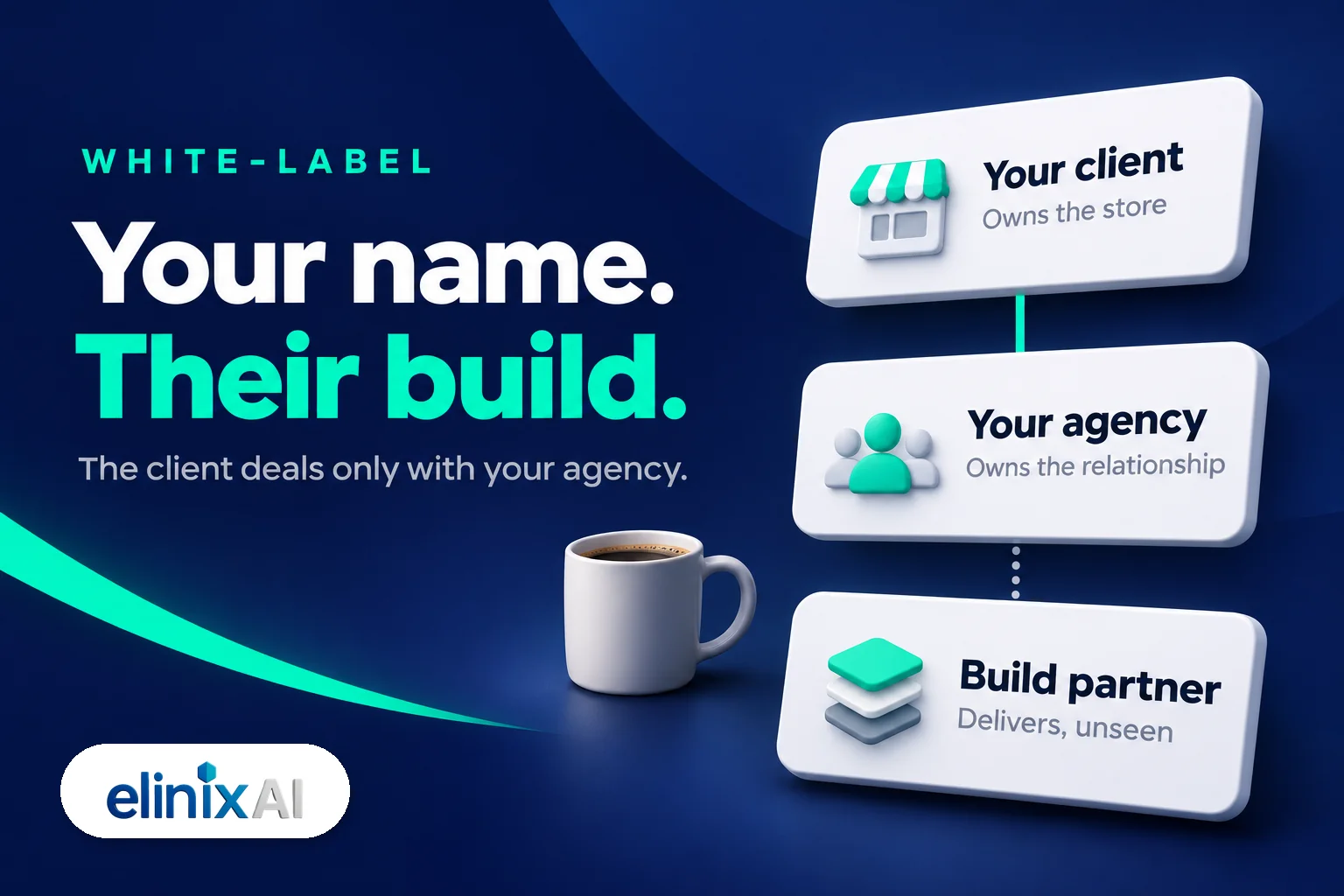
White-label Shopify development means your agency sells a Shopify build and a partner delivers it, with no partner branding on the work. The client signs with you, pays you and talks to you. The partner works behind your agency, to a scope you agreed, and your agency pays the partner. You carry the relationship and earn the margin.
Each of the three parties owns something different:
- The client owns the Shopify store, the domain and the customer data.
- Your agency owns the relationship, the price and the account management.
- The partner owns the delivery, reports to you and stays out of sight.
White-label is a contract arrangement, so the details live in your agreement with the partner. Nothing inside Shopify marks a store as white-label. The parts Shopify does control are who owns the store and who can get into its admin, which the ownership section below covers.
Agencies usually bring a partner in for one of two reasons. Either a client wants something the team does not do, such as a Shopify build, a migration or a Klaviyo setup, or the team does it but is already full. In both cases the client should not notice a change in who they deal with.
How does a white-label Shopify build work, step by step?
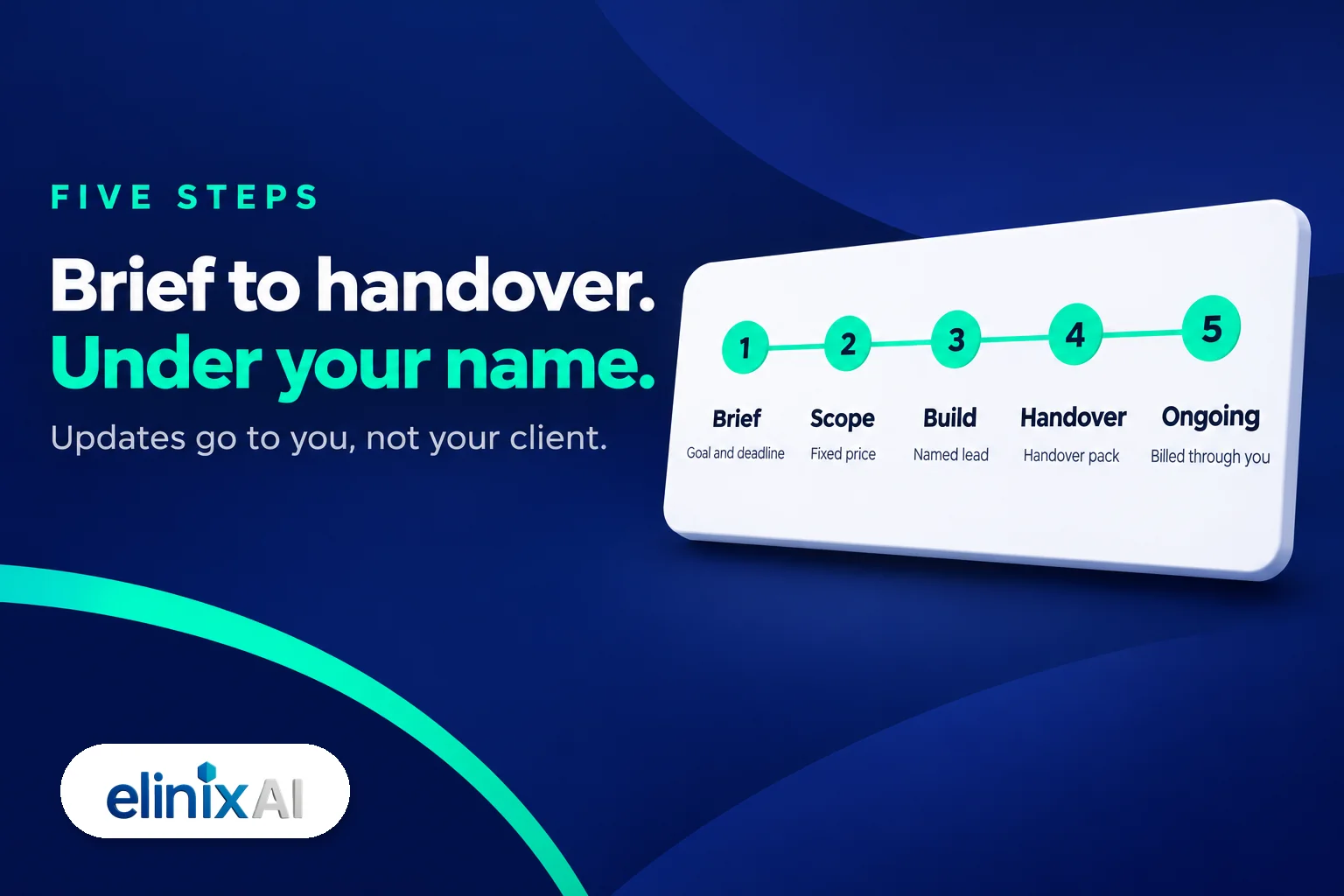
A white-label Shopify build usually runs in five steps. You bring the brief, the partner scopes and quotes your agency, the partner builds, you hand the store over, and ongoing work is billed through you if the client wants it. The partner reports to your agency throughout, so your client sees your name at every stage.
- Brief. You share the client's goal, current setup and deadline. Include the current platform, product count, apps, integrations and any launch date the client has in mind. If the client is still choosing a platform, our Shopify vs WooCommerce comparison covers the trade-offs.
- Scope and quote. The partner sends your agency a fixed price against a written scope. A useful scope lists deliverables, revision rounds, who supplies copy and images, and what is out of scope. You add your margin and present the price as your own.
- Build. The partner either builds a new store under a Partner account or works inside the client's existing store as a collaborator. A named project lead sends progress updates to you, on a timeline you can share with the client.
- Handover. You receive a handover pack, test orders are placed, and the store goes live. Shopify Payments is switched on by the client after any ownership transfer, for the reason explained in the next section.
- Ongoing. If the client wants monthly work, such as maintenance, email or SEO, the partner keeps doing it and bills you. Our guides to the Klaviyo flows every Shopify store needs and to ecommerce SEO, AEO and GEO show what that ongoing work usually involves.
The step agencies most often skip is the scope. As a partner's fixed price only holds for what is written down, every vague line becomes a conversation later. Write the scope in the same words you will use with your client, so the two documents match.
Who should own the Shopify store and the Partner account?
The client should own the Shopify store, and your agency should agree in writing whose Shopify Partner account builds it. There are two ways in. A new store can be built as a client transfer store and handed to the client at launch. An existing store is reached through a collaborator account that the client approves.
| Route | During the build | After launch | Watch for |
|---|---|---|---|
| Client transfer store | Sits in the Partner organisation that created it | The client owns it | Shopify Payments must not be active before the transfer |
| Collaborator access | The client owns it | The client owns it | The client controls which areas the partner can reach |
For a new store, the partner builds a client transfer store inside a Partner organisation, configures it, then transfers ownership to the client when it is ready to go live. Shopify's client transfer store page adds a catch. A transfer fails if Shopify Payments, Shopify Balance, Shopify Credit or Shopify Capital is active, even in test mode. So leave payments for the client to set up after the transfer.
For an existing store, the client approves a collaborator request. Shopify's collaborator accounts page says collaborators do not count towards the store's user limit. The client shares a 4-digit request code, and Shopify advises granting only the permissions the partner needs. The client can also remove a collaborator permanently, and the partner then has to request access again.
The Partner account matters for money too. For a client transfer store, Shopify pays the Partner 20% of the monthly subscription fee plus 0.1% of monthly eligible sales, for 4 years. If the partner creates the store inside their own Partner organisation, Shopify pays that commission to the partner. Decide before the build whether the store is created in your organisation, or whether the commission is reflected in the partner's price.
In-house, freelancer or white-label partner: which suits your agency?
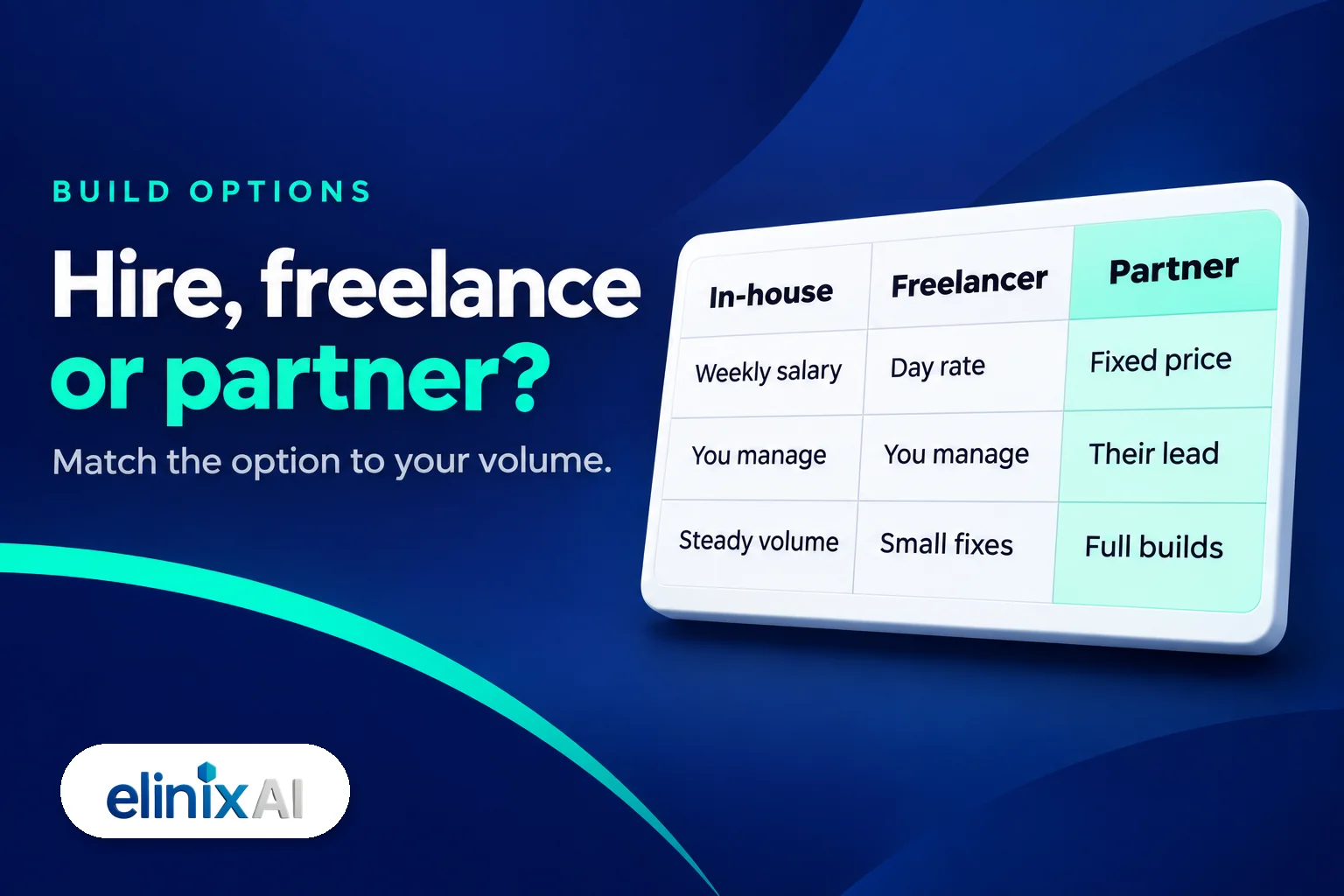
Hire in-house when Shopify builds arrive every month and you can keep a developer busy. Use a freelancer for small, well-defined jobs you can manage yourself. Use a white-label partner when the work is irregular, the job is a full store, or you need a team that covers the build and the handover under your name.
| Factor | In-house developer | Freelancer | White-label partner |
|---|---|---|---|
| How you pay | Salary every week | Day rate or per job | Fixed price per project |
| Who manages the work | You | You | Their project lead, reporting to you |
| Cover for leave or illness | Only if you hire two | Usually none | A team behind the lead |
| Who owns the code by default | Your agency | The freelancer, unless assigned | The partner, unless assigned |
| Best fit | Steady monthly volume | Small fixes and tweaks | Irregular or full builds |
The in-house number is the one to check first. Median full-time earnings for multimedia specialists and web developers were A$2,476 a week, against A$1,852 for all occupations, in ABS data for May 2025. That is about A$128,750 a year before super and other costs, paid whether a build comes in or not.
A freelancer avoids that fixed cost, but the management stays with you. You brief, chase, test and cover for them when they are away. That works for a theme tweak. It gets harder on a full store with a launch date your client has announced.
A white-label partner sits between the two. You pay per project, and the partner's project lead manages the build. As the partner works across many stores, your client gets a team that has solved the same Shopify problems before. Check that the partner works Australian business hours, so client calls, launch days and fixes after launch happen in the same day.
Price the client job before you choose. Our guide to what an ecommerce redesign costs in Australia gives the market bands and what moves them.
Partner call: got a Shopify build your team cannot take on this month? Book a 20-minute partner call and we will come back with a fixed-price scope for your agency.
What should you ask a white-label partner before you sign?
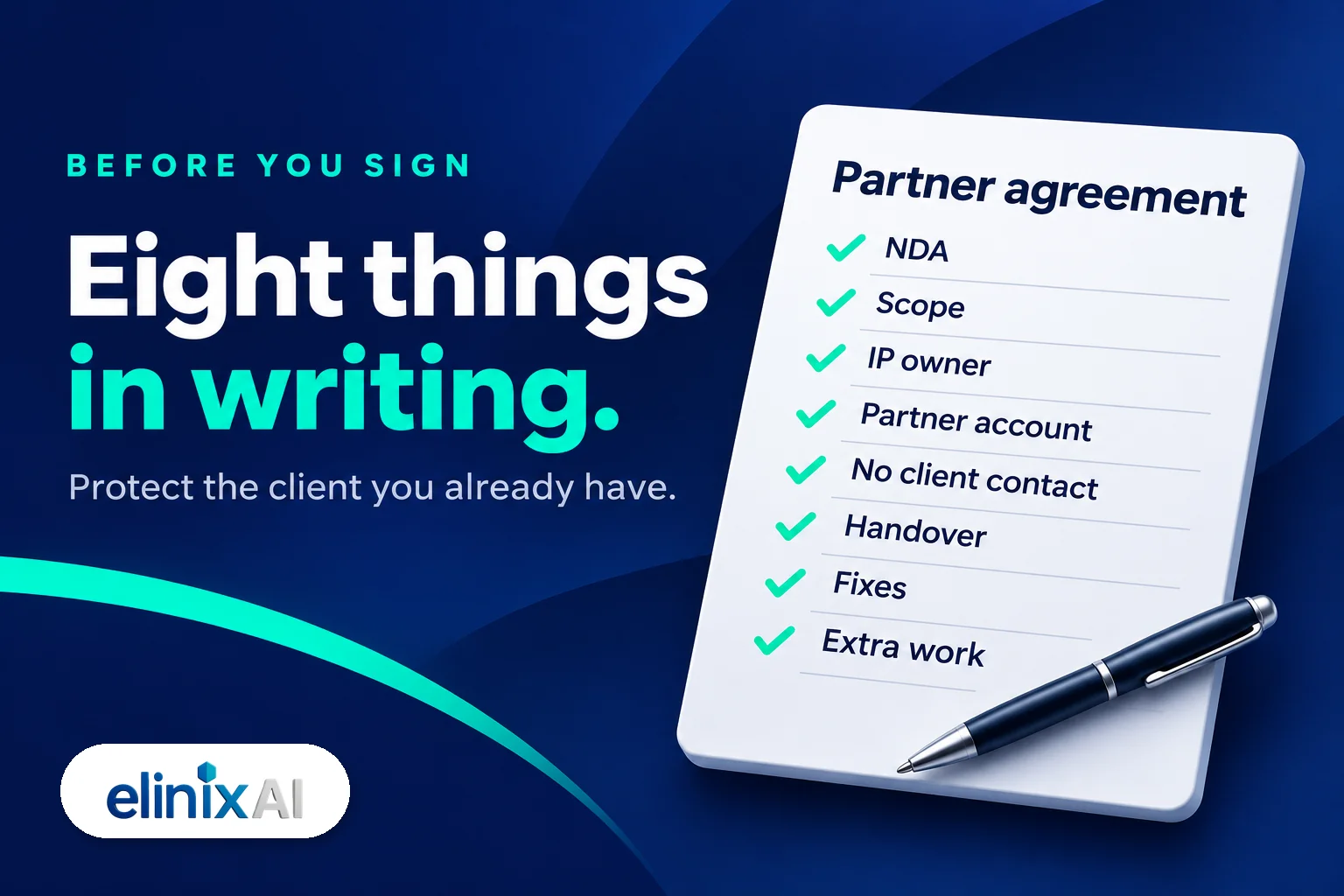
Before you sign, get eight things in writing: confidentiality, the scope, who owns the work, which Partner account builds the store, client contact, handover, fixes after launch, and how extra work is priced. Each one protects part of a relationship your client already thinks is yours.
| Ask | Why it matters | A good answer |
|---|---|---|
| Will you sign an NDA? | The client's data and your pricing stay private | Yes, before the brief |
| What exactly is in the scope? | Scope creep comes out of your margin | Deliverables, revision rounds, content owners, one fixed price |
| Who owns the code and design? | A contractor owns its IP unless the contract says otherwise | A written assignment once paid |
| Which Partner account builds the store? | It decides the transfer and the commission | Agreed in writing before the build |
| Will you contact or pitch to my client? | It protects your relationship | Never, during or after the project, unless you ask |
| What is in the handover? | Your team supports the store afterwards | Logins, app list, theme notes and a walkthrough |
| How are fixes handled after launch? | Launches surface bugs | A set fix period and response time |
| How is extra work priced? | It avoids surprise invoices | Quoted before any work starts |
The ownership question catches agencies out. IP Australia says IP created by a contractor "is the property of the contractor" unless the contract states otherwise. So a build you paid for in full can still belong to the people who coded it. Put an assignment clause in the partner agreement, and make sure it matches what you promised your client.
Remember who the client bought from. Under the Australian Consumer Law, services costing A$100,000 or less carry consumer guarantees, including due care and skill, according to Queensland Government guidance. Your client contracted with your agency, so a problem with the build lands on your desk first. This is general information, so ask your lawyer how it applies to your own contracts.
Then test the partner on a small job before a big one. A theme fix or a single landing page shows you how they scope, report and hand over, at low risk to your client.
How Elinix AI works with Australian agencies
We build Shopify stores, migrations and automations for agencies, under the agency's name, from our Melbourne team. White-label is our default. There is no Elinix branding on the client's work, and we never contact your client unless you ask. We send your agency a fixed-price scope for each project, so you can add your margin.
What we commit to, as it stands on our agency partner page:
- No Elinix branding on your client's work, and we are happy to sign an NDA.
- We never pitch our services to your clients, during or after a project.
- Clear deliverables and a fixed price per project, with anything outside scope quoted before we start.
- A named project lead, a shared timeline and progress updates to you, not your client, unless you ask.
- A handover pack, and we stay available for fixes after launch.
Our Shopify and WordPress builds typically take 3 to 4 weeks. We also take on store migrations, custom portals, Klaviyo email and SMS setups, and ecommerce SEO and AI search, billed monthly through you if the client wants ongoing work. The build work itself is described on our ecommerce website design page.
Each project is quoted after we see the scope. We do not promise a sales figure for your client, because that depends on their product, their margins and their traffic.
Partner call: tell us what your client needs. Book a 20-minute partner call and we will send your agency a fixed-price scope.
Frequently Asked Questions
Does my client need to know a white-label partner built their store?
That depends on your agreement with the client, not on Shopify. Some client contracts limit subcontracting or require consent first, so read yours before you brief a partner. Whatever you tell the client, keep the Shopify store, the domain and the customer data in the client's name.
Who owns the Shopify store after a white-label build?
The client should. For a new store built as a client transfer store, Shopify says the merchant owns the store after the transfer and it leaves the partner's organisation. For an existing store, the client owns it throughout and the partner works inside it as a collaborator.
Will a white-label partner contact my client?
Only if your agreement allows it. Put no-contact and no-pitching terms in writing, covering the project and the time after it. At Elinix AI, we never contact your client unless you ask, and we never pitch our services to your clients, during or after a project.
How long does a white-label Shopify build take?
It depends on the scope, the catalogue and how quickly content arrives. Elinix AI's Shopify and WordPress builds typically take 3 to 4 weeks. Migrations and custom features add time, so agree the timeline in the scope before you give your client a launch date.
How is white-label Shopify development priced?
Ask for a fixed price per project, so your margin is known before you quote the client. Elinix AI sends your agency a fixed-price scope for each project and quotes anything outside the scope before work starts. You add your margin and present the price as your own.
Who gets the Shopify Partner commission on a white-label build?
Shopify pays the commission to the Partner that transfers the client transfer store. According to the Shopify Help Center, that is 20% of the monthly subscription fee plus 0.1% of monthly eligible sales, for 4 years. Agree in writing whose Partner organisation creates the store before the build starts.
Can a white-label partner join calls with my client?
Yes, if you want them to. Elinix AI can join a scoping call under your agency's name. Outside those calls, our progress updates go to your agency, not to your client, unless you ask us otherwise.