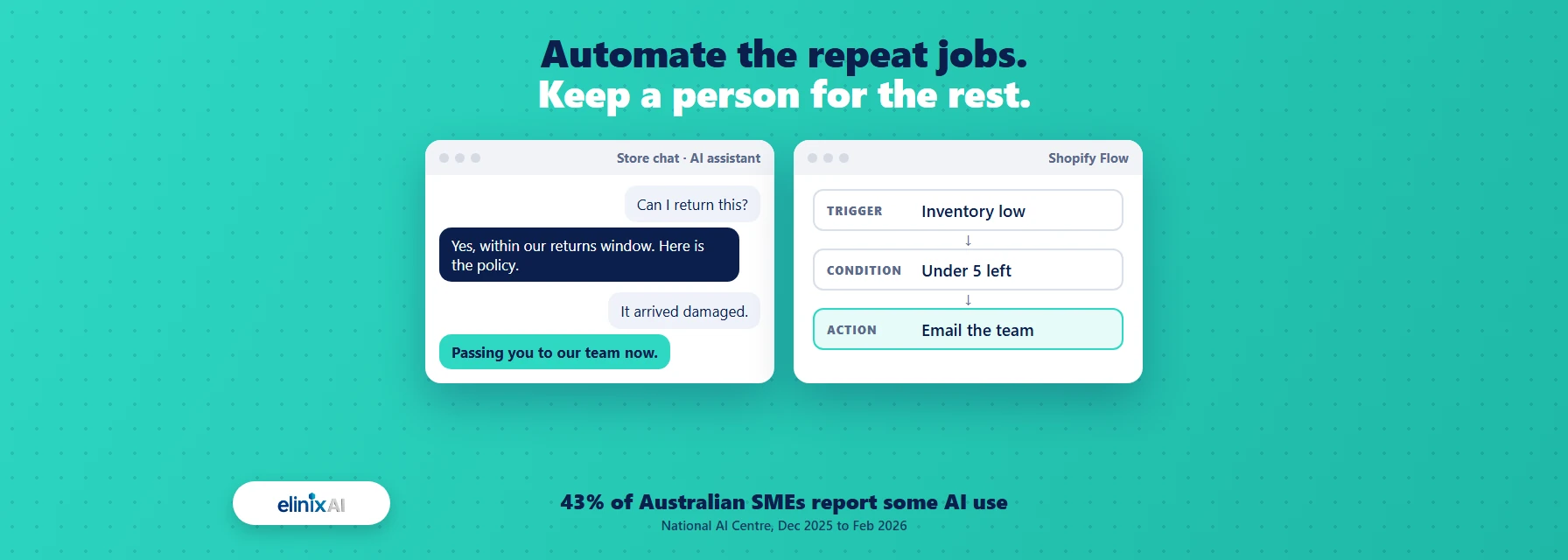
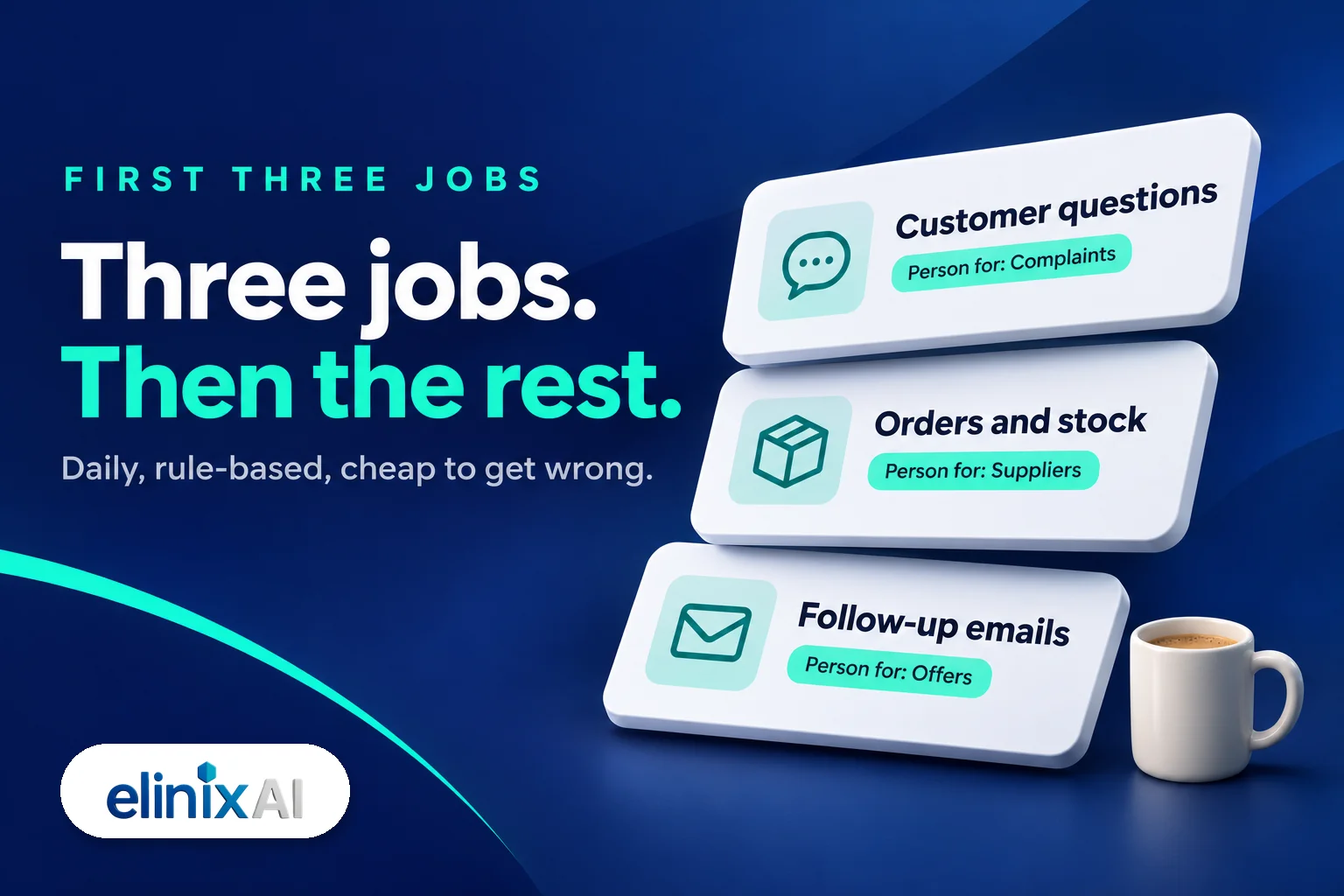
Most Australian ecommerce brands should start AI automation with three jobs: answering repeat customer questions, routine order and stock admin, and follow-up emails after a browse, cart or purchase. These jobs repeat every day and follow clear rules, so a mistake is easy to spot. 43% of Australian SMEs reported some AI adoption from December 2025 to February 2026 (National AI Centre, 2026).
The other 57% are not all behind. According to the same National AI Centre survey, trust was the biggest reason businesses held back, and 19% said they simply did not know how to use AI. This guide answers that second problem for an online store. It covers what an AI chat agent can and cannot handle, the store workflows that need no AI at all, what drives the cost and timeline, and how to start without breaking what already works.
Key facts
- 43% of Australian SMEs reported some level of AI adoption from December 2025 to February 2026 (National AI Centre, 2026)
- Around 65% of non-adopting SMEs cited distrust of AI decisions or a preference for human control (National AI Centre, 2026)
- About half of businesses using AI check its outputs before they affect customers (National AI Centre, 2026)
- Shopify Flow is a free app on the Basic, Grow, Advanced and Plus plans (Shopify Help Center, 2026)
- The privacy regulator says public-facing AI tools such as chatbots should be clearly identified as AI (OAIC, 2024)
- From 10 December 2026, privacy policies must disclose certain decisions made or informed by computer programs (OAIC, 2026)
What should an ecommerce brand automate first?
Automate the jobs that happen every day, follow your own written rules, and cost little when they go wrong. For most stores that is customer questions, order and stock admin, and follow-up emails. Leave anything that needs judgement, such as a refund dispute or a supplier problem, with a person until the simple jobs run cleanly.
| Job | Usual tool | What it handles | Keep a person for |
|---|---|---|---|
| Customer questions | AI chat agent on your store | Delivery times, returns policy, sizing, order status | Complaints, refunds outside policy, anything unclear |
| Order and stock admin | Shopify Flow | Tagging orders, low stock alerts, hiding sold-out products | Supplier calls, stock decisions |
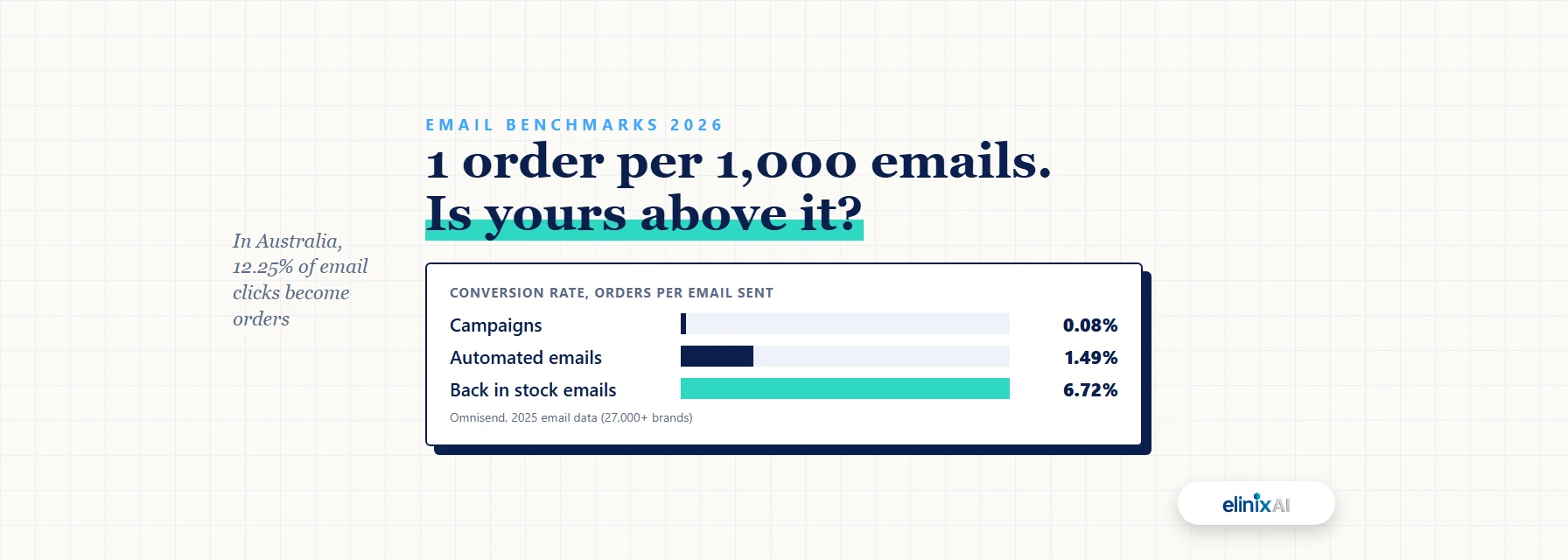
| Follow-up emails | Klaviyo flows | Welcome, cart, checkout, post-purchase, winback, review request | Campaign planning and offers |
| Reporting | Your platform reports or a custom build | Pulling numbers into one place | Deciding what the numbers mean |
Order matters here. Follow-up emails usually come first if you have none, because carts already leave your store every day. Customer questions come next, because a chat agent needs your policies written down first. Reporting comes last, because it depends on clean data from the other jobs.
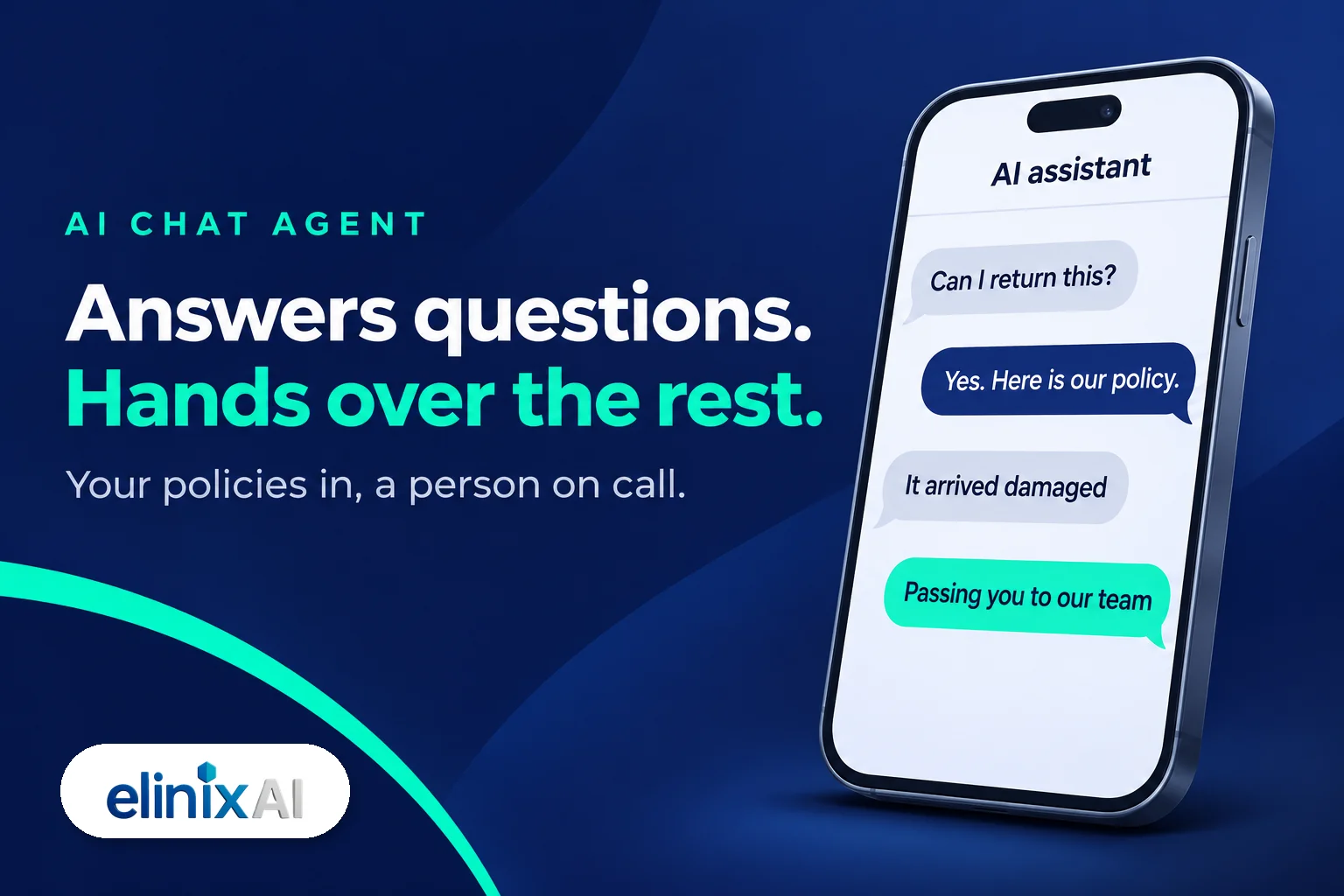
What can an AI chat agent handle, and what should it not?
An AI chat agent can answer the questions your team answers every day, using your own policies, product pages and order data. It should not invent policy, promise refunds it cannot approve, or argue with an upset customer. The rule is simple. If a staff member would need to check with you first, the chat agent should hand over to a person.
Good jobs for an AI chat agent on a Shopify or WooCommerce store:
- Delivery times and costs to each state
- Return and exchange rules, quoted from your policy page
- Sizing, ingredients and product differences
- Where an order is, from the order data
- Collecting details before handing over to a person
Jobs to keep with a person:
- Refunds or credits outside your written policy
- Complaints, damaged goods and angry customers
- Health, safety or allergy questions where a wrong answer causes harm
- Anything the chat agent is not sure about
The reason is legal as well as practical. Treasury's 2025 review called the Australian Consumer Law "economy-wide, principles-based and technology-agnostic". So the same rules on misleading conduct and consumer guarantees apply to what your chatbot says as to what your staff say.
Label the chat agent as AI, too. The OAIC's guidance on commercial AI products says public-facing tools such as chatbots should be clearly identified as such. It also warns that AI systems are known to produce inaccurate or false results, which is why the handover rule matters.
There is a second benefit. The written answers a chat agent needs, on delivery, returns and product differences, are the same answers AI search tools look for on your product pages. Our 12 checks for Shopify AI search show where those answers should sit.
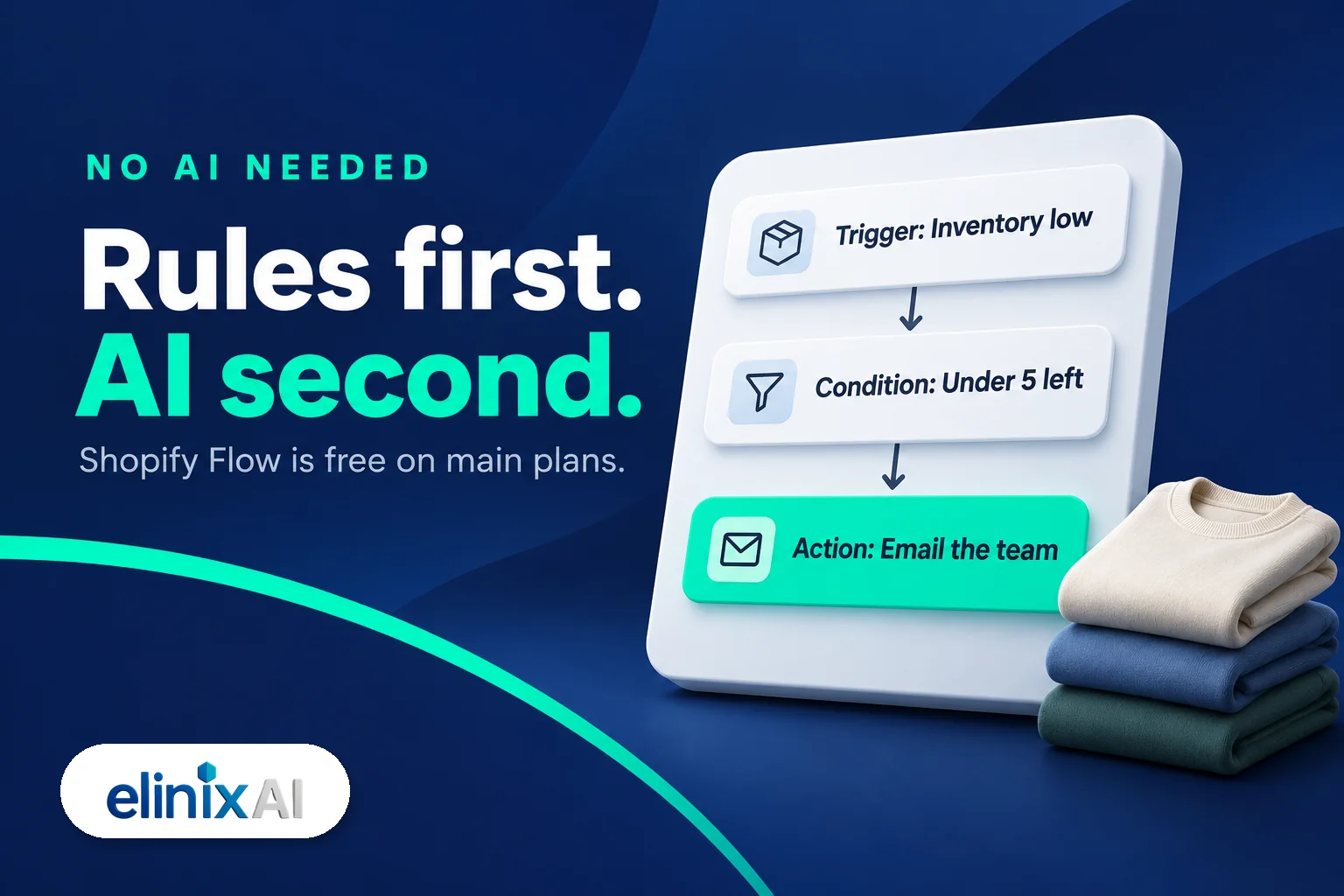
Which store workflows can you automate without AI?
Many store jobs need rules, not AI. Shopify Flow, a free app on the Basic, Grow, Advanced and Plus plans, watches your store for events and runs actions in response, according to Shopify's Flow guide. Klaviyo does the same for emails. Start with these before paying for anything smarter.
Shopify's library of Flow examples includes workflows like these:
| Area | Example workflow in Shopify Flow |
|---|---|
| Orders | Cancel and restock high-risk orders |
| Orders | Get notified about irregularly large order quantities |
| Stock | Get notified when product inventory is low |
| Stock | Hide and republish products based on inventory level |
| Customers | Organise customers by lifetime spend tiers |
| Reviews | Send an internal email when a negative Shop review is received |
Treat the risk examples with care. Cancelling an order automatically is a decision about a real customer, so many stores tag and hold instead, then let a person check.
Follow-up emails are the other big rules-based job. At Elinix AI we build 6 core Klaviyo flows with 30 emails: Welcome (7), Cart abandonment (6), Checkout abandonment (6), Post purchase (6), Winback (4) and Review request (1). The review request is the simplest way to automate reviews, because it asks every customer at the same point after delivery. Our Klaviyo email and SMS service covers the build, and our guide to what email marketing is explains how flows differ from campaigns.
If you sell through Black Friday, finish the flows first. Our Black Friday email calendar shows why the follow-up matters more in a busy week.
Free call: not sure which job to automate first? Book a free call and we will go through the questions your team answers every day and what is worth automating.
What does AI automation cost for an ecommerce store, and how long does it take?
The cost depends on what you automate. A Shopify Flow workflow costs your time, because the app is free on Shopify's main plans. An AI chat agent costs more, because it needs your policies written up, your order data connected and testing before it talks to customers. The scope sets the price, not the label "AI".
What moves the cost of an AI chat agent:
- How many questions it must answer, and how many need order data
- How many systems it connects to, such as Shopify, your help desk and your delivery app
- Whether your policies are already written clearly
- How much testing your product range needs, especially health or safety claims
- Who reviews the conversations each week after launch
We looked for independent Australian price ranges for AI chat agents for online stores and did not find a source we could stand behind. So this guide gives no market band. Be careful with any quote given before someone has seen your store and your inbox.
Timelines follow the same logic. A single Flow workflow can run the day you set it up. Our Klaviyo foundation build takes 21 days. An AI chat agent takes longer to get right than to switch on, because most of the work is the testing.
At Elinix AI, we build AI automation for ecommerce stores, starting with AI chatbots. What we build and what it costs depends on what you want to automate, so each job is quoted after a free scoping call. You can read how we approach AI automation for ecommerce brands. Agencies can bring the same work to us under their own name through our agency partner programme. We do not promise a time saving or a sales figure, because that depends on your store, your customers and your current setup.
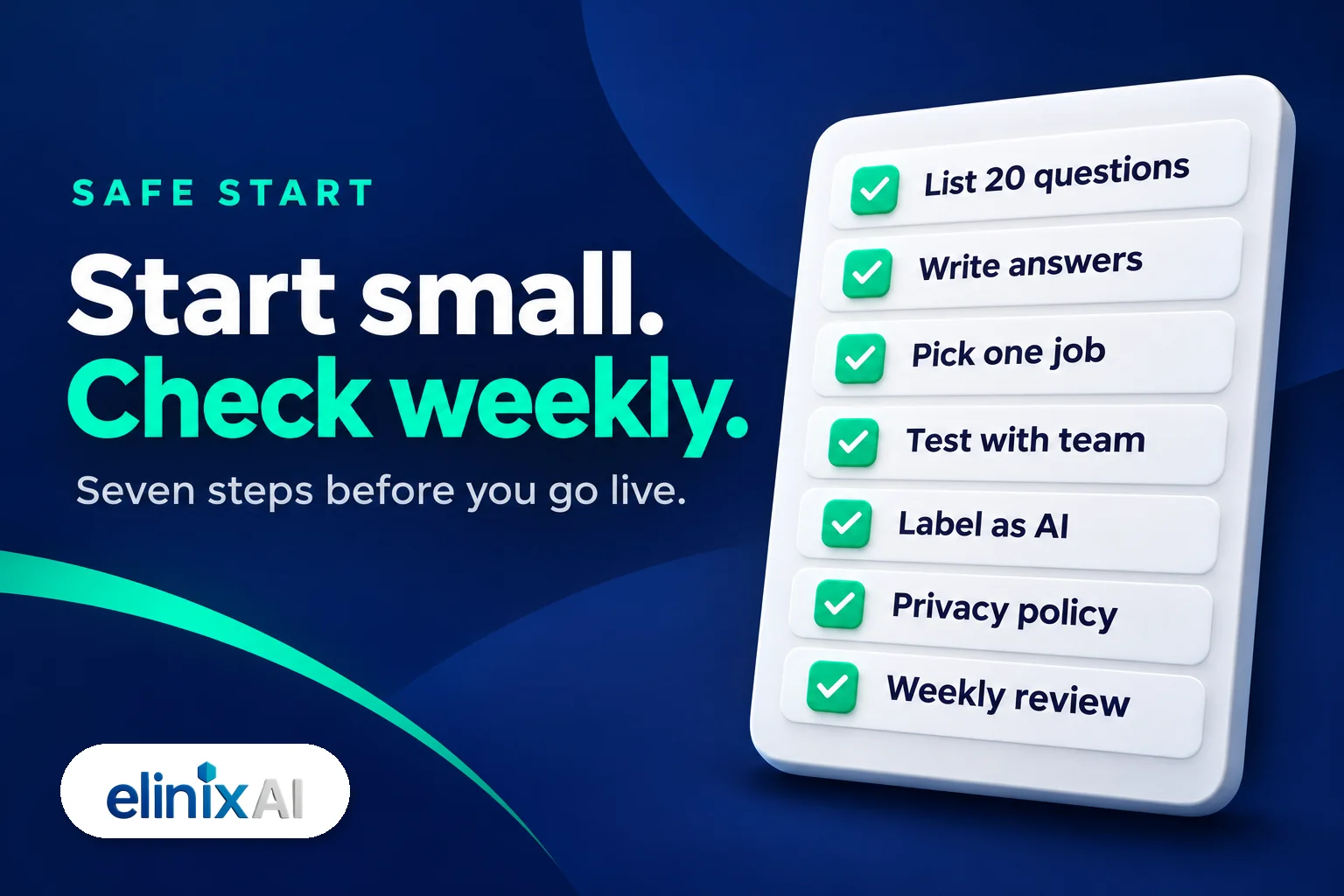
How do you start AI automation without breaking what already works?
Start small, keep a person in the loop, and check the results every week. Pick one job, write the rules down, test with your own team, then go live on a small share of traffic or hours. The National AI Centre found that about half of businesses using AI check its outputs before they affect customers. Be in that half.
- List the 20 questions your team answers most often, from your inbox and chat history.
- Write or fix the source answers: delivery, returns, sizing and contact details.
- Choose one job to automate first, and decide when it must hand over to a person.
- Test it with your own team, including awkward and angry questions.
- Label the chat agent as AI and show customers how to reach a person.
- Update your privacy policy before 10 December 2026 if a program makes or informs decisions about customers.
- Read a sample of conversations every week, and fix the answers that went wrong.
Step 6 is new. The OAIC says that from 10 December 2026, privacy policies must cover the kinds of personal information used by such programs and the kinds of decisions they make. Most chat agents only answer questions, but check with your adviser if yours approves refunds or flags customers.
What to measure in the first month
Measure the automation against the job it took over, not against a vendor's dashboard. If you cannot say what changed for customers or for your team, the automation is not finished. Track a handful of plain numbers each week and compare them with the month before you switched it on.
| Job automated | What to track each week | Warning sign |
|---|---|---|
| Customer questions | Share of chats handed to a person, reply time, complaints | Customers repeat the question to a person |
| Order and stock admin | Orders held for review, stock-outs, staff hours on admin | Good orders held, or sold-out products still live |
| Follow-up emails | Revenue from flows, unsubscribes, spam complaints | Unsubscribes rise after a new flow |
A rising handover rate in week one is normal. It shows you which answers are missing from your policies. Write those answers once, on your site, and both your team and the chat agent can use them.
Keep personal details out of free public AI tools while you set this up. The OAIC's best-practice advice is not to enter personal information, especially sensitive information, into publicly available generative AI tools.
Finally, check your store converts before you automate around it. Australians spent A$82.6 billion online in 2025, up 14% (Australia Post, 2026). A chat agent that answers well on a slow, confusing store still loses the sale. Our 5-minute ChatGPT test is a quick way to see how AI tools describe your store today.
Free call: want a second opinion before you buy an AI tool? Book a free call and we will scope what is worth automating on your store, with no obligation.
Frequently Asked Questions
What is AI automation for ecommerce?
AI automation for ecommerce means using software to do repeat store jobs without a person doing each one by hand. Some jobs use AI, such as a chat agent answering customer questions. Many use simple rules, such as a Shopify Flow workflow that tags orders or a Klaviyo flow that sends a follow-up email.
Will an AI chatbot replace my customer service team?
An AI chatbot should take the repeat questions, such as delivery times and return rules, so your team can spend time on complaints, refunds and the customers who need a person. Keep a clear handover to a human. The OAIC also says customers should know when they are talking to AI rather than a person.
Is Shopify Flow free?
Yes. Shopify says Shopify Flow is a free app on the Basic, Grow, Advanced and Plus plans. Some actions are limited by plan. The Send HTTP Request action needs Grow, Advanced or Plus, and tasks from custom partner apps need Plus. Check your plan in the Shopify admin before you build a workflow.
Is my business responsible for what its chatbot says?
Yes. Treasury's 2025 review described the Australian Consumer Law as technology-agnostic, so the rules on misleading claims and consumer guarantees apply to a chatbot's answers too. Give the chatbot your written policies, stop it promising refunds it cannot approve, and hand unclear questions to a person.
Do I need to update my privacy policy for an AI chatbot?
Possibly. From 10 December 2026, the OAIC says privacy policies must disclose the kinds of personal information used, and the kinds of decisions made, when a computer program makes or informs decisions. The OAIC also suggests privacy policies explain your use of AI clearly. Check with your adviser.
Can I paste customer emails into ChatGPT to draft replies?
Be careful. The OAIC's best-practice advice is not to enter personal information, and particularly sensitive information, into publicly available generative AI tools. Customer emails usually hold names, addresses and order details. Use a tool connected to your store under a proper business agreement, or remove the personal details first.
How much does an AI chatbot cost for a Shopify store?
It depends on how many questions it answers, which systems it connects to and how much testing your products need. We did not find an independent Australian price range we could rely on. At Elinix AI, AI automation is quoted after a free scoping call, because every store's setup is different.